Choose a vibrational Raman shift magnitude , excitation vacuum wavelength and temperature . These are original illustrative inputs, not a measured 1928 optical spectrum or a claim about a particular liquid. They give
Take reciprocal lengths in consistent units before converting to nanometres. At , and . The predicted line-integrated radiant intensity ratio is , whereas the ideal photon count-rate ratio is . Thus the radiometric ratio is about percent, rather than the percent obtained by using the Boltzmann factor alone.
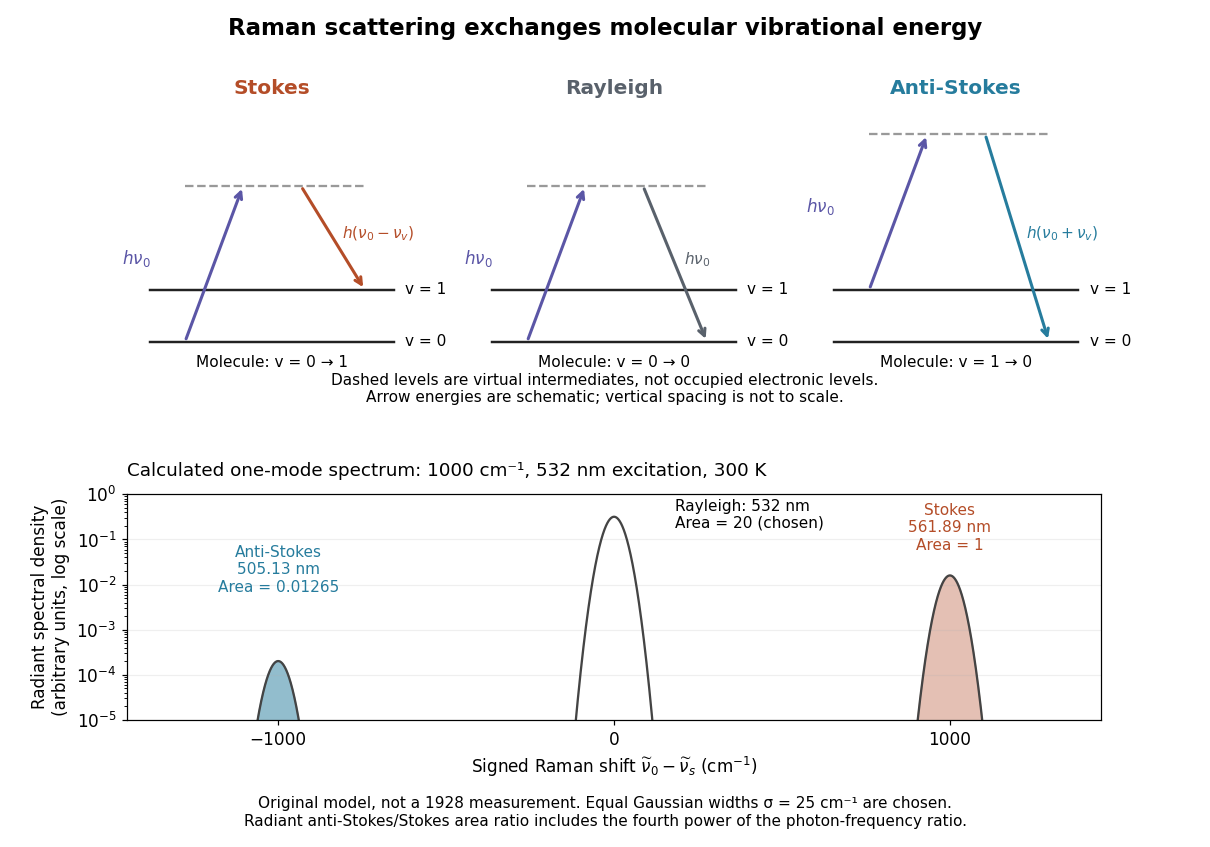
Figure 1.
Molecular energy transfer and an original one-mode Raman scattering line model
. Upper panels show initial and final vibrational levels with schematic virtual intermediates. Lower panel uses the stated , , example. Chosen equal Gaussian function linewidths have standard deviation ; the Rayleigh scattering line has an arbitrarily chosen integrated area of relative to a unit Stokes area. The anti-Stokes area follows the line-integrated radiant intensity formula. The vertical axis is logarithmic. No line shape, width, relative elastic strength or line position is a historical measurement. Source. Details.

Articles by others on the same topic (0)

There are currently no matching articles.