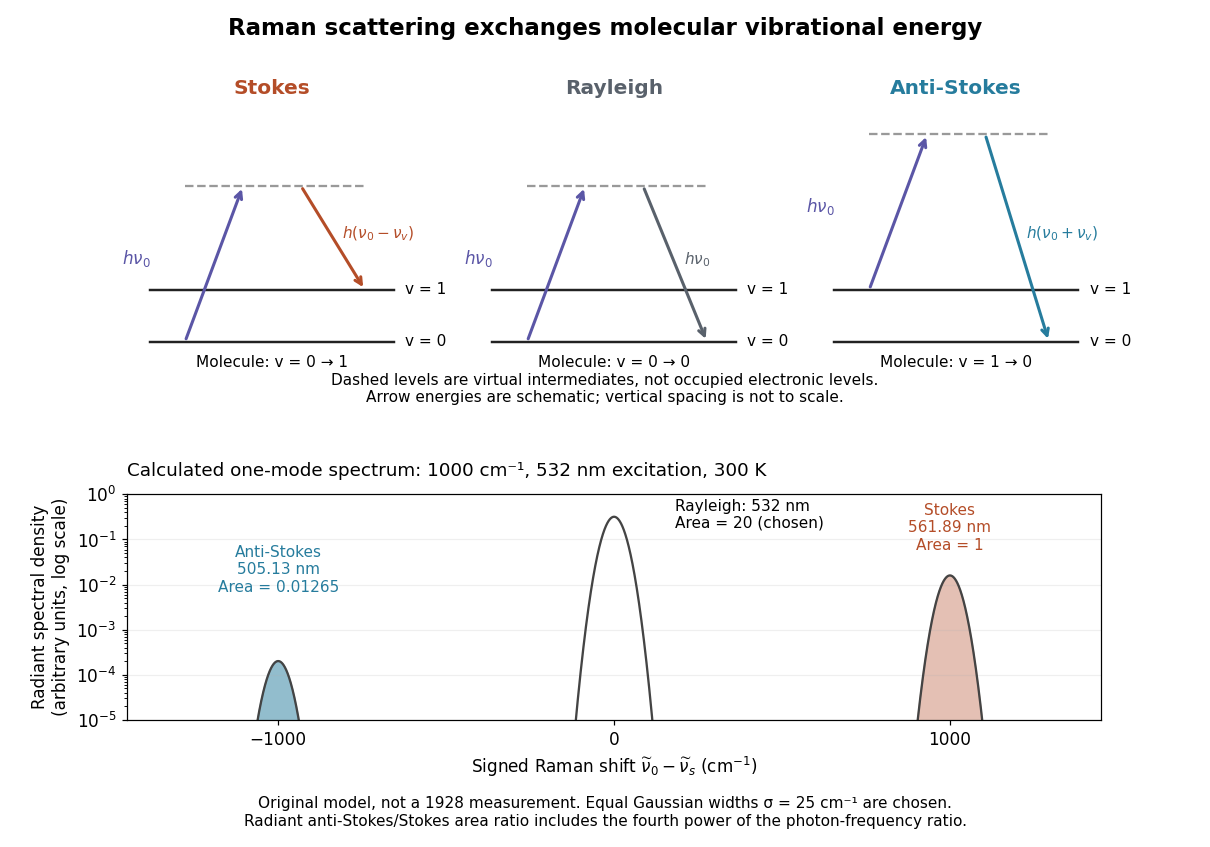
Assume one harmonic normal mode at thermal equilibrium, weak spontaneous excitation far from electronic resonances, the same collection solid angle and wave polarization, and matched response after instrumental correction. The Boltzmann distribution givesHere is the Boltzmann constant, is temperature, and is the probability of vibrational quantum number . Thus . Linear coupling to has squared oscillator matrix elements proportional to for Stokes Raman scattering and for Anti-Stokes Raman scattering. Summing over initial levels gives strengths proportional to and respectively; their ratio is , even when levels above are occupied.
Let and denote line-integrated radiant intensities, meaning power per collection solid angle. The off-resonant electric dipole radiation law adds the fourth power of emitted frequency:The photon rate divides each line's power by its own . Consequently, the ideal response-corrected anti-Stokes/Stokes count-rate ratio has the third power of the same frequency ratio. Peak heights alone do not give line-integrated radiant intensities if linewidths differ. Uncorrected detector counts can also include unequal detector response and unequal optical filter transmission. Resonant enhancement, overlapping spectral lines, nonthermal populations and local optical heating can invalidate a temperature inferred from this simple formula.
Choose a vibrational Raman shift magnitude , excitation vacuum wavelength and temperature . These are original illustrative inputs, not a measured 1928 optical spectrum or a claim about a particular liquid. They giveTake reciprocal lengths in consistent units before converting to nanometres. At , and . The predicted line-integrated radiant intensity ratio is , whereas the ideal photon count-rate ratio is . Thus the radiometric ratio is about percent, rather than the percent obtained by using the Boltzmann factor alone.

Articles by others on the same topic
There are currently no matching articles.