Orientability asks whether local choices of handedness can agree everywhere on a manifold. On a smooth manifold, an orientation of a smooth manifold chooses an orientation of a vector space for each tangent space, continuously with position. An ordered basis describes the same handedness as another one when the change-of-basis determinant is positive. An oriented atlas implements this condition through positive Jacobian determinants of the smooth transition maps.
A paper strip makes the obstruction visible. Join its short ends without twisting: the resulting untwisted band admits a consistent choice of unit normal. Add a half-turn before joining: on the Möbius band, following the core circle of a Möbius band reverses that choice when you first return to the same point. A local decision about handedness has encountered a global contradiction. The normal reversal around the Möbius core makes this precise for an explicit model.
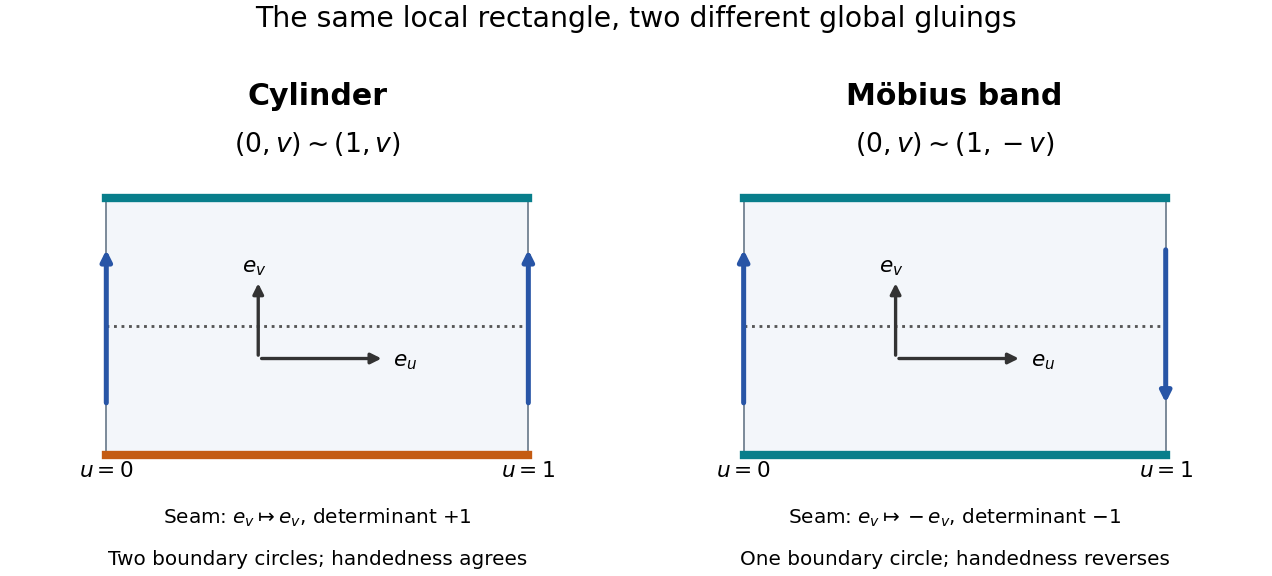
Both rectangles have coordinates . The untwisted band identifies with ; the Möbius band identifies with . Across a seam the corresponding local coordinate changes preserve or reverse , giving determinants and . This sign explains the handedness change; the drawing also tracks the two boundary circles of the untwisted band and the single boundary circle of the Möbius band.
For a smooth topological surface embedded in , choosing an orientation of a surface is equivalent to choosing a continuous unit normal. This picture is specific to surfaces in three-dimensional space: the general definition uses compatible local orientations, without requiring an embedding. Orientability is a topological invariant, so a homeomorphism cannot turn a Möbius band into a untwisted band. The sphere and torus are orientable surfaces; the Klein bottle is not. [ref]
The distinction matters when a sign has geometric meaning. A signed flux surface integral needs an orientation of a surface, and Stokes theorem relates that choice to the outward-normal-first boundary orientation. Ordinary unsigned surface area does not require orientability. Thus a Möbius band still has a perfectly meaningful area even though it has no continuous global unit normal.
A connected orientable manifold of positive dimension has two possible orientations: reversing every local choice gives the other one. If a manifold has several connected components, each component can be oriented independently when it is orientable. For topological surfaces, a useful obstruction criterion is the presence of a Möbius band: a surface is nonorientable exactly when it contains such a band. [ref]
https://pi.math.cornell.edu/~mec/Winter2009/Victor/part3.htm. Cornell Mathematical Explorers' Club, Orientable and Nonorientable Surfaces
Articles by others on the same topic


Orientability is a concept in topology and differential geometry that refers to the property of a manifold regarding the consistent choice of direction or "orientation" across its entirety. A manifold is said to be orientable if it is possible to assign a consistent choice of orientation to all its tangent spaces. To illustrate this, consider the following examples: 1. **Orientable Manifold**: The surface of a sphere is an example of an orientable manifold.