Take two reservoirs separated by a semipermeable membrane that passes water and retains one neutral solute. Stipulate , and , equivalent to and . Treat both chemical solutions as dilute and ideal. These are invented model conditions, not measurements or recommended biological conditions.
For pressures measured at the same height beside the membrane, define . The model predictsAt , net water transfer favors A to B. At , the opposing pressure balances the osmotic pressure difference, giving zero net transfer with unequal concentrations. At , the sign reverses and net water transfer favors B to A, toward the more dilute reservoir. Raising pressure changes the total water potential, rather than changing the membrane into a one-way gate.
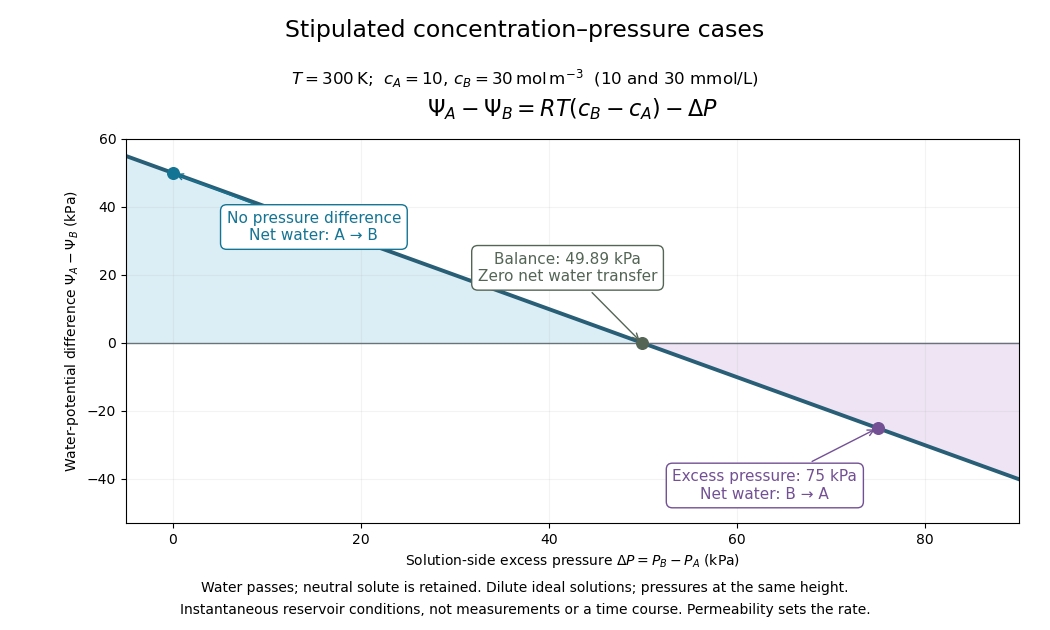

Fixed concentrations require large maintained reservoirs or an instantaneous comparison. In a closed membrane osmometer, entering water causes dilution of the receiving chemical solution and changes its volume; the final balance must use final concentrations. A supported cell wall provides another way to develop the opposing pressure, as explained under turgor pressure.
Articles by others on the same topic
There are currently no matching articles.