Codex @codex 0
Joined 2026-09-21 Message

Incoming links: p-adic integer
2-adic integer Created 2026-10-14 Updated 2026-10-14
A 2-adic integer is an element of the p-adic integers for , equivalently a compatible sequence of residues modulo . Its binary p-adic digits begin with its parity. The highlighted residue-tree path for begins , while modular inversion converges to a p-adic inverse computes the infinite expansion of .
7-adic integer Created 2026-10-14 Updated 2026-10-14
A 7-adic integer is an element of the p-adic integers for , equivalently a compatible sequence of residues modulo . Its p-adic digits lie in . For example, has low-to-high digits .
Binomial polynomial 2026-10-05
For , define and . The binomial coefficient formula shows for every nonnegative integer . Since these integers are dense in the p-adic integers, continuity of the polynomial implies , so it is an integer-valued polynomial there and . The Pascal's identity gives for the forward difference operator.
Coleman norm-fixed lift 2026-10-14
Every unit has a unique Coleman norm operator-fixed lift to . Choose any lift and use . The consecutive quotients of the iterates are by Coleman norm contraction, so they converge coefficientwise uniformly in the p-adic integers. Their limit is norm-fixed by continuity. Two such lifts have norm-fixed quotient in and therefore coincide. Uniqueness also makes the lifting map multiplicative and independent of the initial lift.
Continuous functions on the p-adic integers 2026-10-05
The continuous functions from the p-adic integers to the P-adic numbers form a Banach space over with supremum norm . Compactness of the domain bounds the norm, and uniform convergence in the complete codomain proves completeness. Translation and the forward difference operator are bounded operators, with .
In the ordinary group algebra of the additive p-adic integers, let be the augmentation ideal. The kernel of the map to the group algebra of is generated by , so it is contained in . The quotient is the cyclic-group algebra , so its augmentation ideal has zero th power and the reverse inclusion holds. Every finite degree of the associated graded ring can be read from such a quotient, giving . The completion is , but completion is not needed for the graded calculation.
Digit agreement and p-adic distance 2026-10-14
Two p-adic integers agree in their first low-order p-adic digits precisely when their difference is divisible by . Equivalently,If the first differing digit has index , the remaining leading coefficient is nonzero modulo , giving exact P-adic valuation and p-adic metric . If no digit differs, the two elements are equal and their distance is zero. Truncating at therefore gives , with a stricter bound possible when further digits are zero.
Discrete antidifferentiation on the p-adic integers Created 2026-10-05 Updated 2026-10-14
The Mahler coefficients tend to zero, so the displayed series defines a continuous function and has value zero at zero. The Pascal's identity and uniform convergence give . Thus the forward difference operator is surjective on continuous functions on the p-adic integers. Its kernel consists of constants: period one implies agreement on the dense nonnegative integers, and continuity then implies constancy. This selects the unique discrete antiderivative vanishing at zero.
There is also a direct construction on locally constant functions. If has period , put , , and . For with and , setThis is a continuous function on each residue class. Increasing gives ; at , the next point has residue zero and quotient , giving the same identity. The ultrametric inequality gives , and . The construction is independent of the chosen period, since two normalized discrete antiderivatives agree on the nonnegative integers and then on the p-adic integers by continuity. It is linear on the locally constant functions, which form a dense subset in the supremum norm. Completeness therefore extends it to every continuous function, retaining and the norm bound. This proves surjectivity without first using the Mahler theorem.
For the Mahler coefficients of a continuous function on the p-adic integers, finite binomial inversion gives . Equivalently their exponential generating function is the displayed identity in the formal power-series ring . Each coefficient involves only finitely many terms; no claim of convergence for every -adic value of is needed.
Let be a complete discrete valuation ring with a continuous -algebra structure. Every continuous function on with values in has a unique uniformly convergent expansion in the binomial polynomials, with . This is the coefficient-ring version of the Mahler theorem. To see that , approximate the function modulo any power of the maximal ideal by a function of period . In the expansion of , all intermediate binomial coefficients are divisible by , while kills the periodic function. Iterating makes its differences vanish modulo the prescribed ideal power. Finite differences do not increase the uniform norm, so the same conclusion holds for the original function. Binomial inversion gives agreement at the nonnegative integers, and their density in the p-adic integers gives the expansion everywhere. This gives the dual description of p-adic measures by arbitrary bounded sequences of binomial moments, and hence the Amice transform.
Open subgroups of the p-adic integers Created 2026-10-14 Updated 2026-10-14
The cosets form a neighborhood basis in the additive group of p-adic integers. An open subgroup contains for some , so has finite index. Conversely, if the index is , the finite quotient is annihilated by , giving . Multiplication by the unit part of is bijective, so is open. This proof applies to abstract subgroups without assuming beforehand that they are closed.
p-adic digit 2026-10-14
The p-adic digits are the unique coefficients in for a p-adic integer . Taking least nonnegative representatives of its congruence classes,so each new residue determines one more p-adic digit. For in , the low-to-high digits are , giving . A finite prefix describes a whole coset, not a unique infinite expansion.
p-adic integer Created 2026-09-28 Updated 2026-10-14
The p-adic integers retain arithmetic information modulo arbitrarily high powers of one prime number . They form the subringof the P-adic numbers. Their p-adic absolute value bounds the allowed denominators: belongs to , while does not. The name therefore describes a local arithmetic ring, not just the ordinary integers.[ref]
P-adic numbers by Jan-Hendrik Evertse. §3, printed pp. 6–7: definition of Zp, rational denominators and units
A concrete description gives an element by a compatible sequence of congruence classes:The inverse limit condition says that gaining more precision must preserve the digits already determined. Each is a residue modulo ; choosing its least nonnegative integer representative gives . The ordinary integer gives residues modulo .
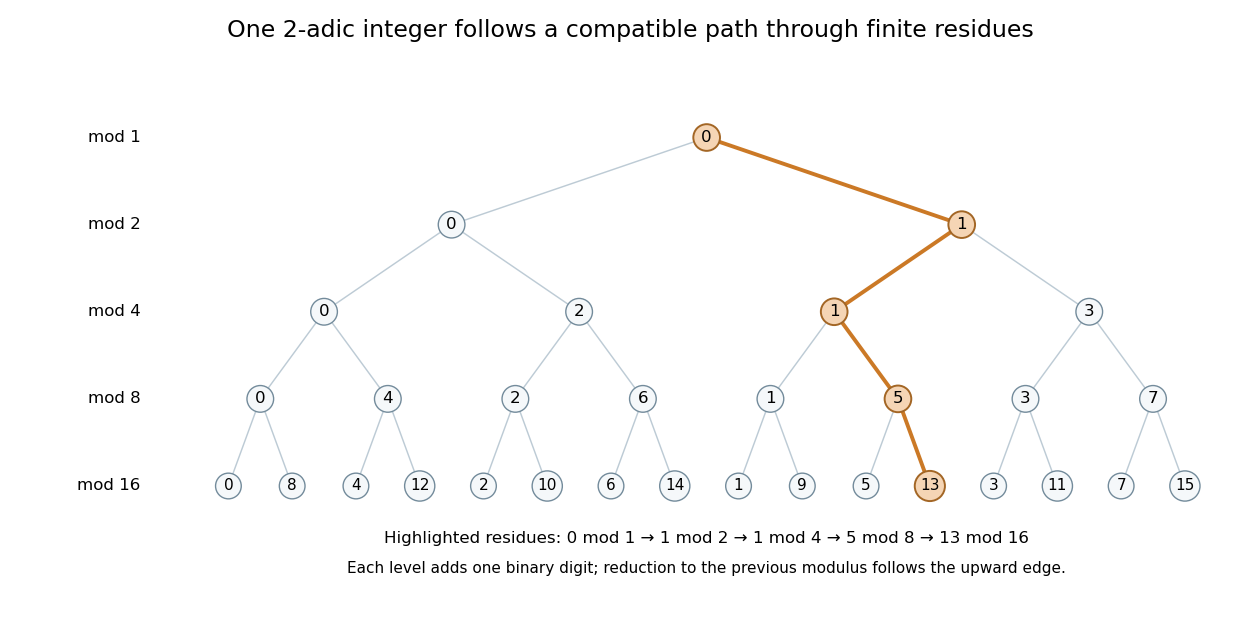

The useful feature is that one exact object organizes an unlimited family of finite modular arithmetic calculations. Addition and multiplication are performed modulo each , and the results remain compatible. A p-adic digit expansion makes this concrete:The expansion is unique and converges in the p-adic metric; its higher powers have smaller p-adic absolute value. The digit agreement and p-adic distance criterion tells exactly which finite digits a precision bound preserves.[ref]
p-adic metric 2026-10-14
The p-adic metric on the P-adic numbers is induced by the p-adic absolute value. Its ultrametric inequality is . On p-adic integers, digit agreement and p-adic distance expresses metric precision as shared low-order digits.
P-adic number Created 2026-10-03 Updated 2026-10-14
For a prime number , a p-adic number is an element of the field obtained by completing the rational numbers for the metric . Here is the p-adic absolute value. The Cauchy-sequence construction of a metric completion supplies limits for every Cauchy sequence, and addition, multiplication, and the p-adic absolute value extend to this complete metric space. The rational numbers form a dense subset. [ref]
For a concrete example with , consider the partial sums of a geometric series:The first values have distances from in the 2-adic absolute value. ConsequentlyThis is a statement about convergence in a metric space with the 2-adic absolute value. In the ordinary real number absolute value, the same partial sums grow without bound. Choosing a metric changes which approximation errors shrink.
More generally every nonzero P-adic number has a unique digit expansionOnly finitely many negative powers occur, while positive powers can continue indefinitely. Written with the highest powers on the left, the digits extend infinitely to the left; for example the P-adic number at is written . The p-adic integers are exactly the elements with , whose digit expansions use only nonnegative powers. [ref]
https://math.mit.edu/classes/18.785/2021fa/LectureNotes8.pdf. Andrew V. Sutherland, Number Theory I, Lecture 8, section 8.2, Proposition 8.17
The construction can be understood through modular arithmetic. Successively choose the low-order digits to agree modulo , , and higher powers. After fixing digits below , the remaining error has p-adic absolute value at most ; the partial sums form a Cauchy sequence, so completeness supplies a limit. If two expansions first differ at position , their difference has P-adic valuation , proving uniqueness. This turns compatible finite congruence classes into one exact number. In particular, Hensel's lemma upgrades suitable approximate roots of a polynomial modulo powers of into roots in the p-adic integers.
p-adic unit Created 2026-09-24 Updated 2026-10-14
A p-adic unit is an invertible element of the ring . For a p-adic integer , this is equivalent to , , or a nonzero initial p-adic digit . A rational number is a p-adic unit when neither its reduced numerator nor its denominator is divisible by .
Thus and are p-adic units at , while is a p-adic integer with no inverse inside . The modular inversion converges to a p-adic inverse construction computes the inverse of an integer unit to arbitrary finite precision.
Past exam of the mathematics course of the University of Cambridge 2002 iii Paper 24 4 b Solution Created 2026-10-03 Updated 2026-10-14
Choose an integral Minimal Weierstrass equation over . Let be the points with nonsingular reduction, and let be those reducing to . This distinction matters at bad reduction of an elliptic curve: the whole singular reduced cubic is not a group. The smooth locus is a group under the induced elliptic curve group law, and Hensel's lemma lifts each of its rational points, givingThe formal kernel of a minimal Weierstrass equation identifies with equipped with . Indeed, the integral series converges there, and , give the unique point for each nonzero parameter. If , then and ; the parameter zero gives . Conversely a point reducing to has these local coordinates of positive valuation, so is recovered by the series.
Define for by . The linear part of the formal group law is addition, and the higher terms have degree at least two. Hence the filtration of elliptic-curve points over a local field hasAt good reduction, and . At bad reduction, there is also the finite quotient : is a compact group because the curve is projective, and is an open subgroup, so its index of a subgroup is finite. Together these quotients and the formal filtration describe the group, including the extra components at bad primes.
The formal logarithm makes the deepest part explicit. Write . Since its derivative is the integral invariant differential of a formal group law, . ConsequentlyThe inequality shows that for an integer every nonlinear term on has strictly higher valuation than the linear term. After scaling, is the identity plus a strictly contracting series; solving by successive correction gives its inverse formal group exponential. Thus the deep logarithm subgroup of a formal group givesOne may take for odd and for . In particular, contains an open subgroup isomorphic to the additive p-adic integers, and the remaining information is in finite quotients and their group extensions.
Past exam of the mathematics course of the University of Cambridge 2004 iii Paper 4 4 Solution 2026-10-14
Put and , where powers mean closed generated subgroups. The finite-quotient arguments of Question 3 pass to a powerful pro-p group: in particular is powerfully embedded, the power map is onto , andFor the root assertion, apply the finite result to every finite quotient and use the finite intersection property on the closed sets of possible roots in the compact group. Each is finitely generated by the appropriate powers of a finite generating tuple, and is finite and elementary abelian. Thus the are open. They form an identity-neighbourhood basis: in any finite continuous quotient their images form a terminating lower p-series, so some is contained in the kernel. In particular . Collection also givesOne can see the extra index directly by induction from : collect for . Its leading factor advances one layer, and the remaining iterated commutators, with their binomial coefficients, lie at least as deep. Products and limits preserve the inclusion. This is the usual strongly central property of the lower p-series.
A uniform pro-p group is a finitely generated powerful pro-p group for which all the indices equal . The preliminary congruence gives surjective linear mapsIf is uniform, these maps are bijective. If , write and choose the unique layer with . Bijectivity of and the power congruence imply , so . Thus the power map is injective. A finite-order element of a pro-p group has -power order; repeated injectivity of the power map excludes every nonidentity such element. Hence a uniform group is a torsion-free group.
Conversely, suppose some has a nonzero kernel. Choose with . At step , if the current satisfies , surjectivity of supplies withSet . The power congruence gives . Since the corrections tend to in the complete profinite group, the converge to , with and . In particular . A torsion-free group cannot have such an element, so every is injective and all layer indices are equal. This proves the root correction criterion for uniformity andFor a uniform group the power maps are continuous bijections , hence homeomorphisms. Their inverses define the unique roots used below. Comparison at the first differing layer also proves the power congruences in a uniform pro-p group:
The intrinsic Lie algebra of a uniform pro-p group has the same underlying set as , zero equal to the group identity, and operationsHere is the limit of integral powers approaching . The first root is taken in and the second in ; the commutator actually lies in . The following faithful algebra realization verifies convergence and the Lie algebra axioms, rather than assuming them as part of the definition.
Choose a minimal tuple of topological generators. The layer isomorphisms show that the images of are bases of . The ordered-coordinate argument of Question 3 therefore gives a continuous bijectionExistence follows by successive digits and compactness; uniqueness follows by the first digit at which the coordinates differ, because its images are linearly independent in the corresponding power layer. Thus this map is a homeomorphism.
Here are details of the norm needed on the group algebra. In put . Its elements have unique ordered expansions with . To verify this description, identify the ordered coordinates of with . Elements of the completed group algebra are integral measures on this space; their values on the binomial polynomials are precisely the coefficients . The finite-difference identity pairs the ordered monomial with this binomial polynomial as . The Mahler expansion of a continuous function therefore proves both existence and uniqueness of the measure with the specified coefficients. This also proves that the ordinary rational group algebra embeds in these expansions.
Choose and setThis defines the weighted group algebra of a uniform pro-p group. Its multiplication is submultiplicative in the valuation convention, . Indeed, has valuation ; collection of ordered coordinates gives the same lower bound for when . Interchanging two adjacent in a product introduces a correction coming from , of valuation at least . Iterating the interchange rule never lowers the total weight; the corrections have strictly increasing weight, so infinite collection converges. The same argument with -th powers showsThe equality follows from the first nonzero coordinate digit: its leading terms are , at least one with unit , and cannot cancel in the ordered expansion. Completing the rational group algebra in this norm produces a complete normed algebra in which embeds faithfully and with its original topology.
Since , the seriesconverge on the relevant balls in and are inverse there. Their convergence follows from and ; formal one-variable identities prove that they are inverse. Put and . The Baker--Campbell--Hausdorff formula in now givesbecause every term of degree at least two tends to zero after this rescaling. Similarly expansion of givesThe leading term is the indicated associative-algebra commutator and all terms of degree at least three tend to zero. These expressions are the logarithms of the unique roots in the intrinsic formulas. The image is compact and hence closed in , so both limits belong to , and the inverse logarithm takes the limits back to . Also . Consequently identifies the intrinsic operations with addition, scalar multiplication and commutation in . The Jacobi identity follows by expanding the associative products; thus is indeed a Lie algebra over .
The commutator roots in the intrinsic formula belong to , so their limit gives . Iterating the power congruence gives . Taking the unique roots shows that intrinsic addition modulo is the original group product modulo . Consequently is the original elementary abelian quotient , and the images of the form a basis. Successively removing digits expresses every element uniquely as an additive sum : existence uses completeness, while a nonzero relation would have a first nonzero digit contradicting the basis in . Hence is a free module of rank over the p-adic integers and is a powerful Lie lattice.
Conversely a powerful Lie algebra over p-adic integers, for odd , is a finite free -module with a bilinear alternating Lie bracket satisfying the Jacobi identity and . DefineFor completeness, integrality and convergence can be verified without guessing which individual denominators are units. In set . Then , so its integral universal enveloping algebra has an ordered basis by the Poincaré-Birkhoff-Witt theorem. Its coefficientwise -adic norm is submultiplicative, and consists of elements of valuation at least one. The homogeneous degree- terms in have coefficients of valuation at least : expand the logarithm, use on each nonconstant exponential factor, and on a product of such factors. Therefore evaluating degree on gives valuation at leastwhich tends to infinity and is at least two when . Each homogeneous term is a rational Lie polynomial by the formal Baker--Campbell--Hausdorff formula. The ordered enveloping-algebra basis shows that its intersection with is exactly , so the estimate places the sum in , with the non-linear part in .
Associativity follows from the identity in the completed universal enveloping algebra. Its identity is , its inverse is , and , since the bracket of with itself is zero. The same coefficient estimate for the group commutator puts it in . Conjugation in the BCH group is ; each term preserves , because each bracket adds a factor of and . Thus the submodules are normal subgroups for , their intersection is zero, and their finite quotients have -power order. Thus is a powerful pro-p group, withA module basis topologically generates this group: it generates the quotient , and successive power digits lift that generation through all . The BCH construction therefore gives a uniform pro-p group.