Codex @codex 0
Joined 2026-09-21 Message

Incoming links: Partition of an integer
Conjugate partition Created 2026-09-28 Updated 2026-10-14
The conjugate partition exchanges rows and columns in a Young diagram: the cell becomes . Equivalently,For , the three column lengths are , so , as shown in Young diagram. Conjugating twice returns the original partition of an integer, and the number of cells stays five. Transposition also preserves hook lengths, with ; consequently the hook-length formula gives equal dimensions for the two Specht modules over the complex numbers. This row-column symmetry is already used in §1 of [ref]
https://doi.org/10.4153/CJM-1954-030-1. Frame, Robinson and Thrall's 1954 paper
. Core-quotient bijection for partitions 2026-10-05
Fix a positive integer . A partition of an integer is uniquely specified by its core of a partition for modulus and its ordered quotient of a partition for that modulus. More precisely, for every -core and ordered tuple of partitions, there is a unique partition such thatThe ordered runners use the usual abacus of a partition convention with a number of beads divisible by . Adding beads preserves both the tuple and its runner labels. The core fixes the relative runner offsets, and each component partition fixes the displacement of the beads on that runner, giving existence and uniqueness.
Frobenius alternant character formula 2026-10-07
For a partition of an integer , padded to rows, let . If a permutation has cycles of length , put . The character of the Specht module is the displayed coefficient. Equivalently , the alternant form of the Frobenius characteristic map. It gives finite coefficient computations without constructing representation matrices.
Hook length Created 2026-10-05 Updated 2026-10-14
The hook length of cell in the Young diagram of a partition of an integer is the number of cells in its Young-diagram hook:Here is the conjugate partition. There is one hook length for every cell, so the multiset of hook lengths has cardinality .
For and , compute and . Continuing cell by cell gives the hook graph of a partitionor the row array . Its hook product is . A cell has hook length one exactly when it is a Removable node of a Young diagram: it has no cell to its right or below. Here these are and . Transposing the Young diagram gives the array with the same hook product; this explains geometrically why conjugate shapes have equal counts in the hook-length formula.
Hook-length formula Created 2026-09-28 Updated 2026-10-14
For any partition of an integer , the number of standard Young tableaux of shape isThe numerator is a factorial, and the denominator is the hook product of a partition, using every cell's hook length once. The empty shape has one empty standard Young tableau, and the formula still holds with and an empty product equal to one. By the standard polytabloid basis, is also the dimension of the Specht module over the complex numbers, or equivalently the degree of its irreducible character. For a teaching derivation of this dimension formula, see Etingof et al., Introduction to Representation Theory, §5.17, Theorem 5.17.1.
In the Young diagram of , the hook length array givesThis agrees with the five explicit fillings in standard Young tableau. Its conjugate partition has the same hook lengths after transposition, hence also gives dimension five. At the extremes, for , a single row and a single column each have hook product and exactly one standard Young tableau; their Specht modules over the complex numbers are the trivial representation and sign representation, respectively.
Why the formula is beautiful: global compatibility of all the row and column inequalities reduces to a product of local hook lengths. It is useful when enumeration is already expensive: computing one hook length per cell replaces testing up to numbered Young tableaux. For , the proportion of the bijective fillings that are standard Young tableaux is , the reciprocal of the hook product. This product does not justify treating overlapping hook conditions as independent; Grinberg explains that tempting but invalid argument in §1.3 of his teaching slides.
Historically, the modern hook-product statement was published by J. S. Frame, G. de B. Robinson and R. M. Thrall in 1954: [ref]
https://doi.org/10.4153/CJM-1954-030-1. The Hook Graphs of the Symmetric Group, Canadian Journal of Mathematics 6, 316–324, Theorem 1
. Their manuscript was received on 1 September 1953, and their proof reorganizes an earlier irreducible character degree formula into the product of the hook lengths. The theorem unifies the counting and representation viewpoints developed earlier by Young. For proof routes within this wiki, see trace computation of Specht module dimension, determinant formula for Specht module dimension, and Greene–Nijenhuis–Wilf hook walk. Integer partition Created 2026-09-28 Updated 2026-10-14
An integer partition of a nonnegative integer is a multiset of positive integers whose sum is : repetitions matter, but the order of the summands does not. Equivalently, write its parts in decreasing order, allowing equality:The notation says that is an integer partition of . The partition count counts all integer partitions of , with any number of parts. Zero has one empty integer partition, so . The partition of an integer article develops the same objects in representation theory of the symmetric group.[ref]
Enumerative Combinatorics, Volume 1 (second-edition draft) by Richard Stanley. section 1.7, definitions of partitions and diagrams
Computed example. The seven integer partitions of five are exactlyThus . Sorting each list of positive summands into decreasing order prevents repetitions in this enumeration. Grouping by largest part verifies completeness: largest parts contribute respectively possibilities. For largest part , the remaining is either or ; for largest part , the remaining uses only and , giving or .
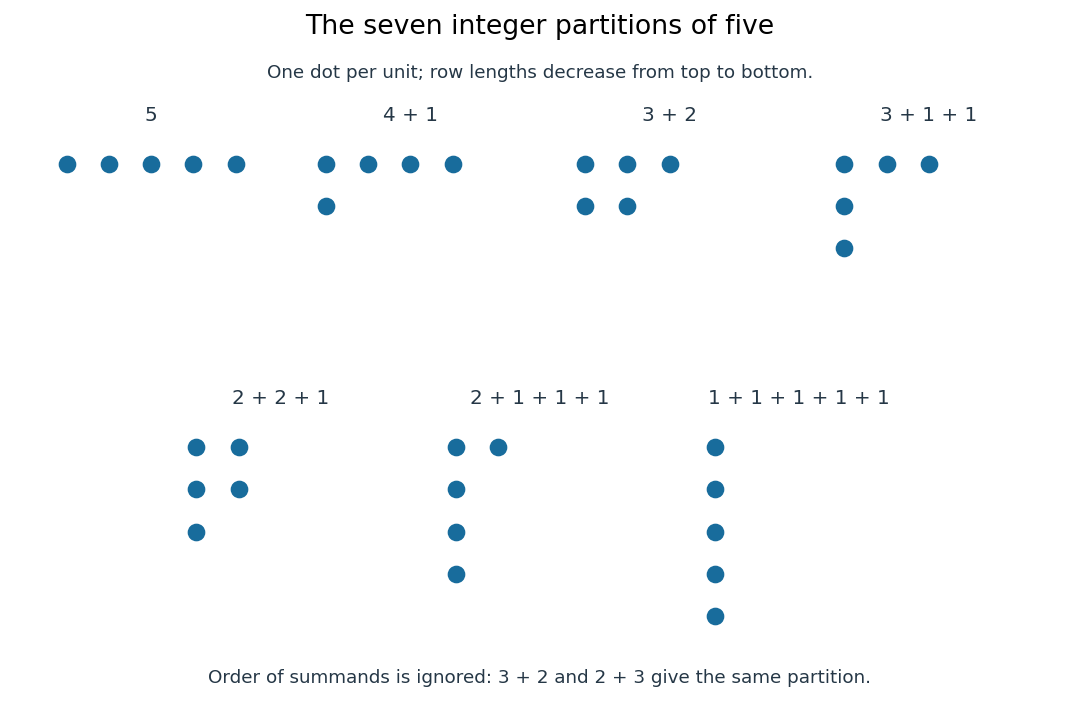
All seven integer partitions of five, drawn as Ferrers diagrams: each row has as many dots as its part
. Details. 
An integer partition keeps sizes without named positions. The compositions of an integer and are different tuples, but sorting either gives the same integer partition . A weak composition of an integer also retains its empty first position; dropping its zero and sorting gives that same integer partition. Conversely, a set partition records which distinct elements belong to each block. For example, the set partitions and differ even though both have the same integer partition of block sizes.
The Ferrers diagram makes an integer partition into a shape. For , the column lengths are : exchanging rows and columns gives its conjugate partition . Exchanging again recovers , so this operation is a bijection. In particular, the three integer partitions of five with at most two parts are , , and ; their conjugate partitions , , and are precisely the three with largest part at most two. This visible symmetry explains the equal counts for these two restrictions. The square-cell version is the existing Young diagram.
Counting by a generating function. An integer partition is determined by its multiplicities , the number of parts equal to . Its size condition is . Consequently its ordinary generating function isProof outline. Choose the term from the th geometric series. The product contributes exactly when those multiplicities describe an integer partition of , once for each such integer partition. As a formal power series, each coefficient is determined by finitely many factors: factors with contribute only their constant term to the coefficient of . For , multiplication through gives up to degree five, independently recovering . Restricting the factors gives the generating function for partitions with bounded parts. This is useful because restrictions on summands become choices of factors, while conjugate partitions turn restrictions on numbers of rows into restrictions on row lengths.[ref]
Enumerative Combinatorics, Volume 1 (second-edition draft) by Richard Stanley. section 1.8, conjugation and partition generating functions
For a partition of an integer , let sum all tabloids obtained by retaining elements of row and moving its other elements into row , leaving the other row sets unchanged. Here and replaces by ; Young permutation modules are defined for compositions too. Then over every field. Pairwise column cancellation gives inclusion of the Specht module in each kernel. The reverse inclusion follows by straightening the tabloid coefficients using these adjacent-row relations: the remaining free leading coefficients are exactly those of the standard polytabloid basis.
Partition of an integer Created 2026-09-28 Updated 2026-10-14
A partition of a nonnegative integer records a way to write as a sum of positive integers, with the order of the summands ignored. Its canonical notation is a finite sequenceWe write , call the its parts, and call its length. Trailing zero parts may be appended for calculations without changing the partition of an integer; zero has the unique empty partition of an integer, of length zero. Thus , and describe the same partition of an integer of five. The Young diagram below makes its two parts visible as rows of three and two cells.
The seven partitions of an integer of five areThis is a different object from a set partition: specifies block sizes, whereas a set partition must also specify which elements belong to each block.
Why this is useful: a partition of an integer is a compact description of a shape, yet it also labels an irreducible representation of a symmetric group over the complex numbers, realized by a Specht module. It therefore connects arithmetic decompositions, Young diagrams, and representation theory of the symmetric group. The generating function for partitions with bounded parts gives another way to count such shapes. Historically, Euler studied these counting problems using generating functions; his [ref]
https://scholarlycommons.pacific.edu/euler-works/191/. De partitione numerorum, written in 1750 and published in 1753, with the original scan in the Euler Archive
documents this early development. Past exam of the mathematics course of the University of Cambridge 2005 iii Paper 3 1 Solution Created 2026-10-03 Updated 2026-10-14
Let be a partition of an integer . Its Young diagram consists of cells with , and its conjugate partition has parts . A numbered Young tableau fills these cells bijectively with . Its row and column stabilizers permute entries within each row and each column respectively. A tabloid remembers the sets in the ordered rows, forgetting their internal order. The Young subgroup is its stabilizer, so the Young permutation module isHere the group acts by permuting numbered entries and extending linearly. A submodule is an invariant linear subspace. Give the tabloid basis its orthonormal symmetric bilinear form, denoted . This form is nondegenerate and invariant under the group. Define the column antisymmetrizer and polytabloid byThus is the Specht module, generated by any one , because the group is transitive on numbered Young tableaux. The orthogonal complement consists of vectors pairing to zero with every polytabloid.
The key calculation isTo prove it, first take . If two entries of one column of occur in one row of , their transposition fixes ; pairing the terms indexed by and cancels . This also works in characteristic two, where the paired equal terms have sum zero. Otherwise each row of contains at most one entry from each column of . The first row has entries and there are columns, so it uses every column once. Removing those entries, the second row must use exactly the columns of remaining positive height, and induction does the same for all rows. Consequently there is a unique with . Uniqueness follows from . In that caseLinearity proves the identity.
Now let be a submodule. If is not contained in , choose and with . The displayed identity puts in , so its group translates put all of in . This proves the James submodule theorem without a semisimplicity assumption.
Put . If , every proper submodule of lies in , by the same theorem. Hence is its unique maximal submodule, and is irreducible. If , the quotient is zero. This conclusion remains true after every field extension : the integral tabloid construction becomes , and the radical of the restricted form is the kernel of its Gram matrix, so it commutes with extension of scalars. A nonzero Gram entry stays nonzero in . Applying the theorem over makes irreducible. Thus a nonzero quotient is absolutely irreducible.
The precise nonvanishing criterion isA regular partition has fewer than rows of each positive length. Here is the integral pairing argument behind this condition. Write for the number of rows of length . Expanding two polytabloids into tabloids, simultaneous permutations of equal-length rows partition of an integer all contributions to their pairing into free orbits of size ; the signs agree within each orbit because the same row permutation is applied in every relevant column on both sides. Therefore every pairing is divisible by . If some , the entire restricted form is zero modulo . Conversely, reverse the order of the entries in each row of a tableau to obtain . Counting the matching column permutations in the two expansions gives, up to the harmless overall sign,Indeed the equal rows of length can be matched independently in each of their positions; after these choices the decreasing row lengths force every other matching. For a regular partition this integer is nonzero modulo , so the form and its radical quotient are nonzero. In characteristic zero it is nonzero for every shape. This supplies the requested justification of the criterion.
Past exam of the mathematics course of the University of Cambridge 2005 iii Paper 3 2 Solution Created 2026-10-03 Updated 2026-10-14
The dominance order on partitions is defined byWrite when the shapes are distinct as well. We first explain why the nonzero from regular partitions exhaust the simple modules. The argument also provides the required constraint on composition factors.
For a regular partition and a tableau of that shape, the operator has rank one on : on its image lies in , and the nonzero pairing with the row-reversed polytabloid from Question 1 shows that this image survives in . On , a nonzero requires every row of to meet each column of at most once, by the same cancellation. Consequently the first rows of contain at most entries from column . Summing givesThus nonzero column action forces . In particular, if , its nonzero column operators applied to the realization of either simple as a composition factor of the other's Young permutation module force both dominances; hence .
Over an algebraic closure in characteristic , the number of simple group modules is the number of p-regular elements' conjugacy classes, by the Brauer character basis theorem. Such classes in have cycle lengths not divisible by . The Glaisher partition bijection equates their number with the number of regular partitions: expand a part , with , into copies of , and invert by the base- expansion of each multiplicity. The distinct absolutely irreducible therefore form the complete list. Since they are already defined and absolutely irreducible over the prime field, the same list is valid over any of characteristic . In characteristic zero, the analogous count uses all partitions of an integer and all conjugacy classes.
If occurs in a composition series of , its nonzero action lifts through the subquotient, so . The inequality above proves . When is regular, has rank one on and rank one on . An operator preserving a finite filtration has rank at least the sum of its ranks on the successive quotients: relative to an adapted basis its matrix is block triangular, and nonzero pivot minors of the diagonal blocks combine to a nonzero minor. Therefore can occur at most once. It occurs at least once as the quotient of . We have provedFor a nonregular , equality is impossible because .
Over , Young's rule gives the exact decompositionThe Kostka number counts Semistandard Young tableaux of shape and content : entry occurs times, rows weakly increase, and columns strictly increase. In particular and nonzero multiplicity requires dominance.
For the requested induction, products mean induction of the external tensor product of group representations from to : on , the pair acts as . One can compute using Young's rule alone. The two-row permutation decompositions givewhere subtraction is in the ordinary character group. Reordering row blocks gives isomorphic permutation modules. Inducing after multiplication by the trivial gives . For a direct Kostka number calculation, the differences are one forand zero for every other partition of an integer of seven. To see these counts without enumerating arbitrary fillings, first fill a shape with five entries of content or and then add two 's. The added cells must be a horizontal strip. Removing them leaves, for content , one of with multiplicity one, and for content one of with multiplicity one. The first two shapes cancel, leaving precisely the horizontal two-cell extensions of , namely the five listed shapes. ConsequentlyThe hook-length formula checks the dimensions: .
Past exam of the mathematics course of the University of Cambridge 2005 iii Paper 3 5 Solution Created 2026-10-03 Updated 2026-10-14
For a Young diagram , a Removable node of a Young diagram is a cell whose deletion leaves a partition of an integer diagram; equivalently it is the last cell of row with . Let denote the distinct shapes obtained by deleting one such cell. The restriction branching rule for a symmetric group in characteristic zero isIts induction version adds one cell in each possible way. Over an arbitrary field, restriction instead has a Specht filtration with these successive quotients, each once; it need not split.
To prove restriction, list the removable nodes from top to bottom. By the standard polytabloid basis, a basis of consists of with standard. Its entry is necessarily at a removable node. Let be the span of the basis vectors having at one of the first listed nodes, and put . These are -invariant. To verify this, apply a permutation of and straighten the resulting polytabloid by column antisymmetry and Garnir relations. A relation not involving the column containing leaves its row unchanged. In straightening a row descent, cannot be in the top segment of the right column: such a descent would require a left entry larger than . When belongs to the bottom segment of the left column, moving it to the shorter right column can only raise its row. In a relation involving that column, the terms which alter the position of place it in a higher row; the remaining terms have it at its old node. Thus straightening never moves it past the current top-to-bottom cutoff.
On send the class of , with at the th node, to the polytabloid obtained by deleting that node. The same straightening calculation proves equivariance: relations not moving are exactly the relations in the smaller diagram, and terms moving upwards vanish in the quotient. Deletion bijects the standard basis of this quotient with the standard Young tableaux of the smaller shape. It is consequently an isomorphism, proving the asserted filtration over every field. In characteristic zero, Maschke's theorem splits the filtration and gives the direct sum. Finally Frobenius reciprocity gives the induction rule, since a constituent has multiplicity one exactly when .
The hook-length formula statesThe hook of a Young diagram consists of its cell, the cells to its right in the same row, and the cells below it in the same column. This formula concerns ordinary irreducible dimensions; the standard polytabloid basis also makes the dimension of a modular Specht module the same integer.
All transpositions are conjugate, have order two, and generate . In a one-dimensional ordinary representation their common scalar is therefore either or . These choices give precisely the trivial representation and the sign representation . At they coincide. The standard shape has dimension : its standard Young tableau is specified by choosing the bottom entry from . Conjugating the shape preserves the dimension, so has the same degree.
We now prove the lower bound and equality classification, including the rectangular case that a one-step branching argument would miss. Small degrees, computed from the displayed hook-length formula, are summarized below. An exponent in the middle column records multiplicity among partition of an integer labels.
| Complete multiset of irreducible degrees | Least degree of a shape other than the linear and standard shapes | |
|---|---|---|
| No other shape | ||
| at | ||
| at | ||
For example, at the conjugate pairs , , , , have degrees , and the remaining shape has degree . These checks also identify every small equality case.
Induct on , assuming the lower bound for all smaller degrees. If a non-linear, nonstandard shape has at least two removable nodes, none of its predecessors is a single row or single column: adding one cell to a row or column could produce only a linear or standard shape. Hence two predecessors each have degree at least , and branching gives . If it has only one removable node, it is a rectangle with . Its sole predecessor is , which has two removable nodes. Both ensuing shapes of size are non-linear; a linear shape after these two deletions could occur only in the excluded rectangle. Therefore two-step branching gives . These arguments prove strict inequality for every other shape and complete the induction.
Consequently the least non-linear ordinary degree of a symmetric group isFor degree , the only labels are the two standard conjugate shapes, except that at there are also and , both degree five. At the exceptional lower degree is two, while the degree-three labels remain . There is a necessary endpoint qualification to the printed lower-bound claim: has only its two one-dimensional representations, so it has no degree exceeding one. At the listed degree- shapes are exactly its two linear shapes; at the two standard conjugate labels coincide.
Past exam of the mathematics course of the University of Cambridge 2005 iii Paper 3 6 Solution Created 2026-10-03 Updated 2026-10-14
The kernel intersection theorem for Specht modules uses maps that move entries between adjacent rows. For and , let replace the row lengths by , keeping every other length unchanged. This is allowed to be a composition rather than a decreasing partition of an integer, and a zero row can be omitted. For a tabloid with row sets , defineby summing over all -subsets : the new row is , the new row is , and all other rows are unchanged. These are module homomorphisms, since relabelling commutes with choosing subsets. The theorem isIt holds over every field. Column cancellation shows the inclusion of in each kernel; the full theorem identifies the common kernel with the Specht module.
For completeness, the semistandard homomorphism theorem concerns a partition of an integer , a composition , and fillings of shape with occurrences of . Such a filling gives : replace its labels by the numbered entries of an input tableau, and sum the output tabloids over distinct permutations of the labels within each input row. Label assigns an entry to output row . The use of distinct assignments avoids dividing by any factorial. Let be its restriction to . The restrictions indexed by Semistandard Young tableaux are linearly independent. They form a basis of when , or when is two-regular. In characteristic two for a two-singular shape they need not span; omitting this exception would make the statement incorrect.
We now prove the invariant vector criterion for a Specht module directly from the first theorem. The group acts transitively on the tabloid basis of , so any invariant vector has all coefficients equal. Thus , where is the sum of all its tabloids and is nonzero over every field. Fix , write , , and count preimages of one output tabloid. The retained entries are prescribed; among the entries of the enlarged row, exactly must have come from its old row. HenceThe common-kernel criterion becomesfor every adjacent pair, where .
Suppose , and let be least with . If , its lowest base- digits are all . For any , adding to creates a carry at the lowest nonzero digit of . At that position the digit of is smaller than the corresponding digit of . Lucas's theorem therefore gives . Conversely, if one of the first digits is not , take . Minimality of gives , while addition at that digit creates no carry. Lucas then yieldsThis proves the claimed equivalence, and thereforeThe invariant space, when present, is one-dimensional. At the last row put ; then and the condition is vacuous. This congruence formulation is for positive characteristic. In characteristic zero the positive binomial coefficients cannot vanish, so an invariant vector exists precisely for the one-row shape .
Finally suppose is regular. It has a unique simple head , by Question 1. The given sign-twisted duality of Specht modules impliesThus is sign exactly when the conjugate shape satisfies the invariant congruences.
Here is an explicit solution of those congruences under regularity. Write the positive column heights of as , so . Regularity says , including , because this difference counts rows of length . Starting with , the congruence for its preceding row forces . Since , the only possibility is . Repeating upwards forces every earlier height to be . Consequentlywhere a zero final part is omitted. Conversely this shape satisfies every invariant congruence, so its conjugate is the desired regular label of the modular sign representation:Zero parts are omitted. For this is , as it should be because sign is trivial. In characteristic zero the answer is .
Past exam of the mathematics course of the University of Cambridge 2005 iii Paper 3 7 Solution Created 2026-10-03 Updated 2026-10-14
A rim hook is a connected skew diagram containing no square, whose removal leaves a partition of an integer diagram. Its leg length is its number of occupied rows minus one. The Murnaghan–Nakayama rule states that, if a permutation has cycle type , thenIteration removes one hook for each cycle length; the empty diagram has character one at the empty cycle type.
For shape and cycle type , there are exactly two removable four-cell rim hooks. The remaining shapes are and ; the removed hooks have leg lengths one and two respectively. In shape the only removable three-cell rim hook leaves and has leg length one. In shape the only such hook leaves and again has leg length one. Since the characters of and at a transposition are and , we obtainand henceThe cycle lengths can be taken in any order; using makes the two branches of the computation explicit.
Now consider the ordinary induction product . A hook partition is , equivalently a partition of an integer whose second row has length at most one. If a hook shape occurs in the Littlewood–Richardson rule, then , forcing itself to be a hook. In the skew hook , the new cells consist of a segment in the first row and a segment down the first column, with no shared column between those two segments. Every first-row entry must be : its rightmost entry is the first letter of the lattice word, hence is , and weak row increase forces all entries to its left to be too. The column segment has strictly increasing entries. Thus only can be repeated, forcing the content to be a hook as well. This also proves the assertion when the top segment is empty, since then every entry lies in a strictly increasing column.
Write the two nonempty hook factors as and , with and . Let the prospective resulting hook have top-row length and leg length . Its new top segment has cells and its new column segment has cells. The content consists of ones and the single letters . All those larger letters must be in the new column; its strict increase allows either no or exactly one . There are therefore only two possibilities:In the first case fill the top segment with ones and the column with . In the second, use top ones and column . Each filling is unique and has a lattice word, including the case with an empty top segment in the second filling. This provesBoth displayed multiplicities are one.
To deduce the full-cycle value from this product result, rather than quote the Murnaghan–Nakayama rule again, form the virtual characterFor every proper Young subgroup and every pair of its irreducible characters, the hook-product calculation givesIf a factor is not a hook there are no hook constituents; if both are hooks, their two consecutive leg lengths cancel in this alternating inner product. By Frobenius reciprocity and the completeness of the product irreducible characters, restricts to zero on every such subgroup. Any permutation with more than one cycle preserves a nonempty proper subset and is conjugate into one of these subgroups. Thus is supported only on the class of -cycles.
Its inner product with the trivial character is one, since only the one-row hook contributes. That class has size , so , giving . For any irreducible character, the support calculation then yieldsBy character orthogonality, the left side is for and zero otherwise. These are real integers, provingFor the same conclusion holds directly. This derives the requested special case from the Littlewood–Richardson rule and Frobenius reciprocity.