The component of the stationary constitutive equation isInsert and . The coefficient of becomes , givingFor , the small-rate shear stress is . At large positive rate, and the shear viscosity decreases as . The shear stress is odd in rate, reaches a positive maximum atand decreases thereafter. The original plot displays this homogeneous constitutive curve. Its decreasing branch can permit shear banding; the local model alone supplies neither an interface-selection rule nor a guaranteed stable homogeneous realization.
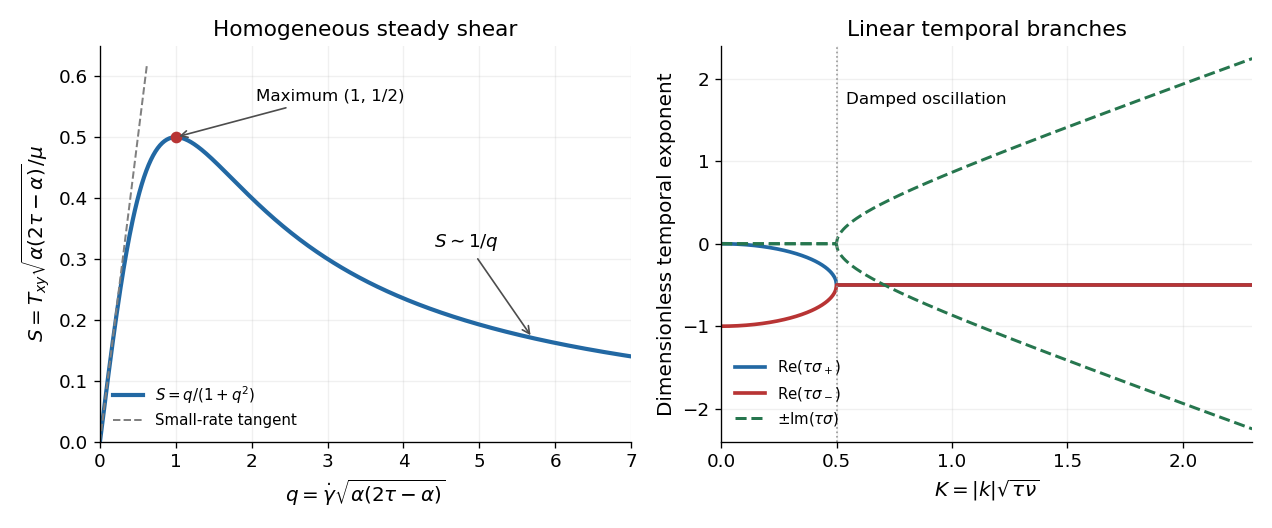
Homogeneous shear stress and the two temporal branches of the linear response
. The steady curve uses q equal to the shear rate times the square root of alpha times (2 tau minus alpha). The spectral panel uses K equal to the wavenumber magnitude times the square root of tau times nu. These are distinct nondimensional variables. Details.
This is a Johnson-Segalman fluid without an added Newtonian fluid solvent contribution. To identify conventions explicitly, set and , with the spin tensor. The derivative appearing in the constitutive equation becomesthe Gordon--Schowalter derivative. Its usual slip interval corresponds to , while a nonsingular genuinely shear thinning curve requiresAt the model is the Upper-convected Maxwell model; at it is the lower-convected derivative counterpart, and both have constant shear viscosity in this test. At the derivative is the Jaumann derivative, giving the corotational Maxwell fluid. Merely requiring is insufficient: for the denominator is , which vanishes at and then gives a negative steady shear viscosity. There is no solvent-induced large-rate plateau in the stated equation.
Articles by others on the same topic
There are currently no matching articles.