Let and use for the source's velocity gradient convention. Seek the homogeneous stationary stress reached under steady simple shear flow. The material derivative of that stress tensor vanishes. In the plane,The , and components of the constitutive equation give, respectively,Thus, putting and using the shear stress calculated below,The out-of-plane shear components vanish on the homogeneous branch. The two normal-stress differences areThe ratio is defined at nonzero shear when ; at both differences vanish, and the displayed constant is their limiting ratio. An arbitrary isotropic pressure in the total Cauchy stress tensor cancels from both differences; it is not an arbitrary addition to the constitutively defined extra stress itself.
The component of the stationary constitutive equation isInsert and . The coefficient of becomes , givingFor , the small-rate shear stress is . At large positive rate, and the shear viscosity decreases as . The shear stress is odd in rate, reaches a positive maximum atand decreases thereafter. The original plot displays this homogeneous constitutive curve. Its decreasing branch can permit shear banding; the local model alone supplies neither an interface-selection rule nor a guaranteed stable homogeneous realization.
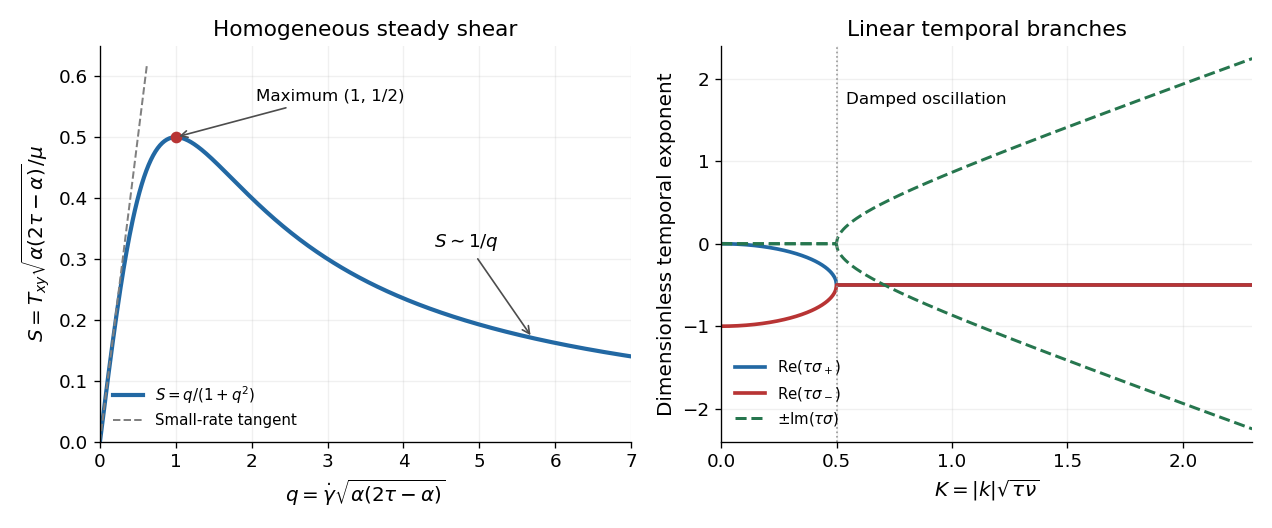
Homogeneous shear stress and the two temporal branches of the linear response
. The steady curve uses q equal to the shear rate times the square root of alpha times (2 tau minus alpha). The spectral panel uses K equal to the wavenumber magnitude times the square root of tau times nu. These are distinct nondimensional variables. Details.
This is a Johnson-Segalman fluid without an added Newtonian fluid solvent contribution. To identify conventions explicitly, set and , with the spin tensor. The derivative appearing in the constitutive equation becomesthe Gordon--Schowalter derivative. Its usual slip interval corresponds to , while a nonsingular genuinely shear thinning curve requiresAt the model is the Upper-convected Maxwell model; at it is the lower-convected derivative counterpart, and both have constant shear viscosity in this test. At the derivative is the Jaumann derivative, giving the corotational Maxwell fluid. Merely requiring is insufficient: for the denominator is , which vanishes at and then gives a negative steady shear viscosity. There is no solvent-induced large-rate plateau in the stated equation.
Articles by others on the same topic
There are currently no matching articles.