Label a trajectory by and write its flow map as , with . An infinitesimal material line joining neighboring labels has tangent , where is the deformation gradient. Differentiating at fixed labels givesThis identity holds for an unnormalized material line tangent even in a compressible flow. Incompressibility also makes an advected magnetic field obey the same stretching law. A unit tangent would instead require a projection removing its change of length.
Use the source's velocity gradient convention . For a outer product , the product rule yieldsThe same law holds for a sum or locally transported average of such outer products. Thus the dyadic transport of material line elements motivatesThis upper-convected derivative vanishes for a symmetric tensor transported solely by stretching of material lines. It subtracts both advection and geometric deformation, allowing a constitutive equation to isolate intrinsic relaxation or production. More generally gives . Under a time-dependent rigid rotation , its value transforms as , making it an objective time derivative. This is a suitable derivative for this transport type; symmetry alone does not make it the unique possible objective time derivative.
When deformation is stopped, the rate-of-strain tensor and velocity gradient vanish, leaving . HenceThe positive constant is the viscoelastic relaxation time. For slow weak deformation, all the transport and quadratic terms are smaller than , so . Thus is the zero-rate dynamic viscosity, measured in stress times time. The corresponding short-time shear modulus of the Maxwell fluid response is . The source's has units of time, since must have units of stress.
Linearize about a relaxed state with constant mass density . In the unforced momentum conservation equation , the component of the pressure gradient is zero for a freely evolving unidirectional flow independent of . A prescribed external pressure gradient would add a forcing term.
For , incompressibility is automatic and the only nonzero entries of the rate-of-strain tensor are . Products of stress and velocity gradient are quadratic in the small amplitude. The constitutive equation consequently becomes to first order. With , its shear component and the component of momentum conservation areThe diagonal stress components have only homogeneous relaxation at this order and vanish if initially relaxed. In particular, does not enter this linear response.
Eliminating the shear stress from the two linear equations gives the Maxwell shear-wave dispersion equation in physical space,where is the kinematic viscosity. Substitution of a Fourier mode givesThese are temporal exponents: the oscillation angular frequency is the imaginary part of , with the sign determined by the selected time convention. For both exponents are real and nonpositive. At equality the repeated exponent is ; generic solutions include . Above the threshold the modes are damped propagating shear disturbances:At large their phase velocity tends to .
For the limit at fixed and , expansion of the square root givesAfter a short initial relaxation, the surviving branch obeys the diffusion equation of a Newtonian fluid. The fast branch disappears on the vanishing viscoelastic relaxation time; at the two exponents are exactly and . This limit is not uniform in : modes with of order still sample the oscillatory transition. If instead is held fixed as , then and the fixed- slow exponent tends to zero. The ordinary Newtonian fluid limit therefore specifies which material parameter is held fixed.
Let and use for the source's velocity gradient convention. Seek the homogeneous stationary stress reached under steady simple shear flow. The material derivative of that stress tensor vanishes. In the plane,The , and components of the constitutive equation give, respectively,Thus, putting and using the shear stress calculated below,The out-of-plane shear components vanish on the homogeneous branch. The two normal-stress differences areThe ratio is defined at nonzero shear when ; at both differences vanish, and the displayed constant is their limiting ratio. An arbitrary isotropic pressure in the total Cauchy stress tensor cancels from both differences; it is not an arbitrary addition to the constitutively defined extra stress itself.
The component of the stationary constitutive equation isInsert and . The coefficient of becomes , givingFor , the small-rate shear stress is . At large positive rate, and the shear viscosity decreases as . The shear stress is odd in rate, reaches a positive maximum atand decreases thereafter. The original plot displays this homogeneous constitutive curve. Its decreasing branch can permit shear banding; the local model alone supplies neither an interface-selection rule nor a guaranteed stable homogeneous realization.
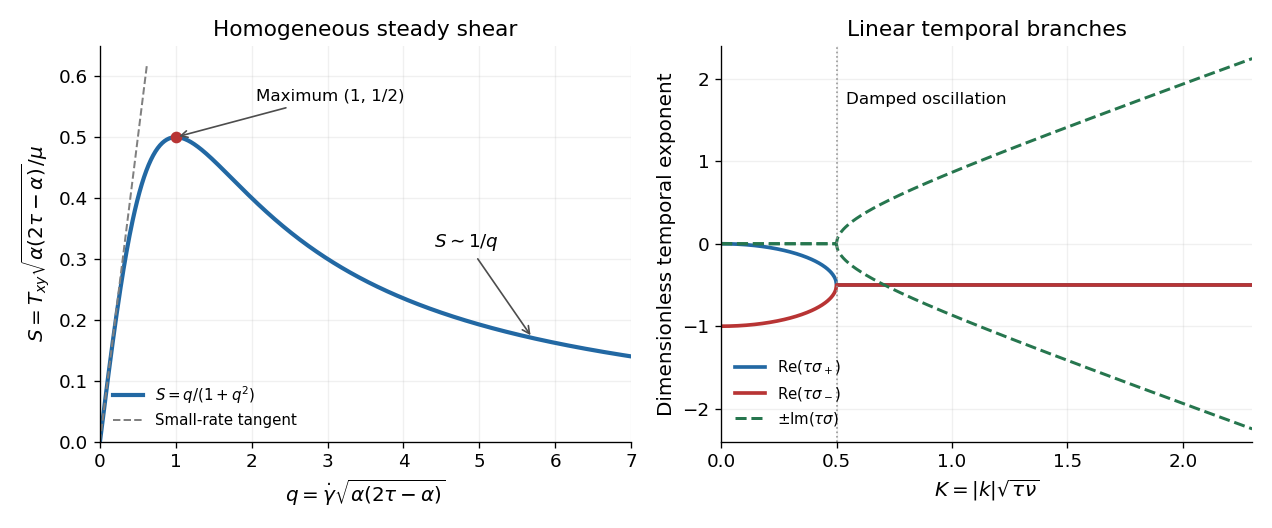
Homogeneous shear stress and the two temporal branches of the linear response
. The steady curve uses q equal to the shear rate times the square root of alpha times (2 tau minus alpha). The spectral panel uses K equal to the wavenumber magnitude times the square root of tau times nu. These are distinct nondimensional variables. Details.
This is a Johnson-Segalman fluid without an added Newtonian fluid solvent contribution. To identify conventions explicitly, set and , with the spin tensor. The derivative appearing in the constitutive equation becomesthe Gordon--Schowalter derivative. Its usual slip interval corresponds to , while a nonsingular genuinely shear thinning curve requiresAt the model is the Upper-convected Maxwell model; at it is the lower-convected derivative counterpart, and both have constant shear viscosity in this test. At the derivative is the Jaumann derivative, giving the corotational Maxwell fluid. Merely requiring is insufficient: for the denominator is , which vanishes at and then gives a negative steady shear viscosity. There is no solvent-induced large-rate plateau in the stated equation.
Articles by others on the same topic
There are currently no matching articles.