The two one-loop Feynman diagrams are fermion loops with three photon interaction vertices. Fix vertex 1; the two cyclic orders are and . A cyclic rotation does not produce another Feynman diagram. Keeping all three external labels in the same positions, these two orders can be represented by the same triangle with opposite fermion flow, as in the first two panels.
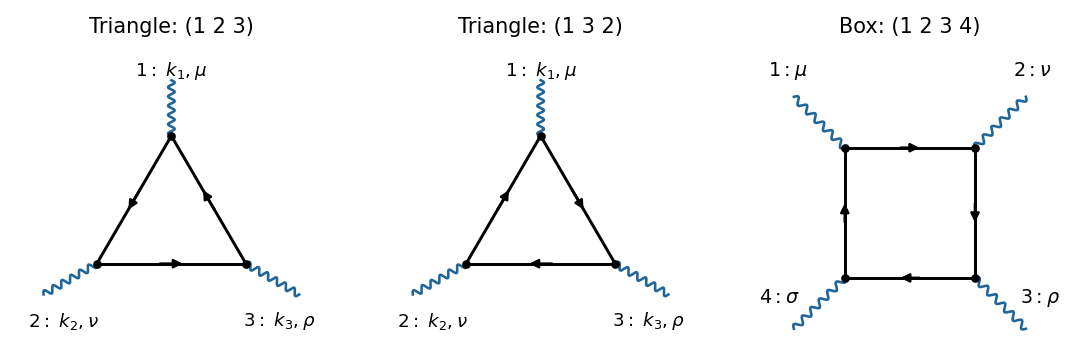
Original Feynman diagrams for the two orientations of the three-photon fermion loop and a representative four-photon box diagram
. Details. 
The photons are labelled , , , with all four-momenta incoming and . The amputation of external propagators removes the three external photon propagators, leaving their Lorentz indices open. There are no other connected one-loop Feynman diagrams with only three external photons in QED.
Put for the Dirac propagator, and for a translation-invariant dimensional regularization of the loop momentum integral. The two oriented scattering amplitudes areThe common minus sign is the closed fermion loop sign. There is no additional symmetry factor for either labelled orientation. Each expression is a trace over spinor indices; all external photon propagators are amputated. If , the common factor is , so, for example, .
Use the source's charge-conjugation matrix convention . It impliesA trace equals the trace of its matrix transpose, which reverses the order of all factors. Inserting the displayed identities givesThere is one minus sign from each of the three photon interaction vertices, and none from the transformed Dirac propagators. In the last line, change loop momentum to . Since , its three Dirac propagators become , , , exactly those of the reversed orientation. HenceThis is Furry's theorem. The regularization in quantum field theory matters: the individual Feynman integrals are superficially divergent, so an unregulated shift of a divergent integral is not a proof. A common dimensional regularization preserves charge conjugation and the vector Ward identity, making the change of variables legitimate. No chirality matrix occurs, so the axial triangle anomaly is not involved.
For an -vertex fermion loop, reversing the fermion flow reverses the ordered product inside its trace. The same charge-conjugation matrix calculation transforms every Dirac propagator by and contributes for each vector photon interaction vertex. Relabel the loop momentum so that the external labels are fixed. The reversed Feynman diagram therefore obeysFor odd , the cyclic orders pair into opposite orientations and cancel. For , the single photon tadpole maps into itself with a minus sign and is zero. The common closed fermion loop sign is present on both sides and does not supply the factor . This proves Furry's theorem for all the requested one-loop Feynman diagrams. The charge conjugation argument also gives vanishing odd-photon correlation functions to all orders in vacuum QED, provided no charge conjugation symmetry breaking background or charged external state is introduced.
The third panel of the figure in part a is a representative four-photon box diagram. Fix the external photon labelled 1 and orient the fermion loop. The six inequivalent cyclic orders of the labelled interaction vertices areThey are obtained by permuting labels on the displayed box, keeping label 1 fixed. Equivalently there are three undirected boxes, each with two opposite fermion flows. The reversal pairs areFor four photon interaction vertices, the sign in part d is positive, so the members of each pair add. They can be represented by three box diagrams multiplied by two. There is no tree photon self-coupling in QED, and therefore no triangle or bubble with a photon self-vertex to add at this loop order. This is the one-loop light-by-light scattering contribution, of order .
At large loop momentum, each Dirac propagator scales as . One four-dimensional loop and four internal Dirac propagators therefore give the superficial degree of divergenceThus a possible ultraviolet divergence in the sum is logarithmic. By locality its divergent coefficient is a degree-zero polynomial in the external four-momenta, namely a constant Lorentz tensor,The photon Ward identities apply to the complete sum for arbitrary external four-momenta, including off shell ones: , and likewise for the other legs. A constant tensor with for every must be zero. Hence andEquivalently, a logarithmic divergence would require a local dimension-four counterterm, forbidden by Abelian gauge invariance. A gauge-invariant four-photon local operator starts with four gauge field strengths, for example , of mass dimension eight; it cannot be this power counting divergence. Individual boxes need not be finite; their forbidden divergent parts cancel in the sum. There are no divergent proper loop subgraphs at this loop order. With the massive Dirac field in the source, there is also no soft or collinear infrared divergence at generic external kinematics. The argument establishes ultraviolet finiteness, and does not claim the absence of physical threshold singularities.
Articles by others on the same topic
There are currently no matching articles.