For physical spin ladder operators, . Operators at distinct sites commute. Expanding the two products cancels their cross terms and givesAdding the remaining component provesFor spin one-half, , , and raising an up spin or lowering a down spin gives zero. These formulas restore the physical factors implicit in the dimensionless ladder hint.
Let abbreviate the state with the only down spin at site , keeping for the fully up state. If lies on neither end of bond , that bond contains two up spins. The ladder terms vanish, while gives . ThusFor a down spin at , the product is instead , and moves it to with amplitude . For a down spin at , the other ladder product moves it back. ThereforeEvery bond in is aligned, so summing its bond energies givesThis is indeed a ground-state energy: a pair of spin-one-half particles has eigenvalues and , so each ferromagnetic bond is bounded below by , simultaneously attained by the fully aligned state. The isotropic Heisenberg model has a whole maximum-total-spin ground multiplet, not a unique all-up ground state.
In the single-excitation subspace, only the two bonds adjacent to the down spin differ from the aligned background. Their diagonal energy increase is , and each neighboring hop has amplitude . Hence, with periodic site indices,This is an exact finite-dimensional hopping problem. Choose the active one-site translation convention . A periodic plane-wave coefficient pattern requires , soThere are independent such wavevectors, for example one set of consecutive integers in a Brillouin zone. The normalized one-magnon Bloch states on a ring are . Reindexing with the periodic coefficient condition gives and hence .
There is a logical qualification to the condition stated in the paper. On an -site ring already holds for every state. In particular, the finite sum written with an arbitrary real also returns to itself after translations; that condition alone does not quantize . The displayed allowed values are the ones for which the ansatz is a single one-site translation eigenstate, equivalently a consistently periodic plane wave. This is the additional condition needed for the subsequent energy-eigenstate argument. Other values generally describe superpositions of the allowed momentum modes.
Apply the hopping Hamiltonian operator and shift the summation index using periodic boundary condition. The coefficients from and are respectively and times the original coefficient. Thusand the nearest-neighbour ferromagnetic magnon dispersion isThe unnormalized state in the question has the same energy. Distinct allowed momenta are orthogonal, since over one set of representatives.
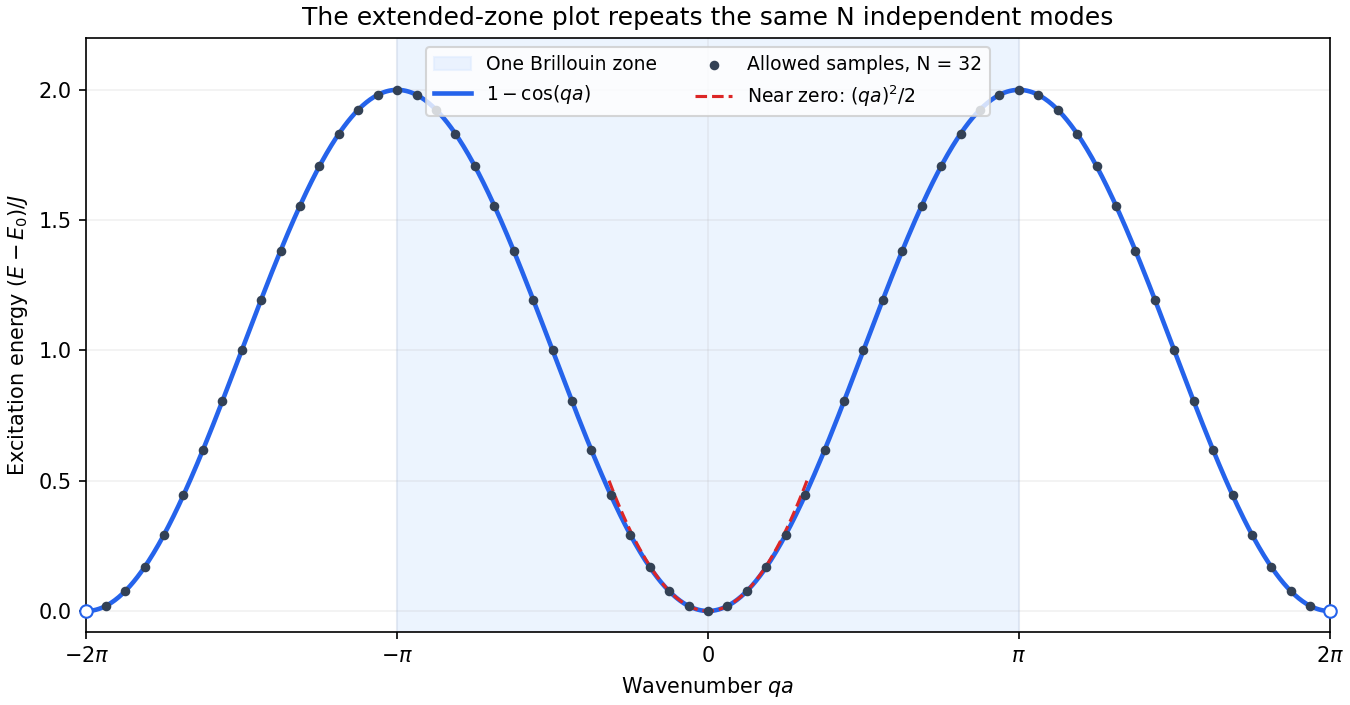

For large the sampled wavevectors become dense, and the requested sketch is the periodic curve over . It has a zero at and tends to the equivalent zero at either open endpoint; maxima occur at . Near any equivalent zero,using measured from that zero. The low-momentum ferromagnetic magnon is quadratic, with group velocity . The state is proportional to the total spin lowering operator acting on , so it belongs to the same ground multiplet and has exactly zero excitation energy. Extending the plot beyond one reciprocal period repeats states rather than adding new independent modes. The lattice spacing is the nearest-neighbor chord length specified in the paper; is the translation length in this lattice description, not necessarily the continuous circumference of a circular arrangement.
Articles by others on the same topic
There are currently no matching articles.