For a nonzero second-order principal part, the discriminant is : positive gives a hyperbolic partial differential equation, negative an elliptic partial differential equation, and zero the parabolic type when the principal part has rank one. If all three coefficients vanish, the equation is instead degenerate to lower order.
Here , , , so for . The characteristic equation isThus chooseTheir Jacobian determinant with respect to is , so they are valid coordinates on the specified half-plane. The level sets are horizontal lines and the right-hand halves of parabolas .
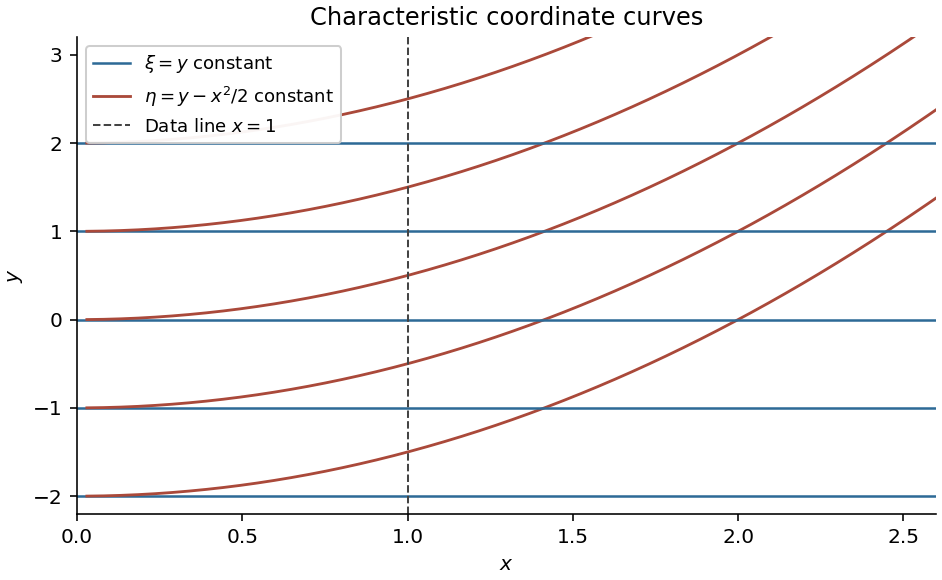

Writing , the chain rule givesThe original equation reduces to , hence the canonical form is . Integrating once in each characteristic variable givesorOn , differentiation gives . The specified derivative therefore forces for every argument, so is a constant. The specified value then gives . ConsequentlyIts derivatives are , and , which verify both the equation and the data directly.
Articles by others on the same topic
There are currently no matching articles.