First prove the general uniqueness claim. The bound prevents a solution from leaving the dependent-variable interval before : up to any first exit, . Let be two solutions with the same initial value. Their integral equations and the Lipschitz condition give, for ,Since their difference is bounded by , repeated substitution into this inequality proves, for every integer ,The same argument with reversed limits works for . Letting forces the difference to zero on the whole interval. This proves at most one solution without assuming that .
For case (i), choose a rectangle around that stays in . There is bounded, giving a uniform Lipschitz constant by the mean value theorem. For example works: and . Separate variables using , obtaining . The initial condition gives , henceIt remains positive for all real , so the same local uniqueness argument continues along this solution.
No rectangle of positive width around has a uniform Lipschitz constant in . For any nonzero in such a rectangle,The vanishing factor at the single initial point does not control neighbouring -values. The failure of the hypothesis is accompanied by actual nonuniqueness: bothsatisfy the equation and have value zero at . Direct differentiation gives , including the zero point by continuity.
The same quotient is unbounded near , so the uniform Lipschitz hypothesis again fails. Two explicit solutions through the initial point areFor the second, put . Then , and . The real power here means the square of the real cube root, so the identity also holds when is negative. Both functions are differentiable through their zeros. Thus uniqueness fails in this case as well.
For a nonzero second-order principal part, the discriminant is : positive gives a hyperbolic partial differential equation, negative an elliptic partial differential equation, and zero the parabolic type when the principal part has rank one. If all three coefficients vanish, the equation is instead degenerate to lower order.
Here , , , so for . The characteristic equation isThus chooseTheir Jacobian determinant with respect to is , so they are valid coordinates on the specified half-plane. The level sets are horizontal lines and the right-hand halves of parabolas .
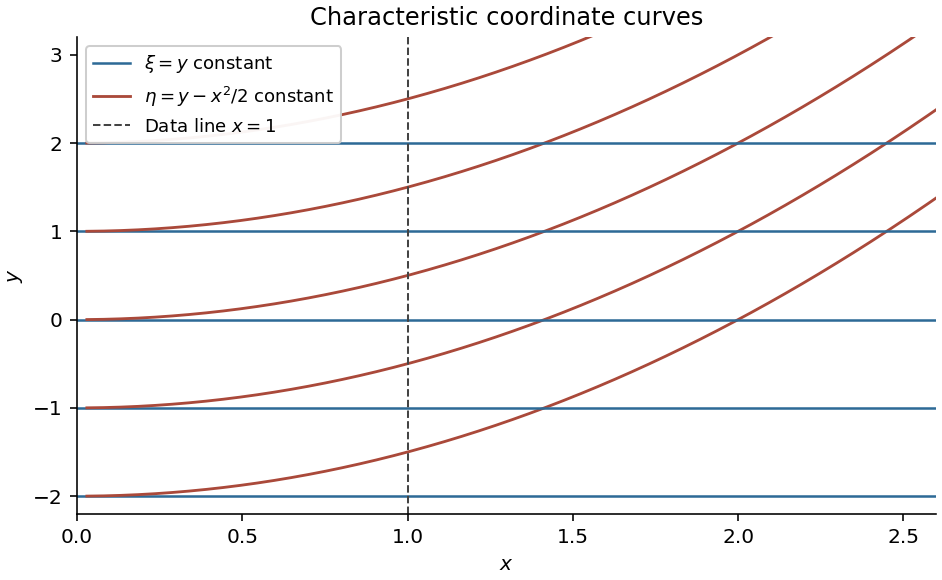

Writing , the chain rule givesThe original equation reduces to , hence the canonical form is . Integrating once in each characteristic variable givesorOn , differentiation gives . The specified derivative therefore forces for every argument, so is a constant. The specified value then gives . ConsequentlyIts derivatives are , and , which verify both the equation and the data directly.
The Laplace transform isA sufficient condition is that be piecewise continuous on each bounded interval and of exponential order , meaning for all sufficiently large . Then the integral is absolutely convergent for , by comparison with .
For the constant function, direct integration gives
Combine the exponentials and integrate:The parameter makes this convergence half-plane larger than the one for the constant function.
Integration by parts, where the transform boundary term at infinity vanishes, givesFor a sufficiently regular function with the required exponential growth bounds, apply this again to to deduceThese identities hold in a right half-plane where the displayed transforms converge; the regular solutions obtained below satisfy those requirements.
Now put , and . Transforming each term of the differential equation, and using the derivative identities, givesThe initial-value terms cancel, leavingIntegrating once yields . Partial fractions giveThe transform pairs therefore imply, on writing ,For the final parameter count, the differential equation is the derivative of : it says . Integrating gives . A regular solution at has finite and , forcing . Thus is first order and leaves only one constant. Equivalently, the original equation at zero requires , so the two usual initial values cannot be chosen independently. The displayed solution satisfies this constraint and verifies the original equation directly.
Articles by others on the same topic
There are currently no matching articles.