Put , so the interior angle at the th polygon vertex is . A conformal map straightens that corner by a power: locally,This follows by composing with the power that maps the corner to a half-plane and using Schwarz reflection along its straight edges. The reflected map has a nonzero first derivative in the straightened coordinates.
For an upper-half-plane branch of the complex logarithm, defineAlong each open interval of the real axis, has constant argument. Crossing from left to right decreases from to zero, so the argument of increases by . This is exactly the exterior turning angle of the polygon boundary. Thus has one constant boundary argument on all the intervals. The corner asymptotics remove its apparent singularity at each prevertex.
For a bounded polygon, the sum of exterior angles gives . Since every vertex has a finite prevertex, infinity maps to an ordinary point of an edge. In the local coordinate , Schwarz reflection gives with . Hence has a finite nonzero limit at infinity. After multiplication by one unit complex number, its boundary values are real. Reflecting across the real axis extends it to an entire function, including each removed prevertex, and it is bounded at infinity. Liouville's theorem makes it constant. Therefore the Schwarz-Christoffel formula isIntegration introduces one further additive constant.
The Möbius transformations preserving the upper half-plane have three real parameters:with common nonzero scaling irrelevant. They can send any cyclically ordered triple of boundary points to another such triple. Consequently three prevertices may be fixed independently; the other are constrained by the polygon's shape, through its side-length ratios. The constants of integration and multiplication account for translation, rotation and scale of the image, rather than further prevertex freedom.
If the last prevertex is infinity, use as its local coordinate. Its factor is absorbed into the overall normalization, leavingFor a finite image vertex at infinity's preimage, this has asymptotic order , because is of order . Thus the omitted factor is not evaluated by substituting infinity into the finite product; its angle is encoded by the behavior at infinity.
The two approaches to the slit base are distinct boundary points, each with interior angle , whereas the slit tip has interior angle . Their exponents in the Schwarz-Christoffel formula are therefore , and . Write and takeon the upper half-plane, with the branch normalized by at infinity. The derivative has the formOn , the upper boundary value is . Both endpoints of this interval map to the slit base, soThe odd term integrates to zero, and ; hence . Now , so . The endpoint values force , and the tip value, using as a boundary limit, forces . ThusThe branch is important: on its boundary value is positive real, on negative real, and on positive imaginary. The intervals and traverse the two sides of the slit, meeting at its tip.
The map is injective in the upper half-plane: equal images imply , and the alternative cannot put both points in that half-plane. Its derivative has no interior zero. The image has positive imaginary part, by continuity of the branch and the fact that an interior real image would require to be nonnegative real, which is impossible for . Conversely, a point in the upper half-plane outside the slit gives a unique upper-half-plane root of . A point with gives only real roots or zero and is excluded. These observations verify that the image is exactly the required slit domain, rather than just matching its boundary.
The imaginary part of the complex potential of a two-dimensional potential flow is the stream function. Its constant values on the wall and the free boundary make the potential domain the horizontal stripThe lower edge is the rigid wall, with at . The upstream end has , and the downstream end has . The upper edge is the free streamline. Thus and are the negative and positive portions of the real axis, respectively.
Write for the complex velocity. Downstream . Upstream the fluid moves towards the corner along a wall of inclination , so its physical velocity has argument and its complex velocity has argument . Along each straight wall the velocity direction is fixed. At the corner the fluid angle is , giving local behavior and hence : is a stagnation point. On the free streamline, the speed is one, so .
The corresponding simple-jet hodograph plane is therefore the circular sectorThe radius at argument represents , the positive real radius represents , and the unit-circle arc represents the free boundary. The upstream and downstream ends are and one, respectively; the corner is the sector's origin.
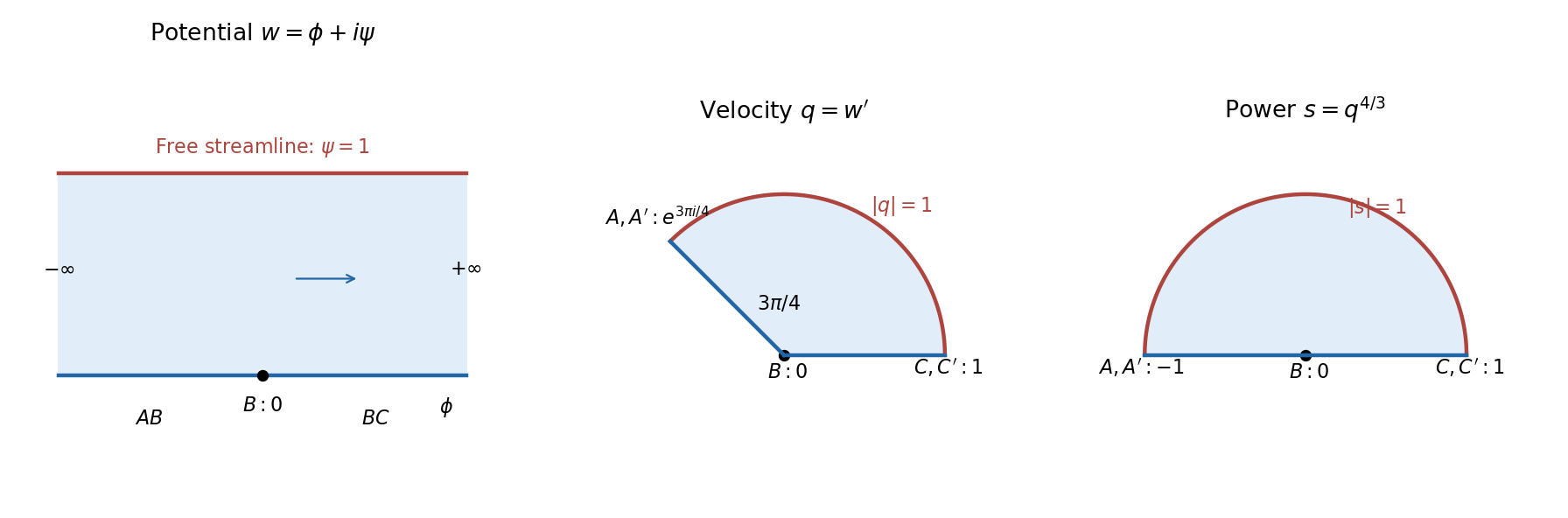
The complex potential of a two-dimensional potential flow strip and hodograph plane, with an intermediate power map
. Details. 
Starting from the hodograph plane, take the complex powerIt takes the velocity sector bijectively to the upper half of the unit disk. The boundary points representing the upstream end, the corner and the downstream end become , zero and one. Next use the Möbius transformationThe diameter maps to the negative real axis, while for on the upper semicircle,which is on the negative imaginary axis. The interior maps to the third quadrant. Squaring therefore gives a conformal bijection from that quadrant to the upper half-plane:The upstream end, corner and downstream end map to zero, one and infinity, respectively. The two walls map to the positive real axis, and the free boundary maps to the negative real axis.
Independently, the exponential function takes the potential strip to the same upper half-plane with the same boundary correspondence. The strip height fixes the coefficient , and the normalization fixes the remaining positive multiplicative constant in to one. ConsequentlyOne can make the branches explicit. In the strip, lies in the first quadrant, whereas . Thuswith the power taking arguments in to . It gives upstream, downstream, and at , verifying both the branch choice and the velocity normalization.
Articles by others on the same topic
There are currently no matching articles.