In the Laplace integral method for a differential equation, differentiate the integral three times with respect to , and replace by . Integration by parts givesThus the weight equation for this construction and its boundary condition arewhich giveThese are the conditions obtained by eliminating the transformed interior term and the endpoint term separately. As usual for this method, differentiation and integration by parts need convergence assumptions; the contours constructed next make every such step valid locally uniformly for all complex . A literal necessity claim for arbitrary weights and contours would additionally require uniqueness of the chosen representation by a Laplace integral; a null weight in a contour Laplace representation can otherwise be added without changing the solution.
LetThe quartic decay sectors for a contour integral contain the four rays . Along each ray, the quartic term is . For , choose to travel from infinity on ray to zero, and then from zero to infinity on ray . Set and defineOn any compact set of values, the integrand and each of its derivatives are bounded by a constant times for some . These bounds are integrable at infinity, so differentiation under the integral sign is justified and the functions are entire. The endpoint term vanishes at both infinite ends. There is no extra term at zero because the two pieces join with the same integrand value and opposite endpoint orientations. Therefore all three functions solve the differential equation.
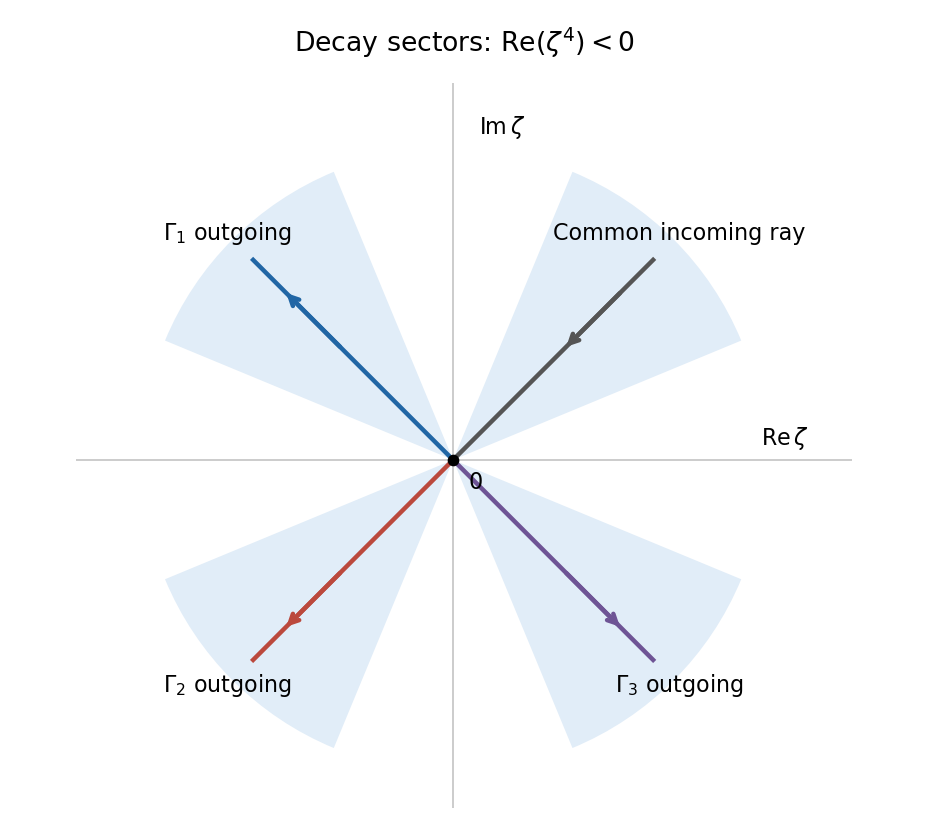
Three independent Laplace integral contours joining rays in quartic decay sectors
. Details. 
To prove independence, evaluate their first three initial data. For ,If , these initial data give for . Define . ThenThe coefficient matrix is a Vandermonde matrix at four distinct fourth roots of , and hence is invertible. All vanish. There is also a concrete reason for the earlier qualification about necessity. Deform the incoming ray of to angle and its outgoing ray to angle , within their respective quartic decay sectors. The quartic integral is unchanged and remains nonzero. On this deformed contour, the extra entire weight contributes zero for every : throughout the closing wedge, , so the large closing arc tends to zero and the Cauchy integral theorem gives a zero integral. Thus represents the same entire solution and has vanishing endpoint terms, although it does not satisfy . The canonical weight equation is the standard sufficient construction, rather than an unconditional uniqueness assertion about contour representations.
Thus the three contours give linearly independent nonzero solutions, and they form a fundamental system of solutions for this third-order linear equation. This proves independence directly instead of inferring it merely from the presence of three different contours.
Write , and . In a common convergence strip, two integrations by parts on each half-line giveThe boundary terms at infinity vanish by exponential decay; the ordinary differential equations also give decay of the required first derivatives. Substituting the two equations for yieldsContinuity makes the terms cancel on addition, while the unit derivative jump givesMultiply by and factor the quadratics. Since , their sum is nonzero, and partial fractions giveThis is the Wiener-Hopf equation for the two half-line Fourier transforms. The plus and minus subscripts refer to support in physical space; their holomorphic domains in transform space are determined next.
Let . On , the modulus of the Fourier factor is , so the given decay bound makes converge absolutely when . On , write ; the bound becomes , so converges absolutely when . Uniform domination on compact subsets permits differentiation with respect to , provingThus the half-planes guaranteed directly by the given common decay bound have and , and the equation holds on their overlapThis is a statement about the domains guaranteed by that bound, not necessarily their largest possible domains. The exact solution below decays at different rates on the two half-lines and gives the sharper convergence half-planes and , with maximal common strip .
The constant-coefficient equations and decay imply that only the modes on the positive half-line and on the negative half-line can occur; the opposite modes grow. Continuity and the nonzero derivative jump then imply nonzero amplitudes, so any common decay exponent satisfies . In particular lies below the plus holomorphic half-plane, and lies outside the minus half-plane. This locates the poles needed for the transform calculation, without yet computing the amplitudes.
Rearrange the equation from part (i) asThe left side is holomorphic in the plus half-plane, and the right side in the minus half-plane. Their equality on the overlap glues them into one entire function. The assumed decay of , together with the rational factors tending to one and the subtracted fractions tending to zero, makes this entire function tend to zero at infinity. It is therefore identically zero by Liouville's theorem. This is the additive splitting step of the Wiener-Hopf method. Solving the two zero identities givesTheir apparent cancellation formulas extend holomorphically wherever a cancelled factor vanishes; the only actual poles are at and .
With the Fourier convention in use, inversion has factor and normalization . For , close the contour in the lower half-plane clockwise, collecting the pole at . For , close in the upper half-plane counterclockwise, collecting the pole at . The residue theorem givesEquivalently, each displayed transform follows immediately by integrating the corresponding decaying exponential on its half-line, so Fourier uniqueness gives the same inversion without a contour estimate. Both values at zero are , and the derivative jump is , directly checking the interface conditions.
The moduli are a nonzero constant times for and for . Hence the largest common exponential decay rate isStrictly, the stated big- bound is also true for every smaller positive ; it does not specify a unique exponent unless the sharp rate is intended. The two transform convergence half-planes are exactly the sharper domains stated in part (ii), and the poles on their boundaries prevent extending either half-line integral domain any farther.
Articles by others on the same topic
There are currently no matching articles.