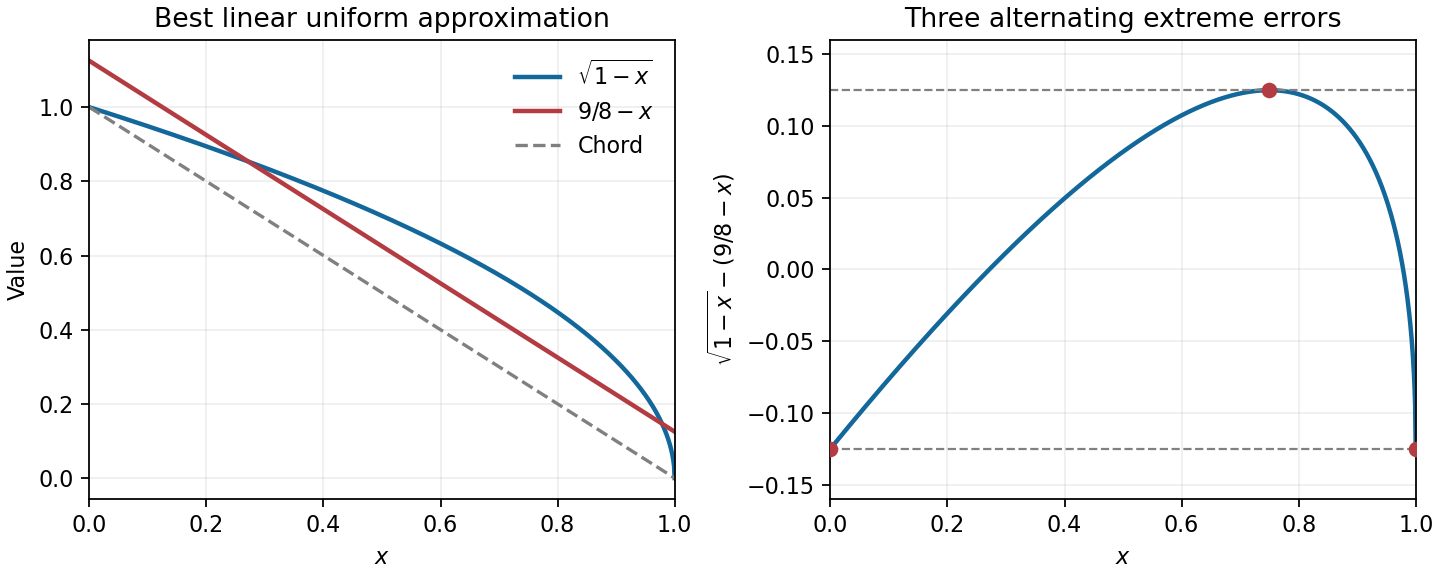
The endpoint chord is . Since the square-root function is concave, the gap is nonnegative. Put to obtain , whose maximum is at , or .
Shift the chord upward by half that maximum. ThenThe errors at are respectively . These are three alternating extrema, so equioscillation proves optimality and uniqueness for linear polynomials. This is minimax linear approximation of a square-root endpoint profile.

Use the Taylor expansion . Expanding the rational form givesMatching through degree two yields , , and . The last equation becomes , soThis is the Padé approximant about zero. Its pole is at four, outside the interpolation interval; its order of matching is local and does not assert uniform minimax optimality.
Let be the centered nondimensional cubic B-spline, even and supported on . The outer cubic must be to make the function and its first two derivatives vanish at the support edge. Write its inner part as . Matching the value and first two derivatives at gives , , . Its nonzero knot values are then , so requiring their sum to be one fixes . ThusIn particular , .
With , represent the spline on as . There are unknown coefficients. interpolation at , , givesThe natural endpoint conditions, using and , giveThese equations are the required matrix system: the interpolation rows have coefficients at consecutive positions and right sides ; the two endpoint rows have and zero right sides. No solution of that system is required. The scaling uses , without an extra , because normalization is by knot values rather than by integral.
Articles by others on the same topic
There are currently no matching articles.