Original source: Cambridge FOI 2023/399 released PDF, physical pages 398–402.
Let increase upwards and let denote the downward gravitational acceleration. The environment obeys hydrostatic equilibrium, . Displace a small parcel by while it remains in pressure balance with its surroundings and exchanges negligible heat. For fixed composition and adiabatic index , its density change at constant specific entropy satisfies . At the displaced position, its density excess over the environment is thereforeThe buoyancy acceleration is . HenceStability requires , equivalentlyAn upward-displaced parcel is then denser than its surroundings and falls back; a downward-displaced parcel is lighter and rises. Equality gives neutral stability in this parcel model. For a perfect gas with constant composition, gives , so a rising specific entropy is stable. This is the parcel form of the Schwarzschild criterion. Rapid pressure equilibration, negligible heat diffusion during displacement and no composition-driven buoyancy are the assumptions behind this test.
For a Newtonian circular orbit, , so the specific orbital energy is . Half of the released potential energy remains in circular orbital motion. The binding-energy estimate between the specified edges is thereforeUsing and one Julian year gives . Thus the radiative luminosity scale is , approximately or . The black-hole mass cancels because both edge radii scale with . The specified inner edge is ; it must not be silently replaced with a different relativistic orbit radius.
For a finite viscous disc, the precise radiated power also depends on boundary work: torque transport of energy in a steady accretion disk means that orbital binding-energy release need not all be radiated inside the two stated edges. If the intended model is a radiatively efficient steady Keplerian accretion disk with a zero-torque inner boundary condition, integrate the one-face flux over both faces. It givesThe difference from is the outward torque power at the outer edge. The question supplies neither boundary torque nor the external material-supply energy budget, so the two calculations state their assumptions explicitly: about W is the binding-energy estimate, while W is the finite-disc zero-inner-torque dissipation result. Both neglect radiation advection, winds and relativistic corrections as required for this model.[ref]
Immediately upstream, free fall from rest at infinity gives . Treat the surface shock as locally planar and stationary, with negligible upstream pressure. The Strong-shock Rankine-Hugoniot conditions for a monatomic gas, , give and . momentum conservation then givesUse the source's gas-constant convention . The immediate postshock temperature isHere adiabatic means that the jump does not lose appreciable heat to the surroundings; the shock is nevertheless irreversible and raises entropy. The gas still has velocity immediately downstream, so setting all upstream kinetic energy equal to downstream internal energy would give the wrong coefficient. Later settling, radiative cooling or changing ionization can alter the temperature; they are outside this immediate, fixed-composition perfect-gas jump.
The Rayleigh-Taylor instability extracts gravitational potential energy when a heavy fluid is supported above a lighter one. A small downward excursion of heavy material and upward excursion of light material can grow instead of experiencing restoring buoyancy. The Kelvin-Helmholtz instability instead extracts kinetic energy from a velocity difference across an interface or shear layer. The interface displacement and its induced flow reinforce one another by tapping the background shear; a reversed density ordering is not required.
A useful common model has two inviscid, incompressible, semi-infinite fluids separated at , with lower density/velocity , upper density/velocity , downward gravity , and surface tension . For a disturbance proportional to , with , the two-fluid interfacial gravity-shear dispersion relation isA negative right side gives exponential growth. With no shear or surface tension and , the growth rate of the Rayleigh-Taylor instability is , where is the Atwood number. With equal densities and no restoring force, the growth rate of the Kelvin-Helmholtz instability is . Heavy-over-light stratification drives Rayleigh-Taylor growth; velocity shear drives Kelvin-Helmholtz growth. A heavy lower fluid supplies gravitational stabilization, and surface tension stabilizes sufficiently short waves in this ideal interface model.
Finite shear-layer thickness, viscosity, compressibility and magnetic tension can change the growth rates and unstable wavelength range. In particular, unlimited growth with increasing is a limitation of the zero-thickness, zero-surface-tension idealization. Density-interface overturning and jet-boundary mixing are appropriate physical applications of the two mechanisms, but the nonlinear mixed state is not determined by the linear growth rate alone.
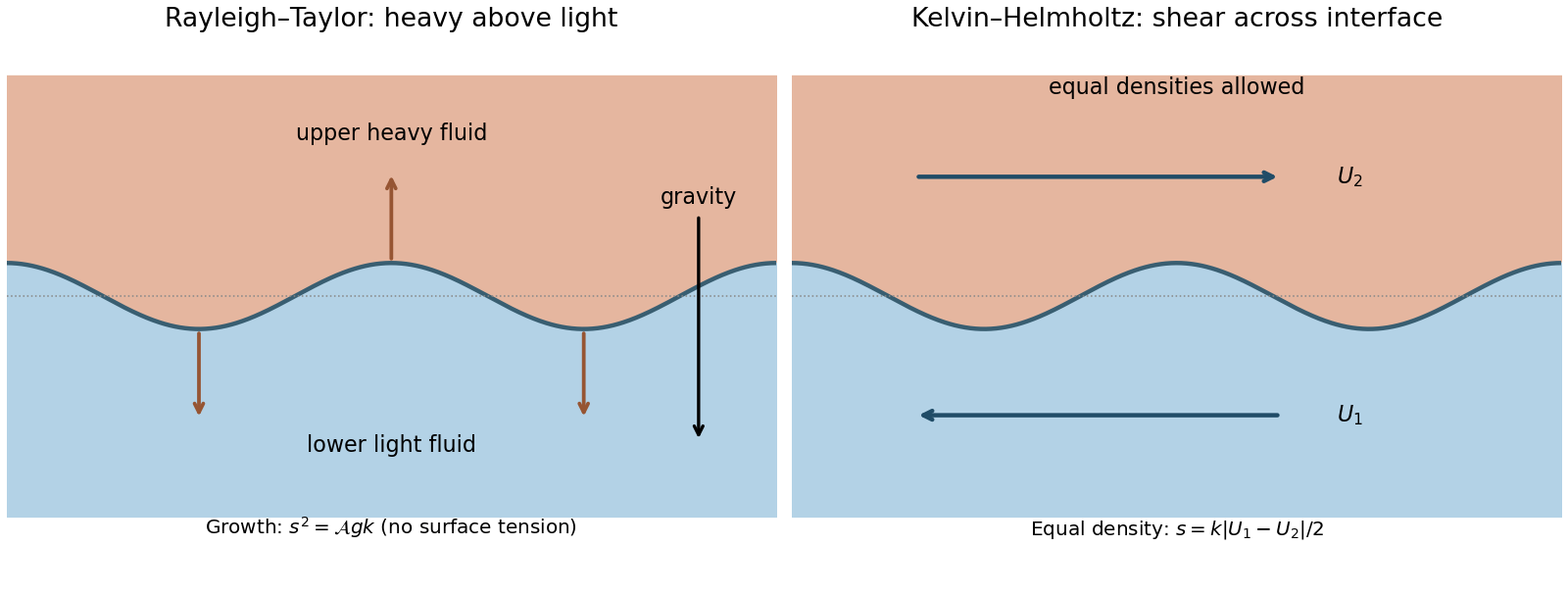
Original schematics of Rayleigh-Taylor instability and Kelvin-Helmholtz instability
. Details. A finite-amplitude compression can steepen because different parts of the wave travel at different characteristic speeds. For a right-moving simple wave in a perfect gas, one may write in terms of the local velocity perturbation . Faster compressive characteristics catch slower ones. When the smooth inviscid description would become multivalued, a physical compression shock replaces it. A rarefaction normally spreads rather than forming an entropy-violating expansion shock.[ref]
Lecture notes: Astrophysical fluid dynamics by Gordon I. Ogilvie. §§6.1.3–6.2, simple-wave reduction and characteristic crossing
Across a locally planar shock, use velocities relative to its moving front. The Rankine-Hugoniot conditions for a perfect gas conserve mass, momentum and total energy flux:where is the specific enthalpy. For upstream normal Mach number ,Thus a normal compression shock increases pressure, density and temperature, reduces the normal velocity, and changes a supersonic upstream flow to subsonic downstream flow in the shock frame. In the strong-shock limit, compression approaches , which is four for a monatomic gas. A shock conserves total energy but generates entropy; an adiabatic shock is not an isentropic compression. For a calorically perfect gas, stagnation temperature is conserved while stagnation pressure falls.[ref]
Normal Shock Wave Equations by NASA Glenn Research Center. normal-shock property ratios, total-temperature conservation and total-pressure loss
Real dissipative processes resolve the narrow front; the jump conditions do not require its detailed internal profile. In a continuum-gas experiment a shock tube can produce a moving shock by releasing a pressure discontinuity. pressure probes separated along the tube measure arrival speed and the pressure jump; distinguishing the shock from the following contact surface is essential. A contact surface can have a density/entropy jump with continuous pressure and normal velocity, whereas a shock carries nonzero mass flux through its front.
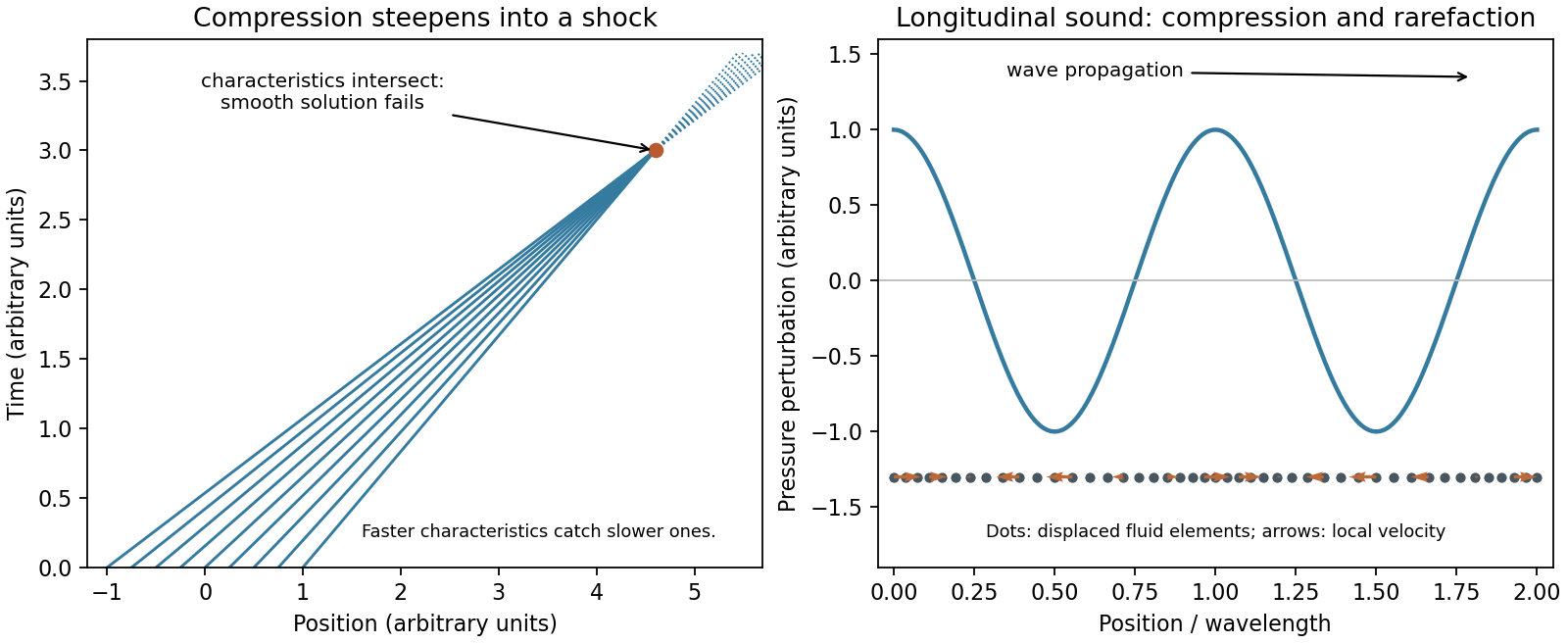
Original characteristic-crossing and longitudinal acoustic wave diagrams
. Details. A small pressure disturbance propagates because compression raises the pressure, the pressure gradient accelerates nearby fluid, and the induced convergence compresses the next region. For a uniform fluid at rest, linearizing mass and momentum conservation and using the adiabatic pressure-density response givesEliminating and gives . A plane wave has and longitudinal velocity parallel to . In a perfect gas,The adiabatic response is appropriate when heat cannot diffuse appreciably out of each compressed region during a period; an isothermal response would give a different derivative. In a moving uniform medium, the acoustic characteristics travel at along the flow, rather than at in the laboratory.
For a progressive wave, ; pressure, density and longitudinal velocity are in phase. The acoustic energy density is the sum of kinetic and compression energies,Sound transports energy while fluid elements execute small oscillations about their mean positions. The ideal uniform-fluid acoustic mode is nondispersive. Spherical spreading reduces pressure amplitude as when total power is conserved; viscosity and heat conduction attenuate waves, while sufficiently large compressions can steepen into shocks. In a stratified astrophysical gas the uniform result is local: wavelengths short compared with background scale heights justify it, whereas long waves can couple to buoyancy and acoustic-cutoff behavior.
Let be the specific internal energy of a calorically perfect gas and define its specific gas constant , so . A reversible adiabatic change has no heat input and obeysUsing and givesIntegration yields , or , with fixed on that isentrope. Equivalently , so specifies entropy as well as composition. In a smooth nondissipative flow this means along each parcel. A single common throughout the fluid additionally requires a homentropic flow. No heat transfer alone does not forbid entropy production: different sides of an adiabatic shock generally have different values. Constant composition and heat capacities are needed for the fixed exponent used here.
Write and use the vector identity . Taking the curl of the momentum equation eliminates all pure gradients, including gravity and the viscous contribution. Before invoking barotropy, the pressure term givesThis is baroclinic vorticity generation. For a barotropic fluid, , so is parallel to and this source vanishes. Constant permits the curl and Laplacian to commute. The result isNo incompressibility assumption was used. Since , an equivalent form isThe terms represent vortex stretching/tilting, compression/dilatation and viscous diffusion. In particular, removing the baroclinic source does not make the vorticity of a three-dimensional parcel constant. A spatially varying entropy-dependent in need not define a single barotropic law; the common-pressure-law assumption matters.
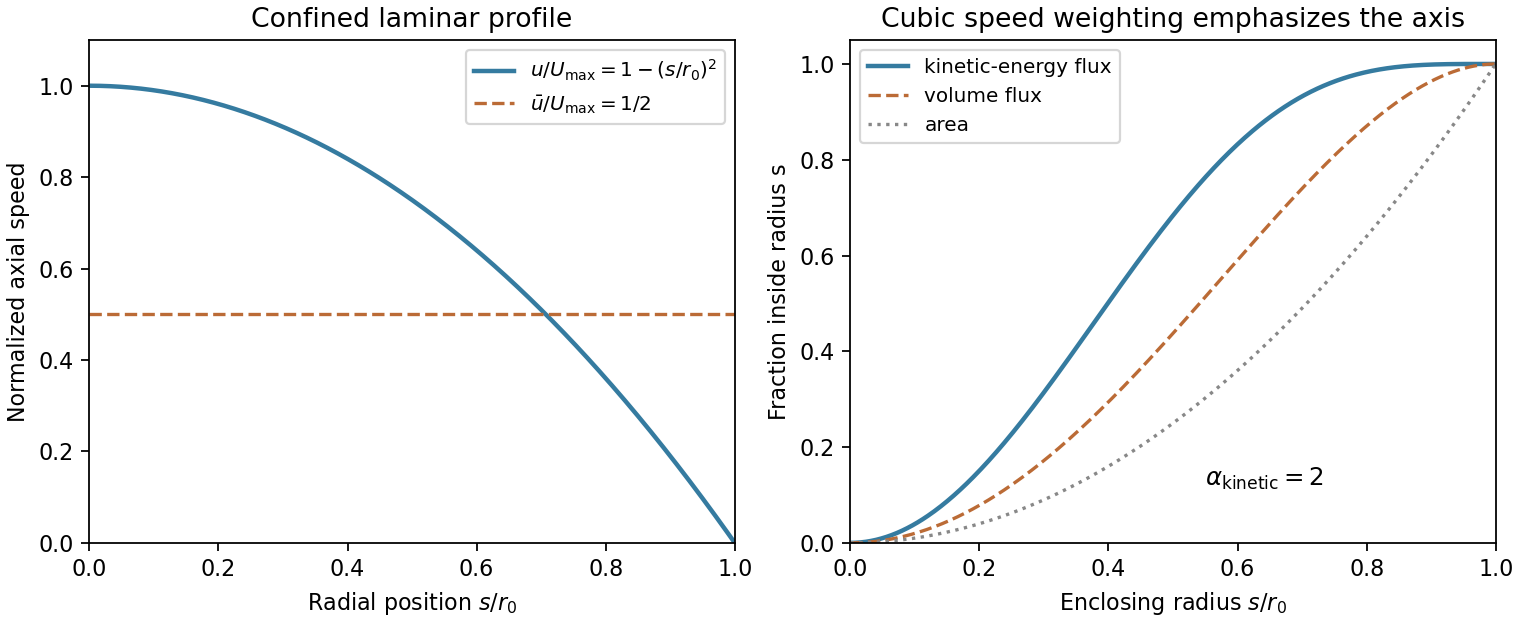
Use the idealized fully developed, laminar cylindrical-flow model implied by the fixed cross-section and zero velocity at its sides. Take the jet length to be , as for a central source reaching the cloud boundary; if the source is off-centre, the actual path length must replace . Let denote distance from the jet axis and write the axial velocity as . Then , the pressure gradient is , and the axial Navier-Stokes equation reduces toRegularity at excludes a logarithmic term. The imposed no-slip boundary condition gives the Hagen-Poiseuille flow profileThe kinetic energy crossing each area element per unit time is , so the velocity must be cubed before integration. ThusConsequentlyThe mean velocity is . Replacing the profile by in underestimates the flux by two; the kinetic energy correction factor is two for this profile. The radius dependence follows from and cross-sectional area .
The specified is outgoing bulk kinetic-energy flux, not the pressure-work rate , which scales as . In a fully developed section the profile is independent of and pressure work is dissipated as heat; entrance acceleration and energy supply establish the profile. A turbulent or freely entraining astrophysical jet need not have this no-slip parabolic structure. The model assumes a long enough, laminar confined region and neglects entrance losses and gravity.
Write the polytropic law as , with constant and . Its pressure potential, or polytropic enthalpy relative to zero density, isHydrostatic balance is . If the surface has zero density and potential , integration gives . At the centre, . ThereforeInsert and into the spherical Poisson equation for Newtonian gravity:The central conditions are and ; the latter follows from a regular spherically symmetric centre. This reproduces the supplied coordinate and potential scaling rather than introducing an unrelated normalization.
For the sound-speed task, the adiabatic sound speed of a perfect polytropic gas isA diatomic gas with active rotational but frozen vibrational degrees of freedom has and . With the requested surface-potential gauge ,The interior potential is then negative. Choosing zero potential at the surface is legitimate; for a finite isolated sphere it is a different additive gauge from setting potential to zero at infinity. Both choices cannot generally be imposed simultaneously.
For the mass-radius task, let be the first zero of the regular Lane-Emden function and . A finite-radius polytrope hasThusAt fixed central temperature, fixed composition and fixed polytropic index, . These are homologous polytropes at fixed central temperature. They do not in general have constant ; imposing constant entropy instead gives a different polytropic mass-radius sequence. If or varies between stars, the displayed dimensionless structure factor and composition factor must be retained: equal alone is not a universal exact proportionality for arbitrary stellar models.
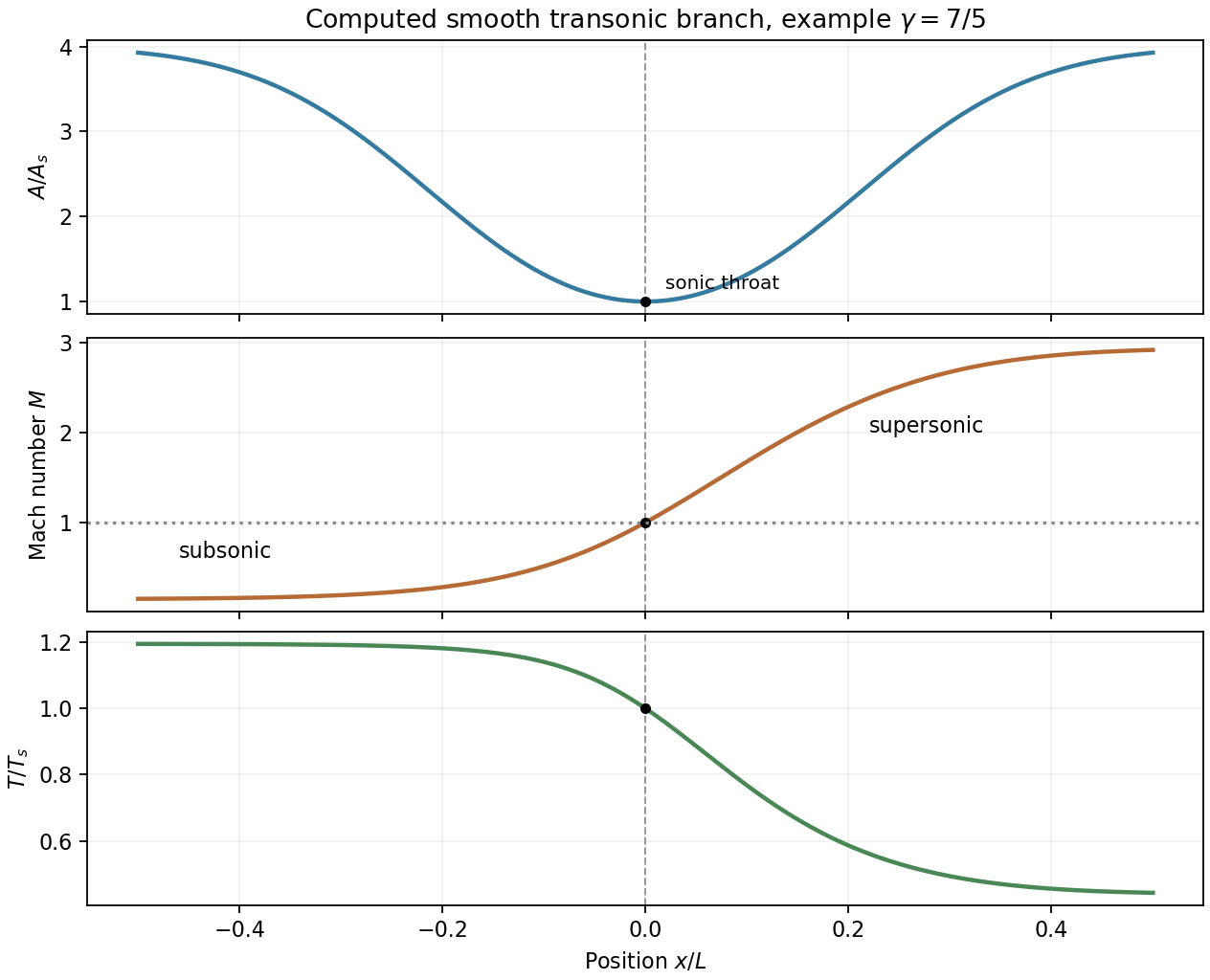
Treat the gas as a smooth quasi-one-dimensional flow through a rigid passage, neglecting axial body forces and heat input. It is the confining medium that is incompressible; the flowing gas must remain compressible. With area and axial speed , continuity and inviscid momentum balance giveCombining their logarithmic differentials yields the nozzle area-velocity relationA smooth crossing of requires an area extremum. The given radius is positive and has derivative , which vanishes only at within the slab and changes from negative to positive there. Thus this station is the unique throat, with and . The specified subsonic inlet and supersonic outlet select the smooth accelerating branch, soA throat by itself does not guarantee transonic flow for arbitrary reservoir and back pressures; that branch is specified here. Before the throat a converging section accelerates subsonic flow; beyond it a diverging section accelerates supersonic flow.[ref]
Nozzle Design by NASA Glenn Research Center. Supersonic and Subsonic Flow, continuity/momentum derivation of the area-velocity relation and choked throat
For the temperature task, evaluate the mass flux and sound speed at the throat using :The ideal-gas relation then givesThis expresses the sonic temperature in terms of the entropy constant, geometry, mass flux and composition; no numerical value of or is provided. Equivalently and . The slab length drops out because the sonic thermodynamic state depends on the minimum area, not on the axial distance over which a lossless smooth nozzle contracts. As a check, conserved stagnation enthalpy gives .[ref]
Mass Flow Choking by NASA Glenn Research Center. equations 1–10 and 19, sonic mass-flow maximum and temperature/Mach relation
The result assumes cross-sectional thermodynamic uniformity and negligible transverse kinetic energy. Exact multidimensional flow through a sharply varying passage can have a curved sonic surface; the radius profile alone does not solve that boundary-value problem. The original numerical plot below computes the standard quasi-one-dimensional branch, rather than reproducing the supplied passage sketch.


Articles by others on the same topic
There are currently no matching articles.