Write for a uniform ambient mass density. Equating mass, length and time dimensions gives , and . Thus the Sedov-Taylor blast wave hasThe dimensionless coefficient depends on the gas's adiabatic index and on whether denotes the shock radius. Solving the similarity profile for a monatomic ideal gas gives , so taking it as unity is an order-of-magnitude approximation rather than an extra dimensional result.
Timed photographs of the 1945 atomic explosion provide a direct scale test: the measured fireball radius follows over the relevant blast-wave interval, and inserting the independently established explosion energy and atmospheric density gives a coefficient of order unity. The published photographic analysis tested the radius-time law and used its normalization to infer an explosion energy of the correct nuclear-test scale. This illustrates both the success and the limits of dimensional reasoning: the power law is fixed dimensionally, whereas the numerical coefficient requires a profile calculation or measured normalization.[ref]
https://doi.org/10.1098/rspa.1950.0050. Part II, photographic radius-time measurements and explosion-energy estimate; the 20–185 m interval tests the predicted similarity scaling
Neglecting the exterior temperature requires a strong shock, , or . The swept-up mass must dominate the initial ejecta for this energy-conserving similarity stage, while radiative losses, gravity, ambient gradients and continuing energy input must be unimportant. A very hot exterior or a late weak disturbance introduces a sound-speed scale and invalidates the cold-upstream similarity assumptions.
Use the local shock rest frame. Let and label upstream and downstream gas, with positive normal speeds through the shock. The unshocked ISM is almost stationary in the stellar frame, so , whereas the shocked gas moves outward at in that frame. For an ideal monatomic gas, ; neglect upstream pressure and enthalpy in the strong-shock limit. Conservation of mass, momentum and energy per unit mass givesPut . The momentum equation gives . Substitution into the energy equation givesDiscarding the unshocked root leavesThe downstream speed in the stellar frame is therefore , not . These conditions describe immediate shock heating; subsequent cooling and evolution behind the front require the downstream flow profile. Cosmic-ray pressure, radiative energy loss inside the shock layer or a different equation of state would alter the compression ratio.
Let the mean particle mass be , with counting total particles so that . The ideal-gas law and the strong-shock pressure give the immediate post-shock temperatureThe robust prediction is . For a transparent numerical convention take , and . ThenFor an ionized mixture with under the same total-particle-density convention, these normalizations become pc and K. The paper does not specify composition or whether its quoted density instead counts hydrogen nuclei; that convention must be stated, not hidden in a precise age.
The ambient-temperature limit of an adiabatic blast wave gives a formal matching estimate, K, givesWith the age is about yr and the radius stays about 90 pc. This matching criterion already lies outside a very strong shock: in the strong-shock formula corresponds to . A separate sonic estimate gives about yr and 133 pc for ; neither extrapolation is a precise transition solution. Using increases these inferred matching ages and radii by factors .
In a real supernova remnant, substantial radiation losses commonly end the energy-conserving phase before these formal pressure-merging limits. The relevant comparison is against the expansion time. A cooling function, composition and ionization state are needed to calculate that earlier age and radius; they are not supplied. The numerical values above answer the ambient-temperature breakdown estimate under explicit assumptions and must not be presented as a uniquely determined radiative shell-formation age.
After cooling, an interior-pressure-driven shell can approximately follow while pressure remains important. In the limiting momentum-conserving stage, and give . Ultimately ambient pressure and turbulent motions make the disturbance merge with the ISM. These slower stages respect the reduced energy budget rather than continuing an adiabatic strong-shock law indefinitely.
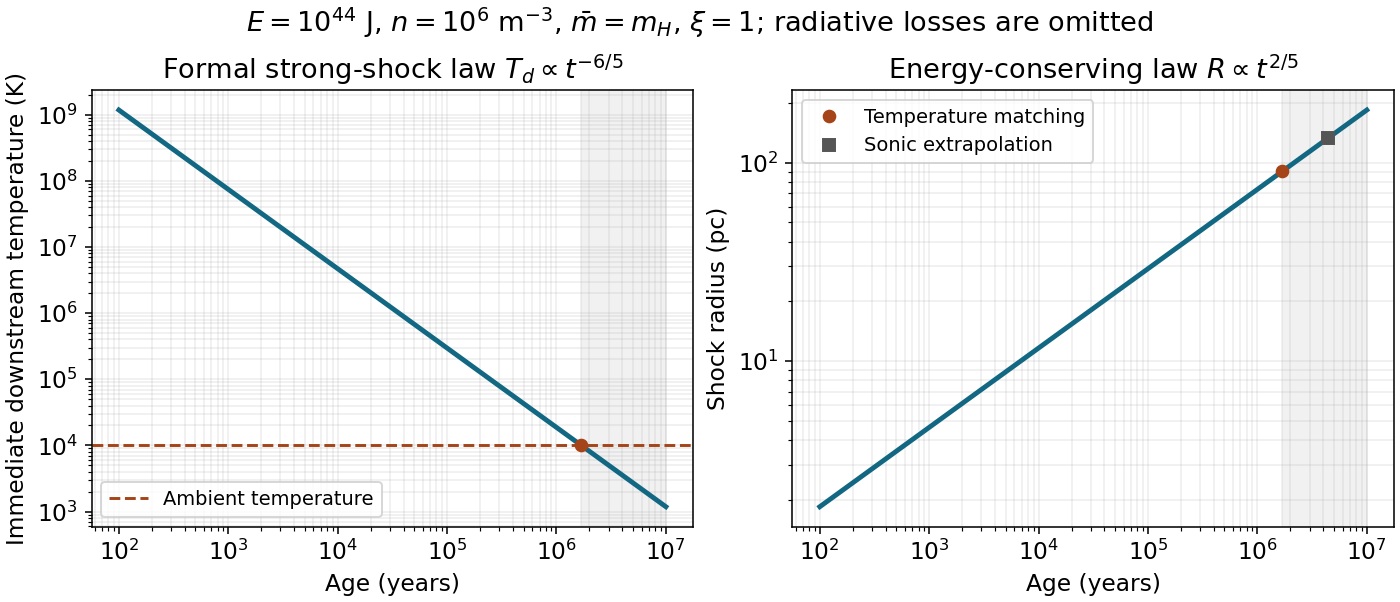
The formal energy-conserving supernova shock temperature and radius, with ambient-temperature and sonic matching distinguished
. Details. 
Articles by others on the same topic
There are currently no matching articles.