Interpret as a constant one-dimensional, isotropic velocity dispersion. The effective pressure is , corresponding to the stated gas-temperature analogy. For , the spherical enclosed mass isThe two sides of the hydrostatic equilibrium equation are thenEquating them fixes the singular isothermal sphere:For collisionless dark matter this is an isotropic Jeans-equation construction, not a claim that the particles thermalize by gas collisions. The central singularity and infinite total mass show that the untruncated profile is an idealization.
Use for the physical projected radius, or impact parameter, in the lens plane. Although the source calls it angular, a physical length is required in the mass and deflection equations; its relation to an angle is . Integrate along physical line-of-sight coordinate :Consequently the projected cylindrical mass inside the image radius isSubstituting a givesIf an angular radius is used instead, write and . The projected mass differs from the spherical mass ; material at three-dimensional radii larger than still projects into the cylinder.
In the weak-field thin-lens limit, circular symmetry makes the physical deflection depend on the projected enclosed mass. With the mass calculated in b,For , this is , orIt is independent of impact radius in this ideal profile.
Enclosed-mass qualification. The source's appeal to Birkhoff's theorem must not be read as permission to use the mass of a three-dimensional sphere of radius here. Deflection accumulates along the light path. A concrete counterexample is a thin spherical shell of radius : its spherical enclosed mass at is zero, but its projected mass is , and it produces a nonzero deflection. The formula above is the axisymmetric projected-mass lens result; it is consistent with b and is not that incorrect spherical-mass interpretation.
Let be the reduced, observed angular displacement between source and image. In the small-angle lens geometry, the physical bending angle is weighted by the lens-to-source and observer-to-source angular diameter distances:In a Euclidean diagram this follows because the transverse displacement at the source plane is , whose observed angle is that displacement divided by . In cosmology the same thin-lens expression uses the corresponding angular diameter distances. For a signed one-dimensional coordinate, the direction is supplied by the image's side of the lens.
The general thin gravitational lens equation is a two-component angular relation,For a spherical lens, image, source and lens centre lie in one plane containing the line of sight. Choose its sky direction as a signed axis. Then can be signed scalars andThey are not fundamentally scalar quantities for a general lens; the reduction uses this symmetry and axis choice. An exactly aligned source requires the full ring geometry, not a unique preferred sky axis.
In general, . For example, in a spatially flat expanding cosmology, comoving radial distances giveThus differs from when the redshifts differ. Ordinary Euclidean addition applies only when the same static physical-distance convention is appropriate.
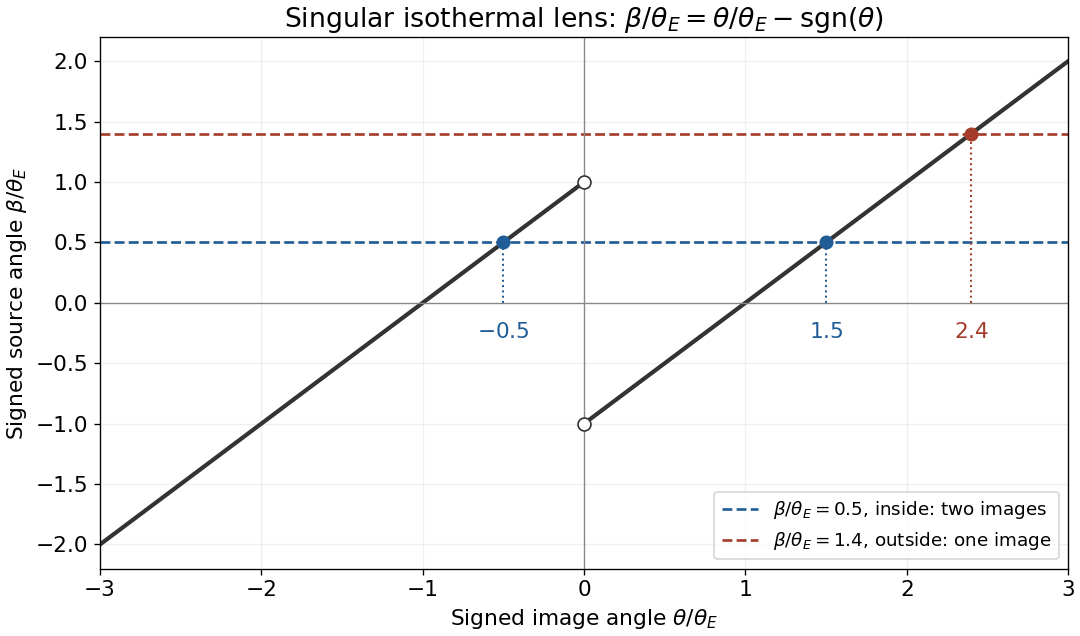
The Einstein angular radius is the image-ring radius of an exactly aligned source. For the singular isothermal sphere lens, set in ii:Choose without loss of generality. The positive branch always gives . A negative-side image would have ; this branch is admissible only when its result is negative. ThereforeAt , symmetry produces an Einstein ring of angular radius . At , the negative branch reaches the singular origin and is not an ordinary additional finite image; the one finite image is at . Reversing the source sign reverses the signed image coordinates, so the multiplicity criterion uses . These features rely on the singular isothermal profile; a smooth finite-density core changes the central-image behaviour.

Articles by others on the same topic
There are currently no matching articles.