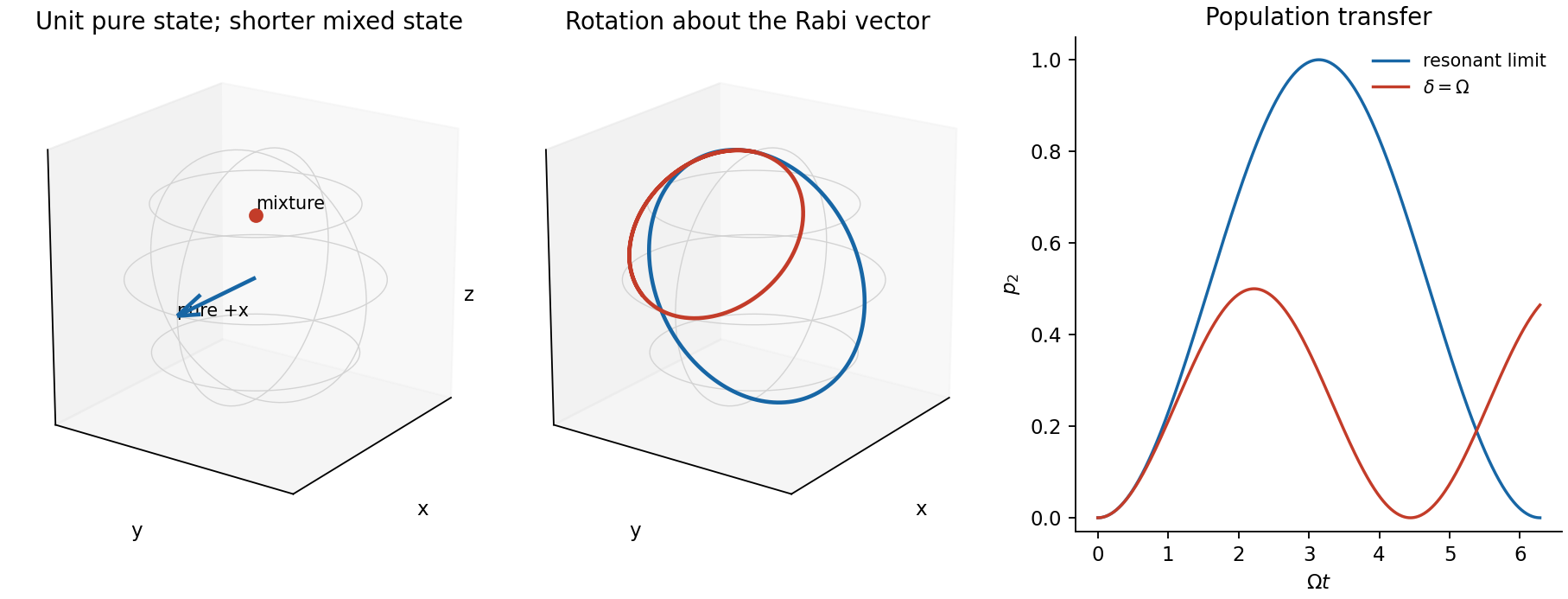
Use the ordered basis and , withA pure quantum superposition has on the Bloch sphere. In contrast, a mixed state has , inside the sphere for . At equal populations its vector is zero. Equal populations alone therefore do not distinguish a coherent superposition from a mixture; their off-diagonal density matrix elements differ.
Choose the drive phase so the rotating-frame Hamiltonian is , where as specified. The Rabi vector is the angular-velocity vectorHere is the on-resonance population oscillation angular frequency, not the unhalved coefficient of a cosine coupling. From , rotation about at givesFor , the rotation axis is nearly transverse, the trajectory nearly a great circle, and transfer is almost complete. For , the axis bisects and , the orbit lies in , and never exceeds . Each member remains a pure state in this coherent evolution.
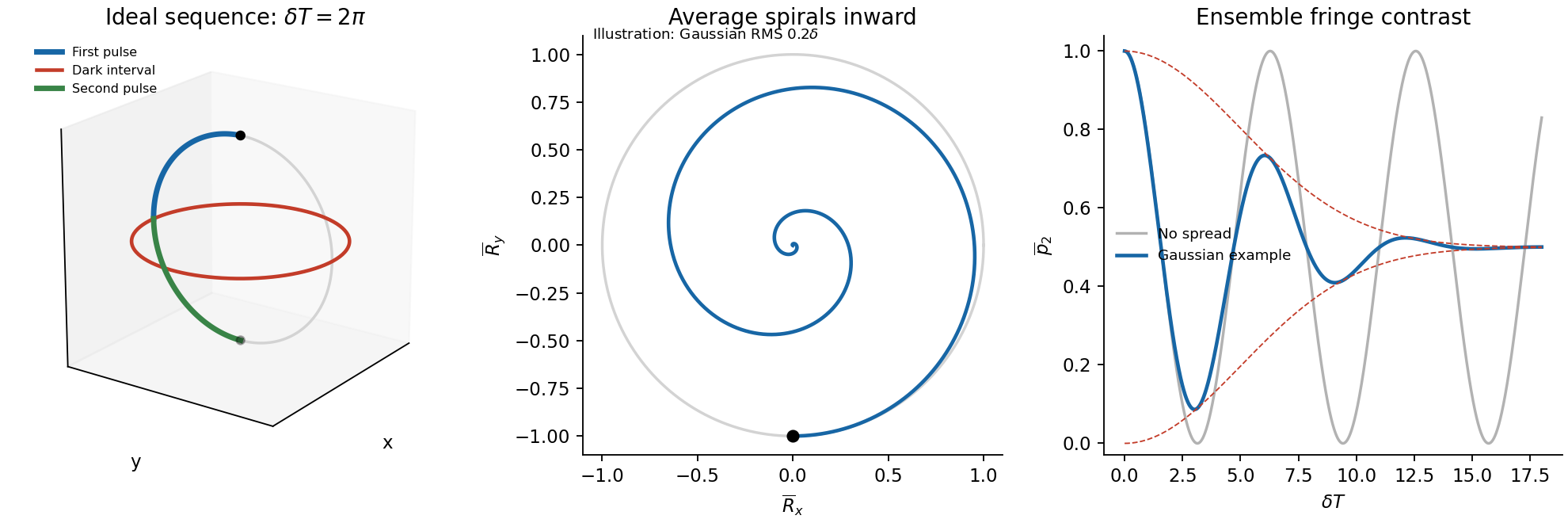
For the Ramsey free interval, let atom have detuning . Instantaneous ideal pulses give the Ramsey ensemble coherence factor . Averaging the free-evolution vector obtained in step (ii) givesDifferent atoms fan out around the equator, shortening the ensemble Bloch vector even though every individual's vector remains unit length. A broad smooth detuning distribution usually makes the average spiral towards the centre and damps the Ramsey fringes towards . The dephasing time is of order . inhomogeneous ensemble dephasing is not necessarily irreversible decoherence of individual atoms; an appropriate spin echo can rephase static frequency offsets.
The given spread does not specify a probability distribution or whether it denotes an RMS width. An exact envelope is therefore not determined. The figure illustrates, rather than infers, a Gaussian distribution with RMS , for which . A uniform distribution would instead give a sinc envelope and side lobes. Both have the same qualitative initial loss of contrast on the quoted inverse-spread scale.
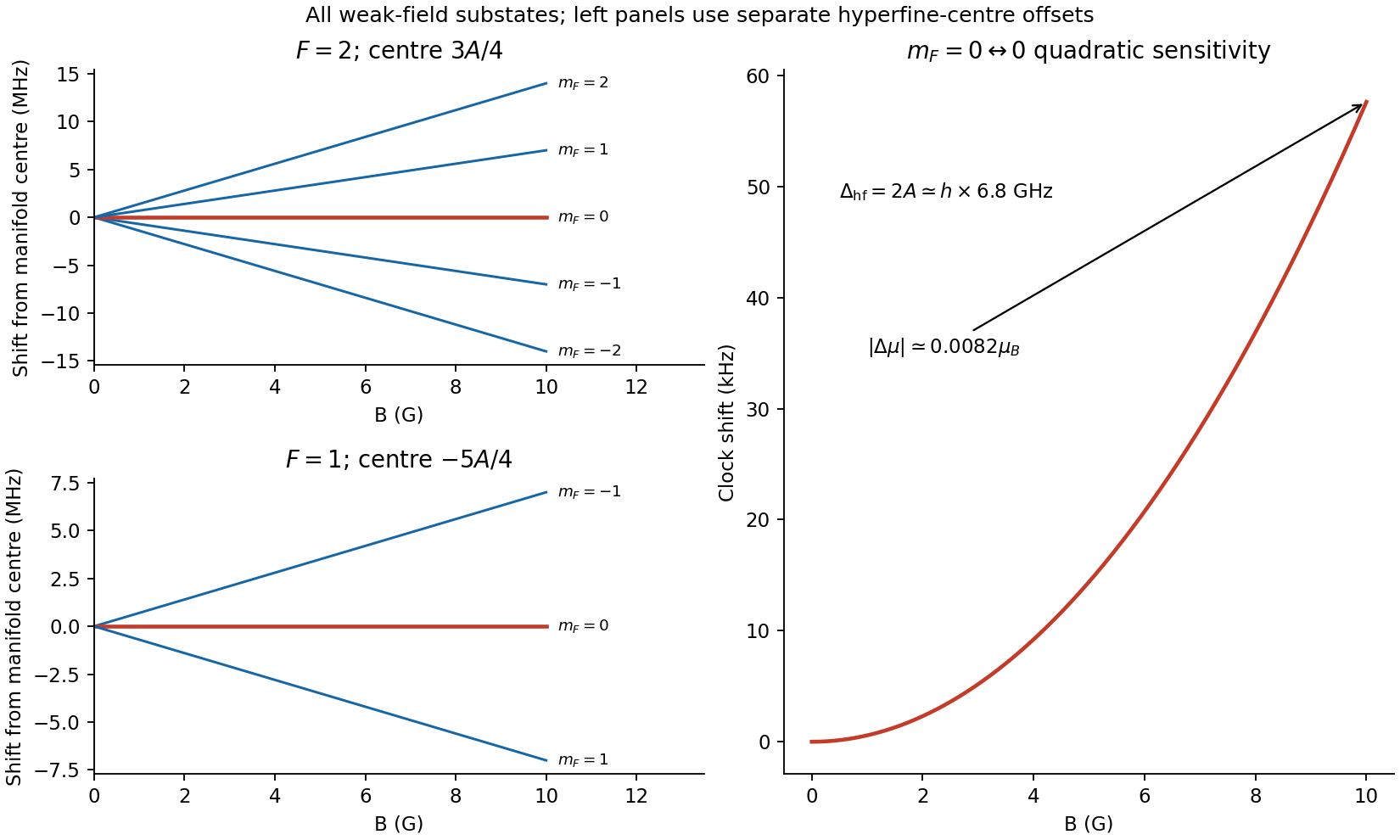
In the rubidium-87 ground-state hyperfine structure, and , so . Taking givesThe zero-field splitting is . Ignoring the small nuclear magnetic term, the weak-field Landé g-factors are and . The diagram labels all three and five substates, with linear shifts .
The pair and is connected by a magnetic dipole transition with , , driven with its oscillating magnetic component along the quantization axis. Both first-order shifts vanish, giving the rubidium-87 clock transition first-order insensitivity near zero field. Its insensitivity does not imply absence of quadratic shifts.
For these two levels the Breit-Rabi formula gives the quadratic Zeeman shift of a clock transition:where the last expression neglects the nuclear term and sets . HenceThis uses and the supplied . With physical moments defined by , the differential magnetic moment is . If effective magnetic moment denotes the positive energy slope instead, that slope difference is positive. The magnitude and physical frequency sensitivity are the same. Retaining the full atomic factors gives the familiar quadratic clock-frequency coefficient about ; the simplified supplied parameters give about .[ref]
Rubidium 87 D Line Data by Daniel A. Steck. §3, equations (26)–(29); table of magnetic factors and clock-transition quadratic shift


Use a far-detuned optical dipole trap, such as a red-detuned focused-beam trap, to confine both clock states. Their first-order magnetic moments vanish; their residual quadratic magnetic slopes are opposite, so a simple static magnetic-field minimum does not confine both in the same way. An optical potential acts through the electronic polarizability and can trap both ground hyperfine states. It is not perfectly state independent: differential AC Stark shifts, intensity noise and residual magnetic gradients still need control during Ramsey evolution.
During a short pulse, detuning is negligible relative to . Rotation through angle about takes the initial north-pole Bloch vector toThe corresponding state is , since . The phase of this equatorial superposition is defined relative to the oscillator that will supply the second pulse.
With the coupling off, . Precession during the dark interval givesThe populations remain during the dark interval; only their relative phase changes. For , the vector makes one complete equatorial circuit and returns to .
The second pulse has the same phase and area as the first, so another rotation by givesAt , the final vector is the south pole and all population is in . The complete path consists of a north-to-equator quarter turn, a full equatorial loop, and an equator-to-south quarter turn. At the pulses instead return the population to . Finite-pulse detuning corrections are small in ; the result is the stated short-pulse Ramsey limit.
Articles by others on the same topic
There are currently no matching articles.