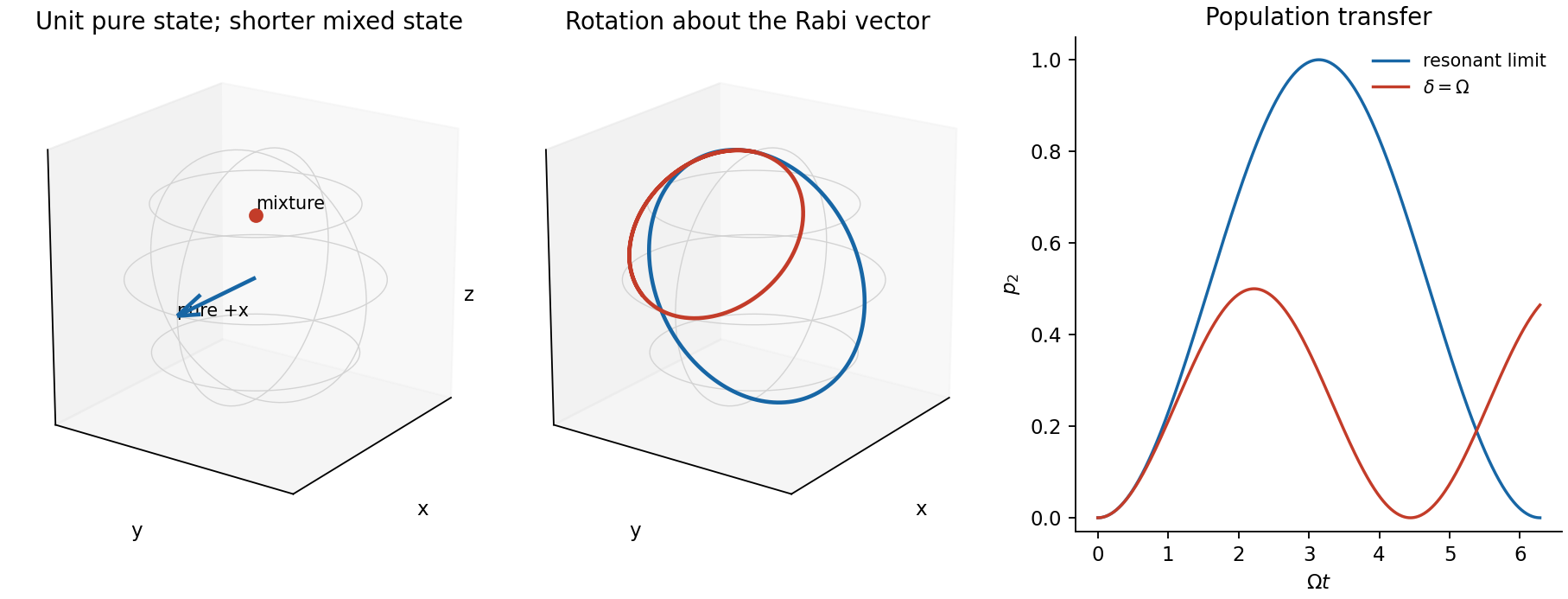
Use the ordered basis and , withA pure quantum superposition has on the Bloch sphere. In contrast, a mixed state has , inside the sphere for . At equal populations its vector is zero. Equal populations alone therefore do not distinguish a coherent superposition from a mixture; their off-diagonal density matrix elements differ.
Choose the drive phase so the rotating-frame Hamiltonian is , where as specified. The Rabi vector is the angular-velocity vectorHere is the on-resonance population oscillation angular frequency, not the unhalved coefficient of a cosine coupling. From , rotation about at givesFor , the rotation axis is nearly transverse, the trajectory nearly a great circle, and transfer is almost complete. For , the axis bisects and , the orbit lies in , and never exceeds . Each member remains a pure state in this coherent evolution.
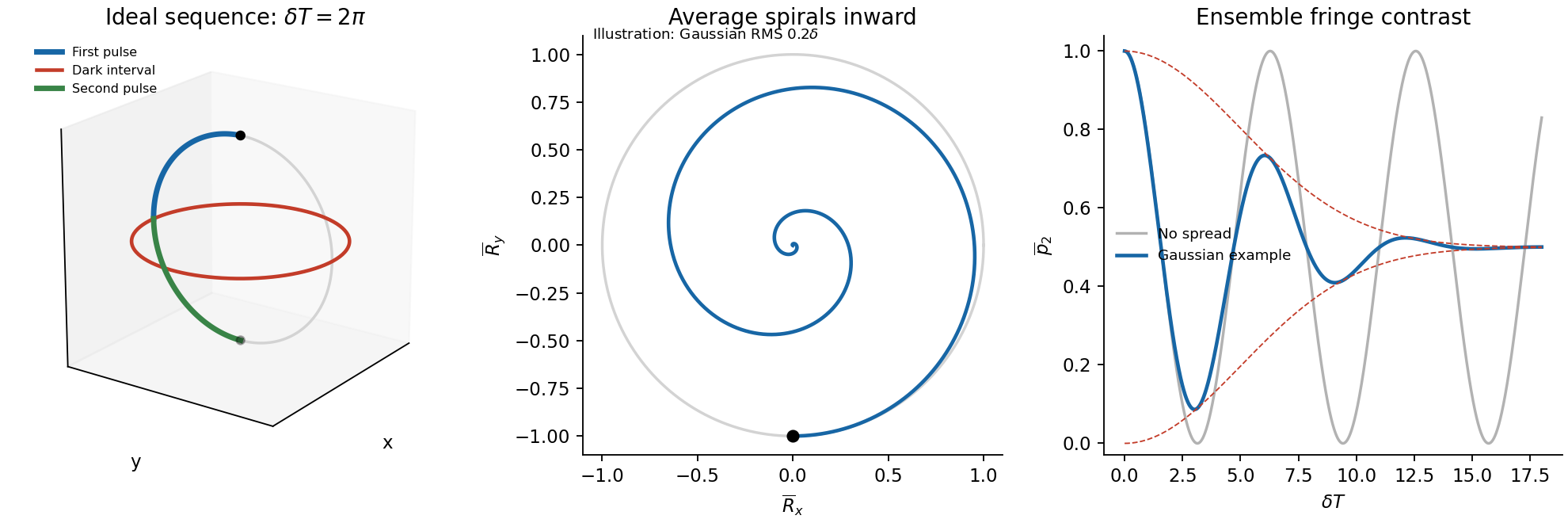
For the Ramsey free interval, let atom have detuning . Instantaneous ideal pulses give the Ramsey ensemble coherence factor . Averaging the free-evolution vector obtained in step (ii) givesDifferent atoms fan out around the equator, shortening the ensemble Bloch vector even though every individual's vector remains unit length. A broad smooth detuning distribution usually makes the average spiral towards the centre and damps the Ramsey fringes towards . The dephasing time is of order . inhomogeneous ensemble dephasing is not necessarily irreversible decoherence of individual atoms; an appropriate spin echo can rephase static frequency offsets.
The given spread does not specify a probability distribution or whether it denotes an RMS width. An exact envelope is therefore not determined. The figure illustrates, rather than infers, a Gaussian distribution with RMS , for which . A uniform distribution would instead give a sinc envelope and side lobes. Both have the same qualitative initial loss of contrast on the quoted inverse-spread scale.
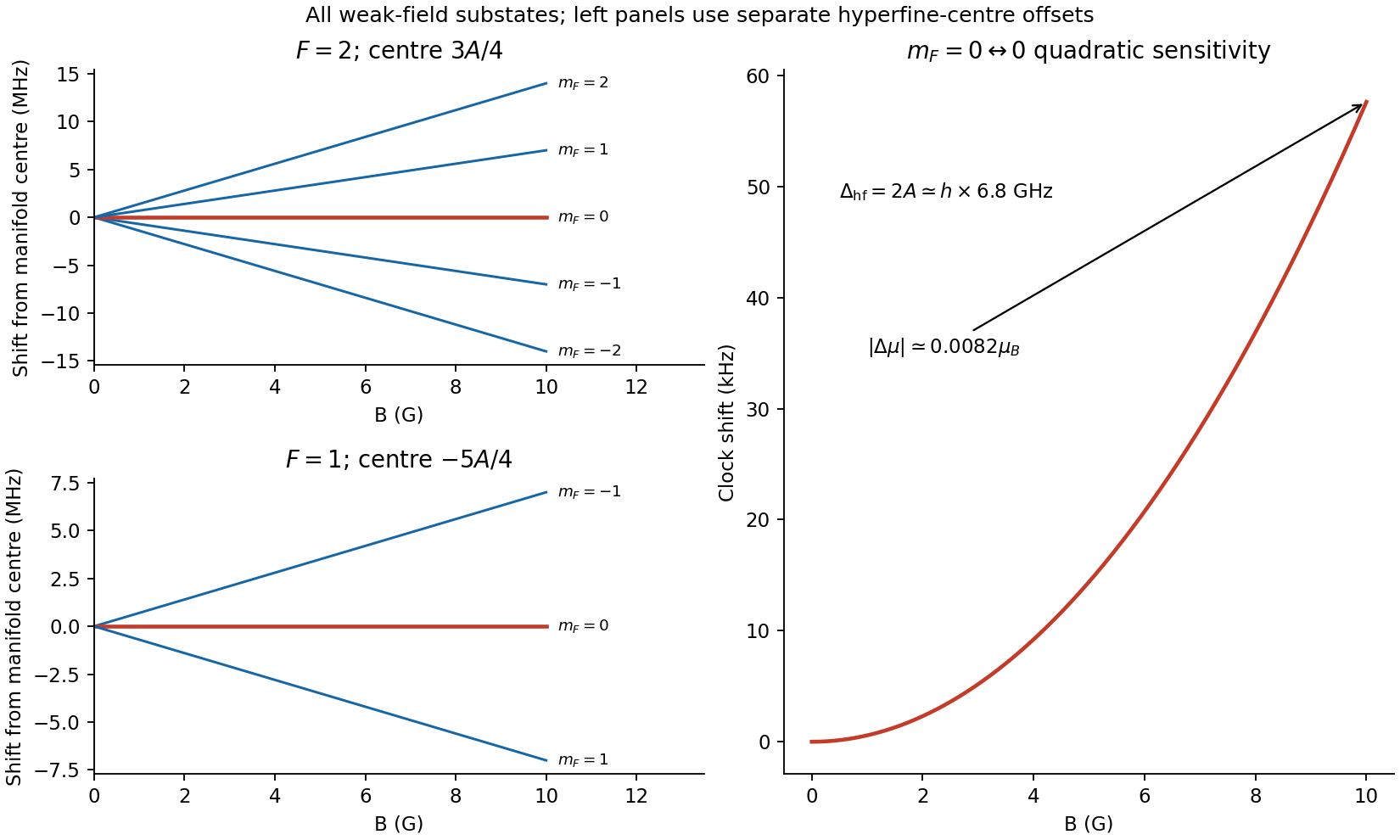
In the rubidium-87 ground-state hyperfine structure, and , so . Taking givesThe zero-field splitting is . Ignoring the small nuclear magnetic term, the weak-field Landé g-factors are and . The diagram labels all three and five substates, with linear shifts .
The pair and is connected by a magnetic dipole transition with , , driven with its oscillating magnetic component along the quantization axis. Both first-order shifts vanish, giving the rubidium-87 clock transition first-order insensitivity near zero field. Its insensitivity does not imply absence of quadratic shifts.
For these two levels the Breit-Rabi formula gives the quadratic Zeeman shift of a clock transition:where the last expression neglects the nuclear term and sets . HenceThis uses and the supplied . With physical moments defined by , the differential magnetic moment is . If effective magnetic moment denotes the positive energy slope instead, that slope difference is positive. The magnitude and physical frequency sensitivity are the same. Retaining the full atomic factors gives the familiar quadratic clock-frequency coefficient about ; the simplified supplied parameters give about .[ref]
Rubidium 87 D Line Data by Daniel A. Steck. §3, equations (26)–(29); table of magnetic factors and clock-transition quadratic shift
Use a far-detuned optical dipole trap, such as a red-detuned focused-beam trap, to confine both clock states. Their first-order magnetic moments vanish; their residual quadratic magnetic slopes are opposite, so a simple static magnetic-field minimum does not confine both in the same way. An optical potential acts through the electronic polarizability and can trap both ground hyperfine states. It is not perfectly state independent: differential AC Stark shifts, intensity noise and residual magnetic gradients still need control during Ramsey evolution.
During a short pulse, detuning is negligible relative to . Rotation through angle about takes the initial north-pole Bloch vector toThe corresponding state is , since . The phase of this equatorial superposition is defined relative to the oscillator that will supply the second pulse.
With the coupling off, . Precession during the dark interval givesThe populations remain during the dark interval; only their relative phase changes. For , the vector makes one complete equatorial circuit and returns to .
The second pulse has the same phase and area as the first, so another rotation by givesAt , the final vector is the south pole and all population is in . The complete path consists of a north-to-equator quarter turn, a full equatorial loop, and an equator-to-south quarter turn. At the pulses instead return the population to . Finite-pulse detuning corrections are small in ; the result is the stated short-pulse Ramsey limit.
Interpret the box as a hard-wall cube. Its one-particle levels are for positive integers, giving . Counting lattice points in a positive octant and differentiating the large-radius count gives the supplied continuum density of states. Expressing its prefactor through yieldsHere denotes the dimensionless constant requested in this question, to distinguish it from the unrelated hyperfine constant of question 1. Periodic boundary conditions would have zero ground energy and would not permit this parametrization by a nonzero .
Separate the ground-state occupation from excited particles. The finite-box ground-energy convention in Bose condensation makes the chemical potential approach the ground energy from below as that occupation becomes macroscopic. In the thermodynamic continuum approximation one shifts the energy zero to the ground state and sets the limiting chemical potential to zero in the excited-state integral. The difference between the exact shifted density and its bulk form gives finite-size corrections; at the transition . ThusThe identity follows by expanding and integrating each term. The excited states have a finite saturation capacity. Setting that capacity equal to determines condensation:Equivalently , with .
At fixed , below the chemical potential is pinned to its limiting value andAbove , and there is no macroscopic ; the chemical potential adjusts rather than allowing the saturation expression to exceed the available particles. At fixed , put . For , and is not macroscopic; for , saturates while grows linearly. This is particle saturation in a homogeneous Bose gas; the sharp threshold is a thermodynamic-limit approximation to finite-box occupations.
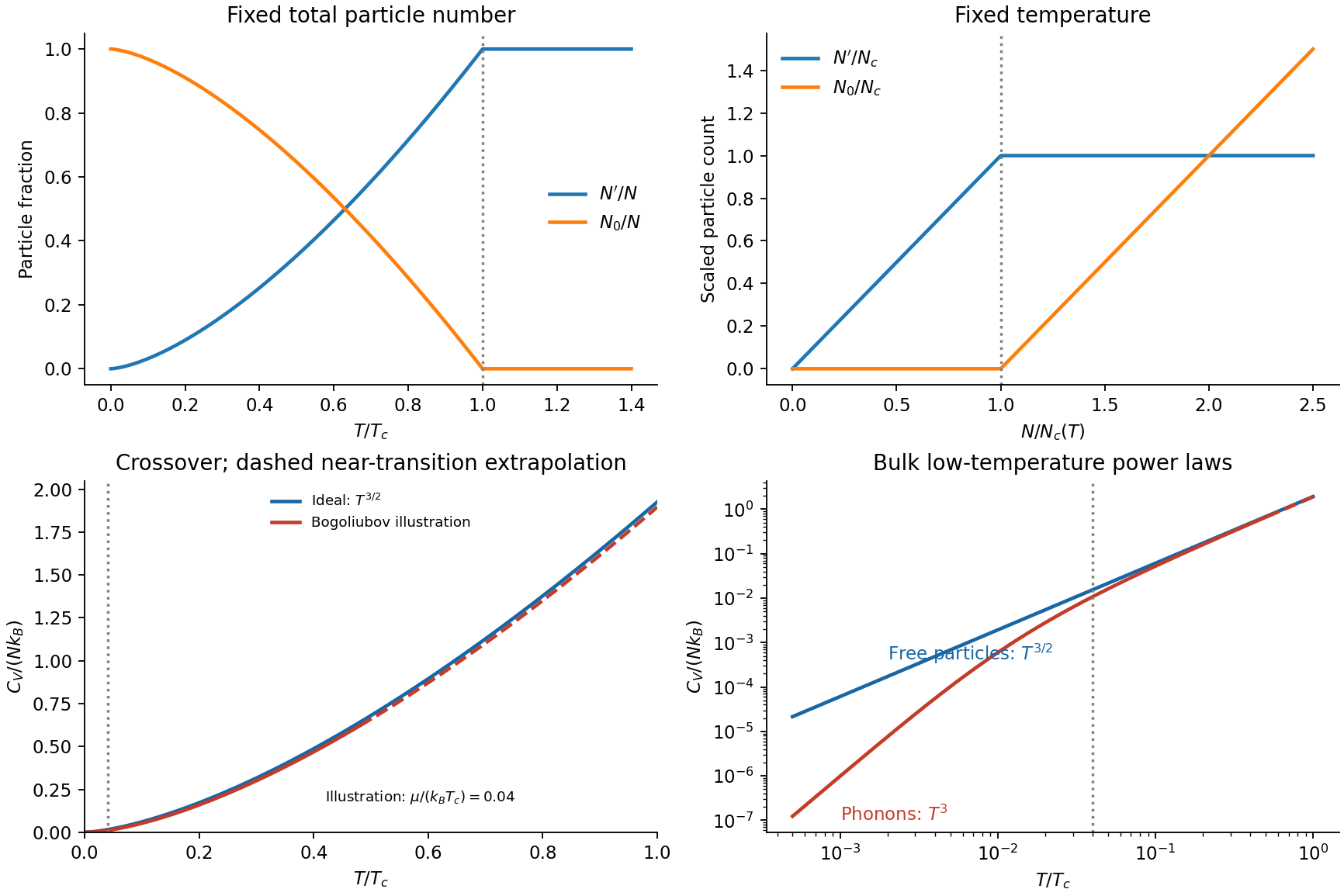
Ideal-box particle saturation and the heat-capacity crossover from phonons to particle-like excitations
. Details. The interaction scale compares differently with confinement and transition energies:Thus the stated range makes interactions dominate the ground-state confinement energy while remaining small on the thermal scale controlling . This is an interaction-dominated ground state with nearly ideal condensation temperature. It also gives the dilute-gas parameter . A contact model has and ; the question's suppresses order-one factors, and the uniform ground energy per particle is , rather than exactly . Weak interactions can shift slightly, but their dimensionless strength makes that a small relative effect. In a hard-wall box, boundary healing layers do not overturn bulk interaction dominance when their thickness is small compared with .
At , thermally occupied Bogoliubov modes have , with . There is one acoustic branch for this spinless gas. Its thermal energy determines the phonon heat capacity of a dilute Bose gas:The zero-temperature interaction energy does not itself contribute to this leading temperature derivative at fixed . This bulk power law also requires so that the phonon spectrum may be treated as continuous; a strictly finite box eventually has discrete-level activated behaviour.
For the noninteracting condensed Bose gas, the ideal Bose-gas heat capacity below condensation follows by integrating :Its limiting value at is about . At very low temperature the interacting phonon curve is suppressed relative to the ideal curve, has slope three on logarithmic axes, and crosses over towards particle-like behaviour around . Since , most of the interval below is approximately ideal at leading weak-coupling order. The figure marks a qualitative extrapolation near the transition: a zero-temperature Bogoliubov spectrum does not determine precise interacting critical heat capacity or its small transition shift. The illustrative fixed- interpolation is not claimed as a controlled critical-region calculation.
In the ideal point-nucleus Dirac-Coulomb problem, hydrogen levels depend on and , so and are degenerate despite their different orbital angular momenta. The Lamb shift removes this degeneracy: the level lies about above , an energy of roughly . This is distinct from the much larger fine-structure splitting.
quantum electrodynamics changes the electron's interaction with the Coulomb field. electron self-energy and vacuum polarization give state-dependent radiative corrections; a complete prediction also keeps specified recoil and nuclear-size contributions. An wave samples the nucleus differently from a wave, so equal no longer ensures equal energy. A leading-log estimate for an radiative contribution scales as , with a numerical prefactor and further state-dependent terms. This is a scale estimate, not a replacement for renormalized bound-state QED. The measurable shift is a difference relative to a specified reference Hamiltonian, rather than an unregulated absolute vacuum energy.[ref]
Theory of the Lamb shift in hydrogen and light hydrogen-like ions by Vladimir Yerokhin and others. §II, definition of level contributions relative to the point-nucleus Dirac value and bound-state QED expansion
The original microwave experiment used a tungsten oven to dissociate hydrogen, an electron beam to populate metastable atoms, and electron ejection from a metal target to measure surviving metastable atoms. Microwaves transferred population to rapidly decaying , reducing detector current. At a fixed microwave frequency, interruption of the radiation and a scan of static magnetic field revealed Zeeman-tuned resonances. Comparing resonance locations with the Dirac-level prediction showed the level shifted upward. Field calibration and homogeneity, excessive microwave intensity, unresolved hyperfine structure and stray-electric-field quenching limit the measurement; the signal is not direct absorption by a large equilibrium excited population.[ref]
Fine Structure of the Hydrogen Atom by a Microwave Method by Willis Eugene Lamb Jr. and Robert Curtis Retherford. pp. 241–243, apparatus, Fig. 1 caption and resonance-field comparison
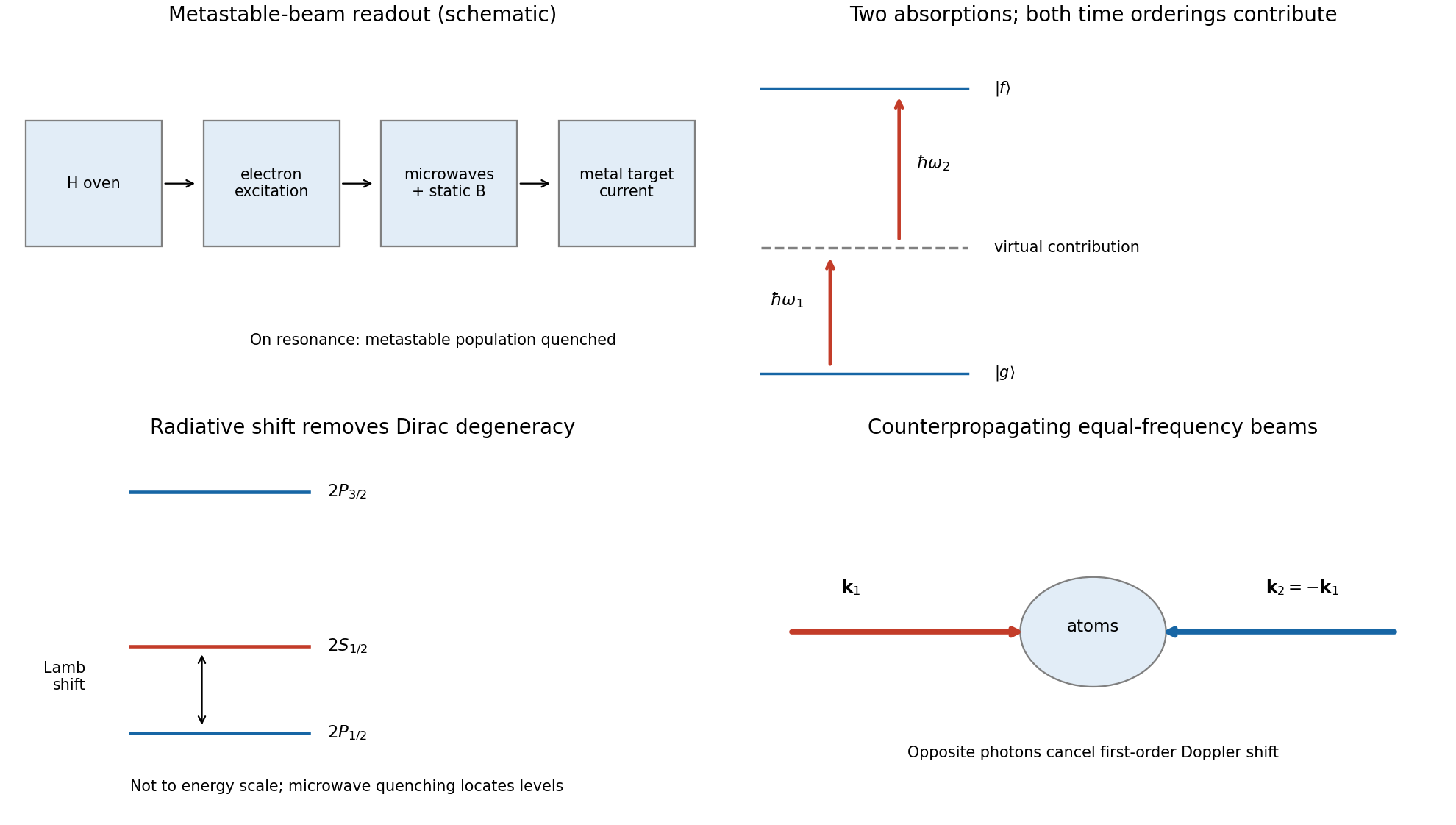
A two-photon transition is a second-order atom-field process. For two-photon absorption, energy conservation requires . A virtual intermediate state in two-photon absorption need not be populated as a real stationary state. In the electric dipole approximation, the two time orderings give an amplitude proportional toThe electric-field amplitudes multiply this expression. Far from intermediate resonance, the denominators are large relative to linewidths and one-photon couplings, keeping real intermediate occupation small. Near an intermediate resonance, sequential absorption, linewidths and saturation require a fuller treatment. For weak unsaturated absorption the rate scales as , or when both photons come from one field. Absorption followed by stimulated emission instead gives a difference-frequency Raman transition; it is not two-photon absorption at the sum frequency.
Two electric dipole interactions change parity twice, so initial and final states have the same parity. For a one-electron orbital, the usual changes are , subject to angular-momentum and polarization constraints. For identical equal-frequency photons, exchange symmetry removes the antisymmetric rank-one tensor: ranks zero and two survive. Thus is possible, whereas is forbidden in this degenerate electric-dipole approximation. It would be too strong to prohibit every transition between nonzero angular momenta, since a rank-two tensor can connect some such pairs. Spin remains unchanged to leading electric-dipole order.
A central example is hydrogen , forbidden as a one-photon electric dipole transition but accessible with two photons near . Absorption of one photon from each of equal-frequency counterpropagating beams makes the first-order Doppler shift vanish and suppresses net recoil. The two same-direction absorption paths can still give a broad Doppler background. A primary demonstration used a frequency-doubled pulsed dye laser near this wavelength and compared with a simultaneously recorded Balmer reference.[ref]
Doppler-Free Two-Photon Spectroscopy of Hydrogen by Theodor W. Hänsch and others. Phys. Rev. Lett. 34, 307 (1975), abstract: 2430-angstrom source and simultaneous Balmer-beta reference
Experimentally, scan the sum frequency and detect the excited state, its subsequent fluorescence or its ionization. Counterpropagating and single-beam spectra distinguish the narrow Doppler-free contribution from its background. Varying intensity tests weak-field scaling and extrapolates AC Stark shifts and power broadening; frequency calibration, beam overlap, residual angle and second-order Doppler shifts still matter. “Doppler free” here cancels the leading velocity term, not every systematic shift.
Two complementary signatures are suppressed low-speed dissipation and quantized circulation. Condensation alone establishes macroscopic occupation, not all of these flow properties. In a uniform weakly interacting condensate, the Landau criterion givesfor the Bogoliubov spectrum. Creating an excitation in a flow changes energy by ; a negative value allows energy transfer. Boundaries and vortex nucleation can make an actual measured threshold lower than this ideal bulk sound speed.
In the moving-obstacle test of atomic superfluidity, a blue-detuned focused laser repelled atoms in a sodium condensate and was scanned at different speeds. After a fixed exposure, time-of-flight absorption imaging measured the reduction of condensate fraction as a heating indicator. Low-speed heating was small, with a pronounced onset near , below the peak-density sound speed near . A stationary-beam control showed no heating; above-transition clouds constrained heating through the noncondensed fraction. Changing scan frequency and amplitude at common obstacle velocity helped separate a flow threshold from a particular trap resonance. Density inhomogeneity, obstacle geometry and vortex nucleation limit identification of the observed onset with a unique homogeneous Landau velocity.[ref]
Evidence for a Critical Velocity in a Bose-Einstein Condensed Gas by C. Raman and others. pp. 2502–2504, Figs. 1–3, stationary-beam and above-transition controls
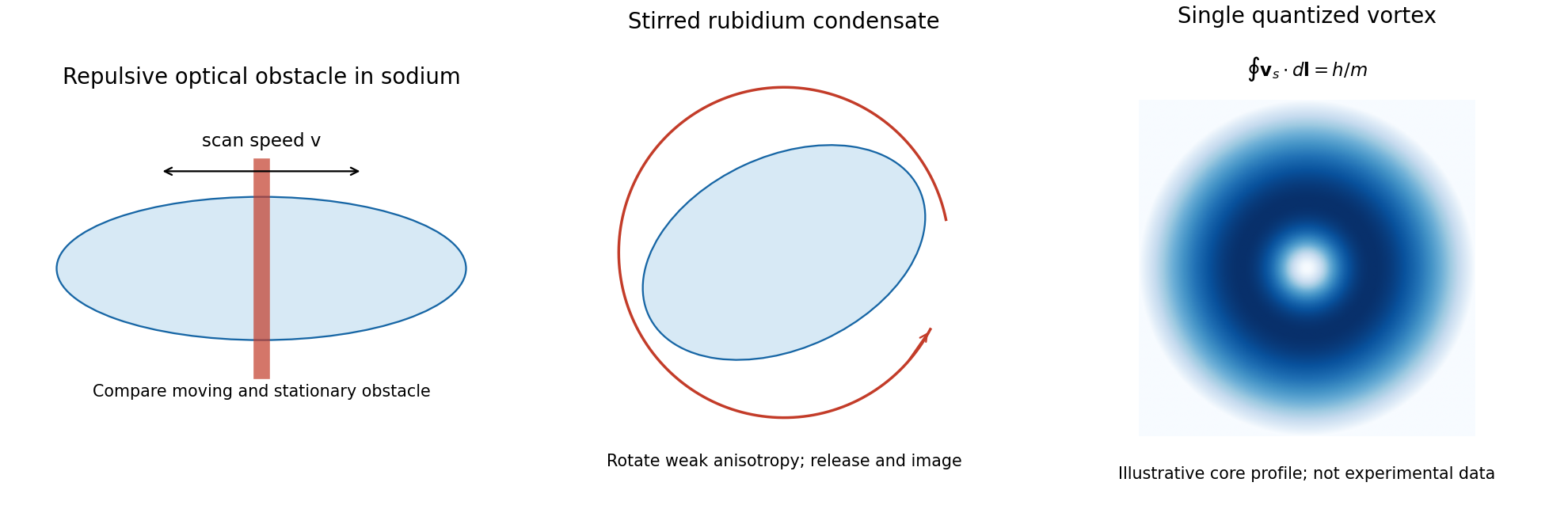


A second experiment stirred rubidium-87 in a magnetic trap by rotating a small transverse anisotropy generated with a far-detuned attractive laser. After stirring, the cloud expanded for and absorption imaging along the rotation axis revealed vortex cores. Below a threshold no cores appeared; faster rotation produced one or several. Ramping the stirrer down before release reduced additional excitation, and waiting after removing it tested vortex survival. Beam-centre stability and residual trap anisotropy are important controls; an isolated density dip without the rotation and persistence evidence would be less conclusive. This stirred-condensate vortex experiment is a response to rotation, distinct from merely imaging the appearance of a condensate.[ref]
Vortex Formation in a Stirred Bose-Einstein Condensate by K. W. Madison and others. preprint pp. 1–3, rotating dipole anisotropy, time-of-flight imaging and single-vortex lifetime
The superfluid velocity is . A closed loop avoiding a core must return a single-valued order parameter, soA singly quantized vortex therefore has phase winding and circulation , with depleted density in a core of order the healing length. This quantized rotational response differs from ordinary rigid-body flow. The experiment supports that interpretation through controlled stirring and vortex formation; imaging cores alone does not independently measure every phase winding or an absolute zero dissipative rate.
Articles by others on the same topic
There are currently no matching articles.