Maturation best explains major changes in Golgi cisternal identity and early-to-late endosomal progression, but neither pathway is a conveyor belt with no stable domains or transport carriers. The useful comparison concerns what persists—membrane, cargo or resident machinery—and what the experiments actually follow.
In a stable-compartment model, each compartment retains its processing identity while cargo moves onward in vesicles or tubules. In cisternal maturation, cargo can remain within a cisterna while its resident enzymes and trafficking machinery change, turning an early cisterna into a later one. This requires selective recycling of resident machinery in the opposite direction. Both models therefore depend on membrane trafficking; observing vesicles alone does not distinguish them. A static image of separate cis and trans markers is likewise compatible with a population of maturing cisternae.
A decisive experiment follows an individual structure over time using early and late resident markers. In budding yeast, live imaging showed initially early-marker-positive Golgi cisternae losing that marker and acquiring a late marker. This is strong evidence for changing cisternal identity within the tracked object.[ref]
Golgi maturation visualized in living yeast by Eugene Losev and others. Live imaging of early-to-late resident-marker replacement
A complementary experiment follows synchronized cargo together with residents. Cargo retention while residents are replaced favours maturation; cargo movement between objects whose residents remain stable favours transfer between persistent processing domains.Large cargo makes a strong mechanistic test. A long procollagen assembly cannot simply be assumed to enter a small conventional coated vesicle. Maturation can move such cargo through the stack without packaging it into small forward carriers at every step. However, cargo size does not by itself prove that every soluble cargo uses the same route. Tubular connections, larger carriers and rapid exchange of small cargo can coexist with maturation. The geometry and spatial resolution of stacked mammalian Golgi also differ from those of dispersed yeast cisternae, so one should not transfer every kinetic detail between systems without testing it.
For the Golgi, the strongest synthesis is therefore a dynamic population of processing compartments with changing identity, coupled to resident recycling and cargo-dependent transport. COPI and other retrieval pathways can maintain enzyme gradients while COPII supplies new material from the endoplasmic reticulum. A named cis, medial or trans region can persist statistically even when its component membranes and proteins do not. Bulk transport, rapid cargo exchange and local stable zones need not be mutually exclusive.
The endocytic pathway poses a related but distinct problem. An early endosome receives material from the surface and separates recycling cargo from cargo retained for degradation. A strictly stable early-endosome model predicts that degradative material must leave in carriers while early identity persists. A maturation model predicts that a cargo-bearing domain changes into a late endosome, alongside removal of material that should recycle.
Time-resolved Rab5 and Rab7 measurements demonstrated replacement of an early Rab machinery by a late one on cargo-bearing endosomes. This Rab conversion provides direct evidence for maturation rather than inferring it solely from differently labeled endpoint compartments.[ref]
Rab Conversion as a Mechanism of Progression from Early to Late Endosomes by Jochen Rink and others. Rab5 loss and Rab7 acquisition on progressing endosomes
The associated changes in lipids, acidity, motility, fusion machinery and internal membrane organization make this a functional transition, rather than a marker swap alone.Yet recycling domains can bud or tubulate from a maturing endosome. Some cargos return to the plasma membrane; others use retromer-associated retrieval routes; still others enter intralumenal vesicles and continue toward lysosomes. A maturing degradative region can therefore coexist with relatively persistent sorting activities elsewhere in the same network. Endosome fusion and fission also mean that an object tracked by microscopy may exchange membrane extensively.
To discriminate mechanisms, combine live tracking of residents and cargo with pulse-chase kinetics, acute perturbations of retrieval machinery and quantitative membrane accounting. Apparent marker conversion caused by two unresolved objects crossing must be excluded. Conversely, failure to observe conversion at low time resolution is not proof of stability. The evidence favours maturation as a major organizing principle, with selective sorting, retrieval and exchange explaining how cells retain steady trafficking functions while individual compartments change.
Myosins convert a nucleotide-driven actin-binding cycle into movement, force or anchoring. Their different cellular roles arise from variations in motor kinetics, directionality, lever-arm geometry, oligomerization and cargo binding. A class name alone does not specify a universal stepping speed or duty ratio.
A myosin usually contains an actin-binding motor domain with an ATPase active site, a neck associated with light chains, and a tail involved in cargo association or assembly. The myosin lever arm amplifies small motor-domain rearrangements. The tail can connect the motor to a membrane, receptor, organelle or another myosin molecule. Some isoforms are autoinhibited until cargo binding, calcium-dependent regulation or phosphorylation favours an active conformation.
The mechanochemical cycle can be organized around actin affinity. In a strongly bound nucleotide-free state, ATP binding weakens actin attachment and promotes detachment. ATP hydrolysis prepares a detached or weakly bound ADP–phosphate state. Subsequent actin interaction and transitions around phosphate release stabilize strong binding and generate the myosin power stroke. ADP release and the next ATP-binding event complete the cycle. The exact ordering and rates of structural transitions and phosphate release depend on isoform and load; the cycle should not be reduced to a claim that ATP cleavage itself is the instantaneous mechanical stroke.
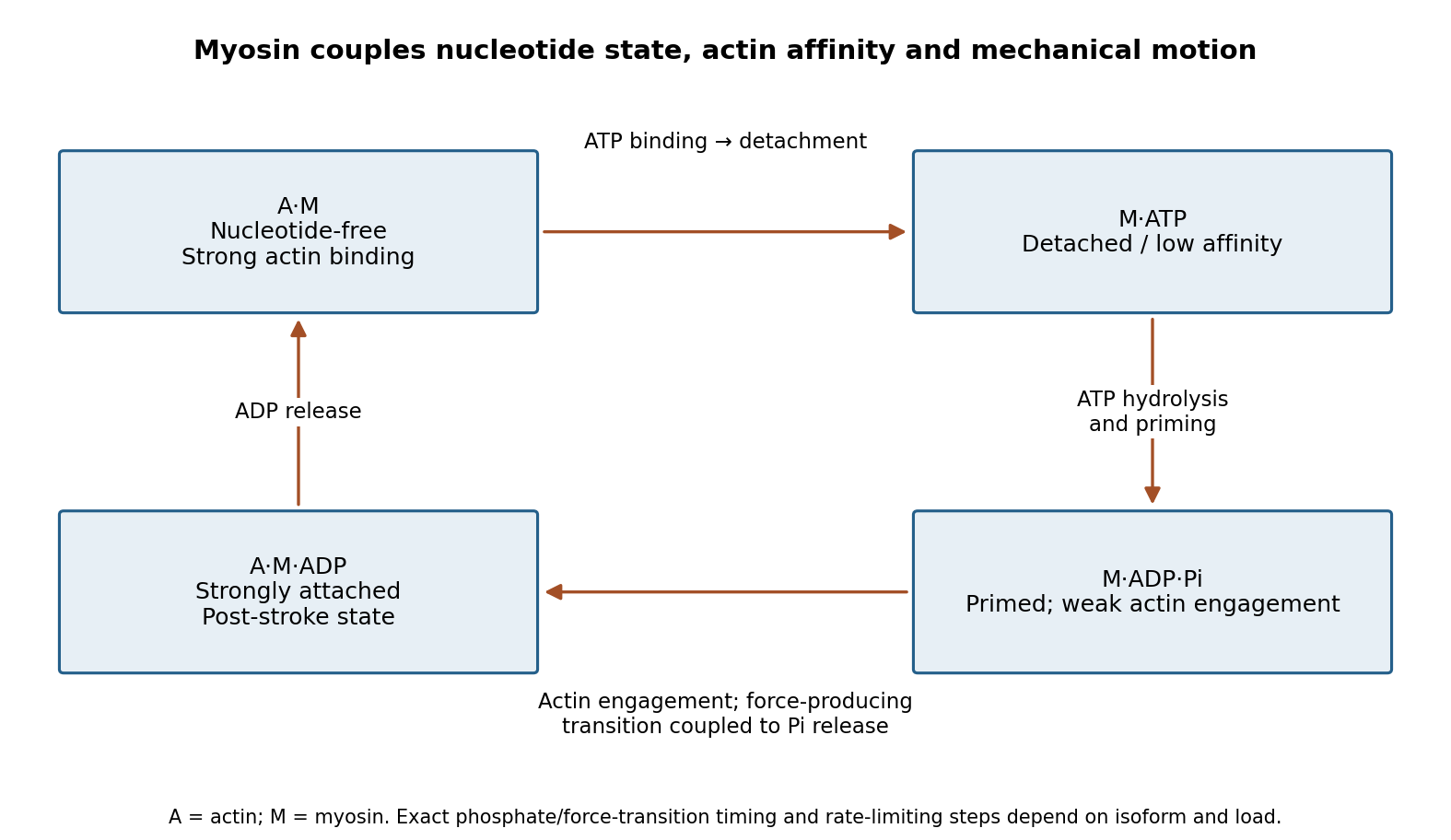
Original myosin actin-affinity and nucleotide cycle, separating ATP binding, hydrolysis and the force-producing transition
. Details. 
Directionality depends on motor geometry and the polarity of actin. Most characterized myosins move toward the barbed end, but Myosin VI moves toward the pointed end. Motor assays established this reversed direction directly, showing that “myosin” does not imply a single transport direction.[ref]
Myosin VI is an actin-based motor that moves backwards by A. L. Wells and others. Directionality assays on polarized actin
In a cortex with complex actin architecture, filament orientation must therefore be known before predicting net cargo movement.The myosin duty ratio is the fraction of a cycle spent strongly bound. A single low-duty motor repeatedly loses its track, whereas an assembly of many such motors can maintain collective contact. Myosin II illustrates this strategy: bipolar filaments bind oppositely oriented actin arrays and generate sliding or tension. In muscle, ordered filament geometry converts sliding into contraction. In nonmuscle cells, related contractile networks contribute to the division furrow, junction remodeling, migration and cortical tension. If the network is anchored, the same sliding mechanism can produce an approximately isometric force rather than large displacement.
Cargo transport poses a different requirement. Dimeric Myosin V motors coordinate their heads so that one remains attached while the other advances. A high-duty coordinated cycle supports myosin processivity, enabling repeated steps before dissociation. Single-fluorophore localization followed one labeled head moving by roughly twice the centre-of-mass step, supporting alternating hand-over-hand motion rather than equal short advances of both heads.[ref]
Myosin V Walks Hand-Over-Hand: Single Fluorophore Imaging with 1.5-nm Localization by Ahmet Yildiz and others. Single-head localization distinguishing walking mechanisms
The approximate 36 nm centre-of-mass repeat reflects the actin track and motor geometry; it is not a step size shared by all myosins.Transport and tension holding overlap. Load can slow nucleotide release and prolong strong binding, allowing some motors to act as dynamic anchors. Myosin VI can participate in endocytic membrane organization or cargo movement, depending on its partners and assembly state. Class-I myosins couple membranes to cortical actin and can regulate membrane tension and local transport. Specialized myosins organize sensory structures or long-range organelle positioning. These roles depend as much on tail-associated adaptors and local actin arrangement as on the catalytic head.
Regulation matches activity to demand. Light-chain phosphorylation can promote nonmuscle myosin II activation and filament assembly. Calcium-sensitive light chains, including calmodulin in appropriate classes, alter motor regulation or lever-arm organization. Cargo-associated adaptors can relieve autoinhibition and assemble transport complexes. Motor number, opposing loads, actin turnover and competition with other transport systems further determine the outcome.
Useful experiments separate these contributions. Actin-gliding assays establish direction and movement, single-molecule tracking measures stepping and run length, and force measurements reveal load-dependent kinetics. ATPase assays alone establish chemical turnover but not productive movement. In cells, rescue with a motor-defective or cargo-binding-defective protein can distinguish catalytic force production from a structural scaffolding role. The unifying mechanism is a coordinated affinity-and-conformation cycle; the biological output can be motion, sustained tension or controlled coupling of membranes to the cytoskeleton.
The SRP–receptor interaction is a regulated delivery and handover reaction, not merely a binding equilibrium. GTP binding and hydrolysis provide timing, conformational control and recycling so that a hydrophobic nascent chain reaches an available translocon before it aggregates or is released at the wrong place.
The signal recognition particle recognizes an appropriate exposed signal sequence or membrane-spanning segment on a ribosome-associated nascent chain. Its conserved SRP54 subunit contains a signal-binding region and a GTPase domain; bacterial Ffh is the corresponding homolog. The partner GTPase is the SRP receptor alpha subunit in the eukaryotic ER system or FtsY in bacteria. Thus the targeting machinery integrates information from the emerging chain, the ribosome and a membrane-associated receptor. Productive delivery also requires a translocon, not just any membrane surface.
GTP loading permits the two homologous GTPases to assemble into a complex. They then undergo further rearrangements and mutually stimulate their hydrolysis reactions. This is more elaborate than a one-step association of two preformed active surfaces: different nucleotide-bound conformations distinguish cargo capture, membrane delivery, handover competence and termination. Correct cargo and a suitable membrane/translocon environment can alter the kinetics of these transitions. The pathway can therefore respond to whether the chain is appropriate and whether a downstream acceptor is ready.
The timing matters. If hydrolysis occurs too early, SRP and receptor may dissociate before cargo transfer. If dissociation is prevented indefinitely, a stable complex can trap the machinery instead of making another delivery. Efficient targeting consequently requires both a sufficiently long-lived delivery intermediate and a route for its timely disassembly. Experiments with GTPase mutants separated receptor interaction or hydrolysis behaviour from successful cargo unloading, demonstrating that formation of a stable complex is not itself the endpoint of targeting.[ref]
Conformational changes in the GTPase modules of the signal reception particle and its receptor drive initiation of protein translocation by Shu-ou Shan and others. Mutant targeting and translocation assays separating binding from productive handover
This provides a form of kinetic discrimination. A wrong nascent chain can dissociate or fail to progress through a sequence of conformational checkpoints, while an appropriate chain promotes forward passage. Energy-consuming termination and recycling prevent every encounter from being governed solely by the final binding affinity. The logic resembles kinetic proofreading, but one should distinguish a general analogy from a demonstrated proofreading scheme: identifying a particular rejection step requires rates and fluxes, not merely observing GTP consumption. Not every incorrect interaction necessarily consumes the same number of GTP molecules.
A useful comparison is a passive docking model. At equilibrium, strong SRP–receptor affinity would favour occupancy but could impede turnover, and it would not establish that the cargo has been delivered to a conducting channel. In the actual cycle, nucleotide states connect the binding interface to signal-sequence release and receptor recycling. Hydrolysis makes a directional, dissipative cycle possible when cellular nucleotide ratios are maintained. It should not be described as GTP physically pushing the polypeptide through the membrane; translocation and membrane insertion use additional interactions and, depending on the substrate and system, other energy inputs.
A decisive experimental design measures several outputs separately: SRP–receptor association, GTP hydrolysis, transfer of a labeled nascent chain to the translocon, and protection or processing of the resulting product. Compare a nonhydrolyzable nucleotide analog with mutants that alter specific conformational transitions, and control for ribosome binding and membrane integrity. A reagent that stabilizes docking but reduces completed import shows why affinity alone is an inadequate readout. Testing repeated targeting cycles also distinguishes one successful handover from efficient recycling.
The answer is therefore coordination and reliable turnover. Energy expenditure links recognition to an available membrane insertion pathway, controls the lifetime of delivery intermediates, helps reject unproductive encounters and returns the machinery to a reusable state. The strength of this explanation is that it predicts experimentally separable failures—binding without handover, premature release, and stalled recycling—rather than assigning GTP the vague role of supplying energy to an otherwise simple contact.
Articles by others on the same topic
There are currently no matching articles.