An organelle maintains a reproducible molecular and functional organization while continuously replacing its components. Identity is therefore a regulated steady state, rather than a permanent collection of molecules. A useful explanation must connect selective delivery and retrieval to local biochemical reactions, physical boundaries and inheritance.
For a membrane-bounded organelle, the lipid bilayer separates its contents from the cytosol, preserves membrane-protein topology and permits lumenal conditions to differ from the surroundings. A lysosome, for example, requires an acidic lumen and retained hydrolases as well as a membrane. Its vacuolar proton ATPase establishes acidity, while counterion conductance and regulated transport prevent unbounded charge accumulation. An endoplasmic reticulum lumen instead supports protein folding and calcium storage. These environments determine which reactions occur and help stabilize the appropriate resident proteins. A boundary alone is insufficient: an empty vesicle can have the same basic bilayer architecture without the same biological identity.
Membrane composition creates selective recruitment sites. Local phosphoinositide synthesis and dephosphorylation produce membrane domains recognized by particular lipid-binding proteins. Phosphatidylinositol 3-phosphate is associated with early endosomal domains, whereas phosphatidylinositol 4-phosphate contributes to Golgi organization. These distributions reflect localized enzymes and regulated turnover, not an immutable lipid barcode. Other properties—including sterol abundance, bilayer thickness and curvature—can favour some membrane proteins over others. Membrane contact sites and lipid transfer proteins redistribute selected lipids while preserving the separation of the two compartments.
Rab GTPases provide a second layer of recognition. Membrane recruitment and nucleotide exchange generate an active Rab domain; effectors then promote vesicle tethering, motor recruitment and sorting. A Rab and its effectors can reinforce one another's localization. GTP hydrolysis and extraction provide opposing reactions that prevent uncontrolled spread. SNARE proteins, together with tethering factors and the appropriate lipid environment, subsequently favour fusion of compatible membranes. Specificity is combinatorial: neither a Rab nor a SNARE should be treated as a unique address sufficient by itself.
Membrane trafficking would progressively mix organelles without selective retrieval. COPII exports selected cargo from the endoplasmic reticulum, while COPI-dependent and other retrieval pathways return escaped residents and trafficking machinery. Resident proteins can be retained through interactions or retrieved using recognizable sorting information. The Golgi similarly balances forward cargo movement with recycling of processing enzymes. Endosomes sort some receptors back to the surface through recycling carriers while directing other material toward degradation. Such exchange preserves an organelle's characteristic composition without requiring every incoming molecule to remain there.
Identity can also change in an organized sequence. In endosome maturation, a compartment can lose Rab5 and acquire Rab7 while retaining internalized material. Live imaging of this Rab conversion argues that an early identity is actively replaced, rather than the same early compartment retaining an unchanging molecular label forever.[ref]
Rab Conversion as a Mechanism of Progression from Early to Late Endosomes by Jochen Rink and others. Live-cell Rab-marker conversion during cargo progression
A cell maintains distinct early and late populations even though individual compartments pass between them. Thus stable system-level organization and changing individual organelles are compatible.Some compartments use additional rules. Mitochondria and chloroplasts combine organelle protein import, genome expression, membrane growth and division; their identity cannot be reduced to vesicle fusion specificity. Peroxisomes import matrix proteins and receive membrane constituents through their own biogenesis pathways. Organelle positioning, fission and inheritance keep these functions distributed through growth and division, while damage recognition and turnover remove defective components.
Experimentally, one should distinguish causation from marker correlation. Acute inhibition of a localized lipid enzyme or Rab regulator can be followed by live imaging, cargo transport, lumenal pH measurements and rescue with a functional allele. A convincing identity change alters function and multiple independent features, rather than merely displacing a fluorescent marker. The central principle is selective flux plus local self-organization, balanced by retrieval and turnover.
First establish that proteins cross the organelle boundary; then define its resident proteome and determine which residents arrive by import. A protein detected near an organelle may be a surface binder, contaminant, transient visitor or locally synthesized product. These possibilities require different controls.
Start with an operational definition of the new organelle: its location, boundary, ultrastructure and reproducible biochemical enrichment. Fluorescence microscopy with independent markers and electron microscopy can determine whether it is membrane-bounded and whether it contacts or engulfs other compartments. A condensate without a membrane can recruit proteins by partitioning; that should not be mistaken for translocation through a membrane. Purification by density-gradient centrifugation or affinity isolation should include markers for likely contaminants and measurements of organelle integrity. An enriched fraction is a starting material, not evidence of import by itself.
Choose candidate proteins from fractionation, imaging or sequence predictions and make minimally perturbing labeled versions. Follow newly synthesized protein using a pulse-chase experiment and independently verify its position relative to the organelle boundary. Loss of a cytosolic precursor followed by accumulation of an internal mature form is suggestive, but proteolytic processing alone does not demonstrate translocation. Tags can obscure targeting signals or change folding, so compare different tag positions and validate endogenous localization where possible.
The key biochemical test is an organelle import assay coupled to a protease protection assay. Incubate isolated intact organelles with a labeled precursor, then remove externally accessible protein with protease. Imported lumenal or matrix protein should be protected in intact organelles but become sensitive after detergent disruption. Surface-bound controls must remain accessible; an independent internal marker tests organelle sealing. Include organelle-free incubations to identify protease-resistant aggregates, and verify that detergent does not simply inactivate the protease. Carbonate extraction or membrane fractionation can distinguish an integral membrane product from a soluble internal one. For membrane proteins, map protected fragments and terminal accessibility rather than demanding protection of the entire chain.
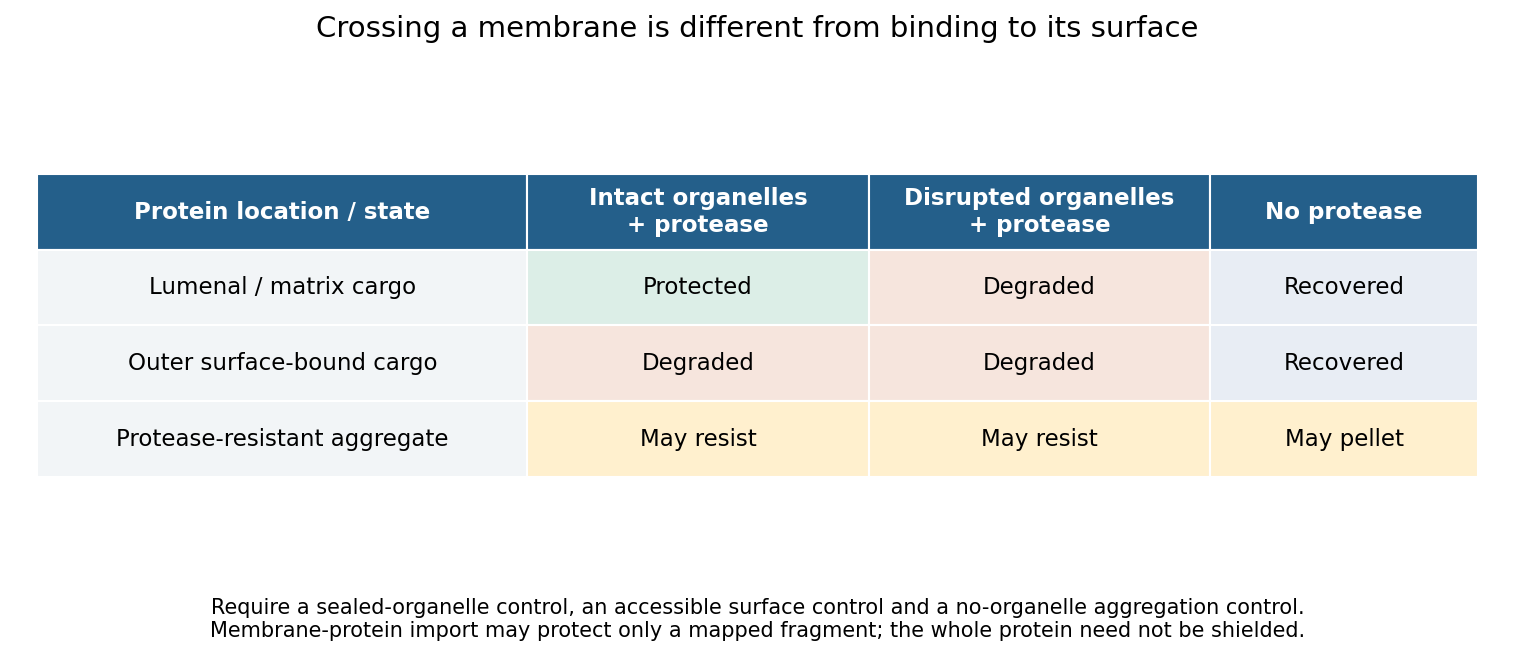
Original control logic separating protein import from surface binding and protease-resistant contamination
. Details. 
Perturbation then tests the mechanism. Compare incubation time and temperature; deplete and restore relevant energy sources; dissipate a membrane potential only after confirming that this treatment preserves membrane integrity; and compete with an excess of unlabeled substrate. Energy requirements must be discovered rather than assumed. Mitochondrial matrix entry, ER translocation and peroxisomal import use different machinery. In particular, stable folding is not a universal barrier: primary peroxisome experiments demonstrated import of stably folded substrates.[ref]
Import of stably folded proteins into peroxisomes by P. A. Walton and others. Import tests challenging a universal unfolding requirement
Mutating a candidate targeting signal should reduce import, while appending that signal to a suitable reporter can test sufficiency. Disrupting a candidate receptor or translocation component, followed by rescue with the wild-type protein, tests necessity. Because a blocked pathway may destroy the organelle indirectly, pair import measurements with morphology, membrane integrity and the import of unrelated controls. An import-defective allele that leaves the compartment otherwise functional is more informative than complete organelle loss. A negative isolated-organelle result does not exclude import if purification removed a required factor; compare with an intact-cell assay. Conversely, protection shows internalization but does not alone distinguish direct protein translocation from delivery inside a vesicle or engulfed compartment. Route-specific perturbations and topology measurements must resolve that distinction.
For the protein complement, combine quantitative spatial proteomics with complementary methods. Measure protein abundance across an entire fractionation gradient and identify proteins with reproducible localization profiles, rather than accepting every protein in a single pellet. Compare intact-organelle protease treatment with disrupted controls, and compare wild type with an import-defective condition. Analyze both soluble and membrane fractions. Liquid chromatography-mass spectrometry identifies peptides, but poorly soluble, scarce or unusual proteins may escape detection, so fractionation and acquisition strategies should be varied.
An internally localized TurboID or other proximity labeling enzyme can reveal proteins accessible in the relevant compartment in living cells. A cytosolic control, a catalytically inactive labeling construct and matched expression levels help identify background. Proximity labeling establishes accessibility and neighborhood, not translocation or stable residency by itself; labeling radius, reagent access and perturbation by the enzyme must be considered.[ref]
Finally distinguish resident, imported and all imported. A resident may have been synthesized by an organelle genome; an imported protein may only transit through the compartment. Time-resolved labeling, precursor processing, localization and dependence on a defined import pathway can classify these cases. Report coverage across growth conditions, detection limits and a confidence tier for each candidate. No single proteomic experiment proves absolute completeness, but convergent topology, kinetic and genetic evidence can produce a well-supported import catalogue.
Maturation best explains major changes in Golgi cisternal identity and early-to-late endosomal progression, but neither pathway is a conveyor belt with no stable domains or transport carriers. The useful comparison concerns what persists—membrane, cargo or resident machinery—and what the experiments actually follow.
In a stable-compartment model, each compartment retains its processing identity while cargo moves onward in vesicles or tubules. In cisternal maturation, cargo can remain within a cisterna while its resident enzymes and trafficking machinery change, turning an early cisterna into a later one. This requires selective recycling of resident machinery in the opposite direction. Both models therefore depend on membrane trafficking; observing vesicles alone does not distinguish them. A static image of separate cis and trans markers is likewise compatible with a population of maturing cisternae.
A decisive experiment follows an individual structure over time using early and late resident markers. In budding yeast, live imaging showed initially early-marker-positive Golgi cisternae losing that marker and acquiring a late marker. This is strong evidence for changing cisternal identity within the tracked object.[ref]
Golgi maturation visualized in living yeast by Eugene Losev and others. Live imaging of early-to-late resident-marker replacement
A complementary experiment follows synchronized cargo together with residents. Cargo retention while residents are replaced favours maturation; cargo movement between objects whose residents remain stable favours transfer between persistent processing domains.Large cargo makes a strong mechanistic test. A long procollagen assembly cannot simply be assumed to enter a small conventional coated vesicle. Maturation can move such cargo through the stack without packaging it into small forward carriers at every step. However, cargo size does not by itself prove that every soluble cargo uses the same route. Tubular connections, larger carriers and rapid exchange of small cargo can coexist with maturation. The geometry and spatial resolution of stacked mammalian Golgi also differ from those of dispersed yeast cisternae, so one should not transfer every kinetic detail between systems without testing it.
For the Golgi, the strongest synthesis is therefore a dynamic population of processing compartments with changing identity, coupled to resident recycling and cargo-dependent transport. COPI and other retrieval pathways can maintain enzyme gradients while COPII supplies new material from the endoplasmic reticulum. A named cis, medial or trans region can persist statistically even when its component membranes and proteins do not. Bulk transport, rapid cargo exchange and local stable zones need not be mutually exclusive.
The endocytic pathway poses a related but distinct problem. An early endosome receives material from the surface and separates recycling cargo from cargo retained for degradation. A strictly stable early-endosome model predicts that degradative material must leave in carriers while early identity persists. A maturation model predicts that a cargo-bearing domain changes into a late endosome, alongside removal of material that should recycle.
Time-resolved Rab5 and Rab7 measurements demonstrated replacement of an early Rab machinery by a late one on cargo-bearing endosomes. This Rab conversion provides direct evidence for maturation rather than inferring it solely from differently labeled endpoint compartments.[ref]
Rab Conversion as a Mechanism of Progression from Early to Late Endosomes by Jochen Rink and others. Rab5 loss and Rab7 acquisition on progressing endosomes
The associated changes in lipids, acidity, motility, fusion machinery and internal membrane organization make this a functional transition, rather than a marker swap alone.Yet recycling domains can bud or tubulate from a maturing endosome. Some cargos return to the plasma membrane; others use retromer-associated retrieval routes; still others enter intralumenal vesicles and continue toward lysosomes. A maturing degradative region can therefore coexist with relatively persistent sorting activities elsewhere in the same network. Endosome fusion and fission also mean that an object tracked by microscopy may exchange membrane extensively.
To discriminate mechanisms, combine live tracking of residents and cargo with pulse-chase kinetics, acute perturbations of retrieval machinery and quantitative membrane accounting. Apparent marker conversion caused by two unresolved objects crossing must be excluded. Conversely, failure to observe conversion at low time resolution is not proof of stability. The evidence favours maturation as a major organizing principle, with selective sorting, retrieval and exchange explaining how cells retain steady trafficking functions while individual compartments change.
Myosins convert a nucleotide-driven actin-binding cycle into movement, force or anchoring. Their different cellular roles arise from variations in motor kinetics, directionality, lever-arm geometry, oligomerization and cargo binding. A class name alone does not specify a universal stepping speed or duty ratio.
A myosin usually contains an actin-binding motor domain with an ATPase active site, a neck associated with light chains, and a tail involved in cargo association or assembly. The myosin lever arm amplifies small motor-domain rearrangements. The tail can connect the motor to a membrane, receptor, organelle or another myosin molecule. Some isoforms are autoinhibited until cargo binding, calcium-dependent regulation or phosphorylation favours an active conformation.
The mechanochemical cycle can be organized around actin affinity. In a strongly bound nucleotide-free state, ATP binding weakens actin attachment and promotes detachment. ATP hydrolysis prepares a detached or weakly bound ADP–phosphate state. Subsequent actin interaction and transitions around phosphate release stabilize strong binding and generate the myosin power stroke. ADP release and the next ATP-binding event complete the cycle. The exact ordering and rates of structural transitions and phosphate release depend on isoform and load; the cycle should not be reduced to a claim that ATP cleavage itself is the instantaneous mechanical stroke.
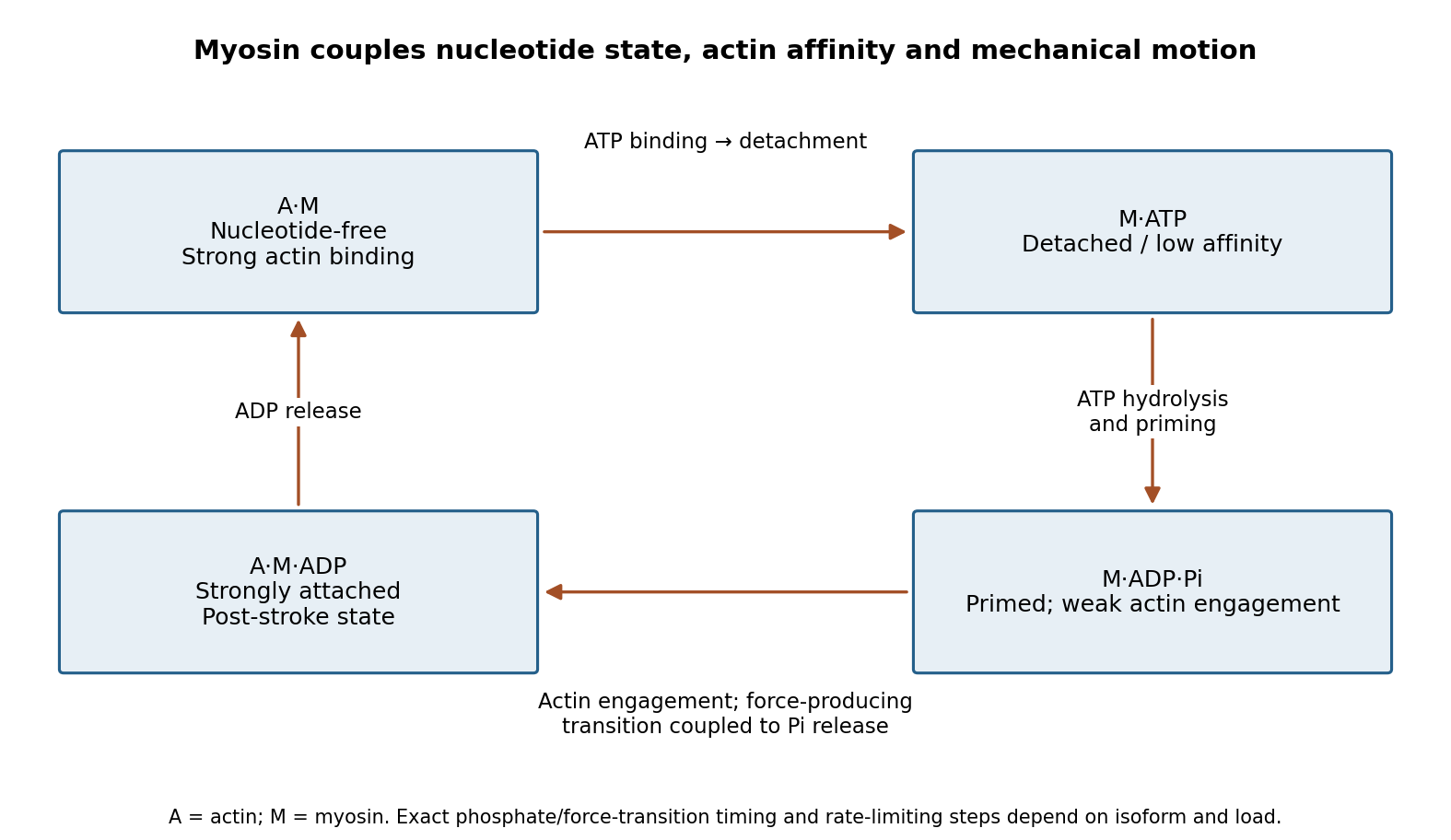
Original myosin actin-affinity and nucleotide cycle, separating ATP binding, hydrolysis and the force-producing transition
. Details. 
Directionality depends on motor geometry and the polarity of actin. Most characterized myosins move toward the barbed end, but Myosin VI moves toward the pointed end. Motor assays established this reversed direction directly, showing that “myosin” does not imply a single transport direction.[ref]
Myosin VI is an actin-based motor that moves backwards by A. L. Wells and others. Directionality assays on polarized actin
In a cortex with complex actin architecture, filament orientation must therefore be known before predicting net cargo movement.The myosin duty ratio is the fraction of a cycle spent strongly bound. A single low-duty motor repeatedly loses its track, whereas an assembly of many such motors can maintain collective contact. Myosin II illustrates this strategy: bipolar filaments bind oppositely oriented actin arrays and generate sliding or tension. In muscle, ordered filament geometry converts sliding into contraction. In nonmuscle cells, related contractile networks contribute to the division furrow, junction remodeling, migration and cortical tension. If the network is anchored, the same sliding mechanism can produce an approximately isometric force rather than large displacement.
Cargo transport poses a different requirement. Dimeric Myosin V motors coordinate their heads so that one remains attached while the other advances. A high-duty coordinated cycle supports myosin processivity, enabling repeated steps before dissociation. Single-fluorophore localization followed one labeled head moving by roughly twice the centre-of-mass step, supporting alternating hand-over-hand motion rather than equal short advances of both heads.[ref]
Myosin V Walks Hand-Over-Hand: Single Fluorophore Imaging with 1.5-nm Localization by Ahmet Yildiz and others. Single-head localization distinguishing walking mechanisms
The approximate 36 nm centre-of-mass repeat reflects the actin track and motor geometry; it is not a step size shared by all myosins.Transport and tension holding overlap. Load can slow nucleotide release and prolong strong binding, allowing some motors to act as dynamic anchors. Myosin VI can participate in endocytic membrane organization or cargo movement, depending on its partners and assembly state. Class-I myosins couple membranes to cortical actin and can regulate membrane tension and local transport. Specialized myosins organize sensory structures or long-range organelle positioning. These roles depend as much on tail-associated adaptors and local actin arrangement as on the catalytic head.
Regulation matches activity to demand. Light-chain phosphorylation can promote nonmuscle myosin II activation and filament assembly. Calcium-sensitive light chains, including calmodulin in appropriate classes, alter motor regulation or lever-arm organization. Cargo-associated adaptors can relieve autoinhibition and assemble transport complexes. Motor number, opposing loads, actin turnover and competition with other transport systems further determine the outcome.
Useful experiments separate these contributions. Actin-gliding assays establish direction and movement, single-molecule tracking measures stepping and run length, and force measurements reveal load-dependent kinetics. ATPase assays alone establish chemical turnover but not productive movement. In cells, rescue with a motor-defective or cargo-binding-defective protein can distinguish catalytic force production from a structural scaffolding role. The unifying mechanism is a coordinated affinity-and-conformation cycle; the biological output can be motion, sustained tension or controlled coupling of membranes to the cytoskeleton.
The SRP–receptor interaction is a regulated delivery and handover reaction, not merely a binding equilibrium. GTP binding and hydrolysis provide timing, conformational control and recycling so that a hydrophobic nascent chain reaches an available translocon before it aggregates or is released at the wrong place.
The signal recognition particle recognizes an appropriate exposed signal sequence or membrane-spanning segment on a ribosome-associated nascent chain. Its conserved SRP54 subunit contains a signal-binding region and a GTPase domain; bacterial Ffh is the corresponding homolog. The partner GTPase is the SRP receptor alpha subunit in the eukaryotic ER system or FtsY in bacteria. Thus the targeting machinery integrates information from the emerging chain, the ribosome and a membrane-associated receptor. Productive delivery also requires a translocon, not just any membrane surface.
GTP loading permits the two homologous GTPases to assemble into a complex. They then undergo further rearrangements and mutually stimulate their hydrolysis reactions. This is more elaborate than a one-step association of two preformed active surfaces: different nucleotide-bound conformations distinguish cargo capture, membrane delivery, handover competence and termination. Correct cargo and a suitable membrane/translocon environment can alter the kinetics of these transitions. The pathway can therefore respond to whether the chain is appropriate and whether a downstream acceptor is ready.
The timing matters. If hydrolysis occurs too early, SRP and receptor may dissociate before cargo transfer. If dissociation is prevented indefinitely, a stable complex can trap the machinery instead of making another delivery. Efficient targeting consequently requires both a sufficiently long-lived delivery intermediate and a route for its timely disassembly. Experiments with GTPase mutants separated receptor interaction or hydrolysis behaviour from successful cargo unloading, demonstrating that formation of a stable complex is not itself the endpoint of targeting.[ref]
Conformational changes in the GTPase modules of the signal reception particle and its receptor drive initiation of protein translocation by Shu-ou Shan and others. Mutant targeting and translocation assays separating binding from productive handover
This provides a form of kinetic discrimination. A wrong nascent chain can dissociate or fail to progress through a sequence of conformational checkpoints, while an appropriate chain promotes forward passage. Energy-consuming termination and recycling prevent every encounter from being governed solely by the final binding affinity. The logic resembles kinetic proofreading, but one should distinguish a general analogy from a demonstrated proofreading scheme: identifying a particular rejection step requires rates and fluxes, not merely observing GTP consumption. Not every incorrect interaction necessarily consumes the same number of GTP molecules.
A useful comparison is a passive docking model. At equilibrium, strong SRP–receptor affinity would favour occupancy but could impede turnover, and it would not establish that the cargo has been delivered to a conducting channel. In the actual cycle, nucleotide states connect the binding interface to signal-sequence release and receptor recycling. Hydrolysis makes a directional, dissipative cycle possible when cellular nucleotide ratios are maintained. It should not be described as GTP physically pushing the polypeptide through the membrane; translocation and membrane insertion use additional interactions and, depending on the substrate and system, other energy inputs.
A decisive experimental design measures several outputs separately: SRP–receptor association, GTP hydrolysis, transfer of a labeled nascent chain to the translocon, and protection or processing of the resulting product. Compare a nonhydrolyzable nucleotide analog with mutants that alter specific conformational transitions, and control for ribosome binding and membrane integrity. A reagent that stabilizes docking but reduces completed import shows why affinity alone is an inadequate readout. Testing repeated targeting cycles also distinguishes one successful handover from efficient recycling.
The answer is therefore coordination and reliable turnover. Energy expenditure links recognition to an available membrane insertion pathway, controls the lifetime of delivery intermediates, helps reject unproductive encounters and returns the machinery to a reusable state. The strength of this explanation is that it predicts experimentally separable failures—binding without handover, premature release, and stalled recycling—rather than assigning GTP the vague role of supplying energy to an otherwise simple contact.
Cytochrome P450s are versatile haem-containing oxidation enzymes that can install chemically difficult, highly selective functional groups. Photosynthetic microorganisms can supply their reducing equivalents and metabolic precursors, but useful production requires coordinated enzyme expression, electron delivery, substrate supply and product handling.
A Cytochrome P450 contains an iron–haem centre coordinated by a protein cysteine thiolate. The characteristic spectrum of its reduced carbon-monoxide complex gives the family its name. A common monooxygenation can be writtenOne oxygen atom enters the product and the other is reduced to water. Electron transfer and protonation activate bound oxygen, generating a powerful oxidant such as P450 compound I. Hydrogen abstraction followed by oxygen rebound can hydroxylate a C–H bond, but the family also supports other reactions, including epoxidation and successive oxidation steps. The exact chemistry is enzyme- and substrate-dependent; not every P450 simply performs a single hydroxylation.
This selectivity is valuable for complex natural products. Closely related substrates can differ in the position and stereochemistry of oxygenation, and an enzyme can distinguish sites that are difficult to separate by ordinary chemical synthesis. Oxygenated terpenoid intermediates, drug precursors and other specialized metabolites are therefore attractive targets. The opportunity is selective chemistry, not a guarantee that every plant pathway will be cheap to reproduce in a microbial host.
In an oxygenic photosynthetic chassis, light absorption by photosystem II supports extraction of electrons from water. Transfer through the photosynthetic chain and photosystem I generates reduced ferredoxin, which can feed a compatible P450 directly or contribute to NADPH production for an appropriate reductase system. The distinction matters: native microsomal P450s often use a flavoprotein reductase, whereas engineered direct ferredoxin delivery can bypass that partner. Electrons must still reach the P450 at adequate rates and with correct coupling to substrate oxidation.
There is a clear experimental proof of principle. A plant CYP79A1 catalytic domain was fused to the photosystem-associated PsaM anchor in a cyanobacterium, positioning it near the thylakoid electron supply. Activity was observed in light-driven experiments. This demonstrates functional rerouting of photosynthetic reducing power into a plant P450 reaction, rather than establishing commercial production of a finished pharmaceutical.[ref]
A production design starts from the entire pathway. Supply a suitable scaffold from endogenous metabolism or introduced enzymes, express the required P450s with compatible membrane anchors and redox partners, and include any downstream transferases or other finishing enzymes. CYP79A1, for example, participates in the pathway to dhurrin; expressing it alone establishes one activity, not the completed multienzyme pathway. For a new high-value oxygenated terpenoid, one must similarly verify every intermediate rather than equating scaffold accumulation with final-product synthesis.
Several constraints can dominate performance. Plant membrane enzymes may fold poorly, insert in the wrong orientation or fail to acquire haem. An abundant P450 may remain inactive because its substrate or electron donor is limiting. Competition with carbon fixation and essential redox metabolism can make maximal electron diversion harmful to growth. Uncoupled oxygen activation can generate reactive oxygen species instead of product. Excess light may increase oxidative damage, while high cell density limits light penetration. Oxygen supply is required for ordinary P450 monooxygenation even though the host produces oxygen photosynthetically.
Optimization should therefore measure carbon flux, enzyme abundance, redox state and products together. Adjust expression ratios, redox-partner choice, subcellular localization and induction timing; relieve precursor bottlenecks without starving essential pathways; and consider export or product capture to limit toxicity. A bioreactor must balance mixing, illuminated surface area, gas exchange and biomass density.
Useful controls include dark incubation, a catalytic-site mutant, pathway-minus strains and perturbation of photosynthetic electron supply while monitoring cell viability. Mass spectrometry and authentic standards establish product identity; oxygen uptake or a fluorescent reporter alone does not. Finally report titre, productivity, carbon yield and stability over repeated cultivation. Light-powered enzyme activity is the biochemical entry point; reliable, selective and economically recoverable product formation is the engineering goal.
Plant lipid diversity is generated by combinatorial biosynthesis in several compartments, selective exchange and remodeling, and evolutionary diversification of the underlying enzymes. Its functions extend from membrane mechanics and photosynthesis to storage, barriers and signaling, so no single adaptive explanation covers every lipid species.
At the simplest level, different acyl chains vary in length, double-bond number and position, and chemical substitution. Plastid fatty acid synthase builds chains carried by an acyl carrier protein. Chain termination and export determine which products enter further metabolism. Endoplasmic-reticulum fatty acid elongase enzymes extend selected acyl substrates, creating very-long-chain products used in surface and membrane lipids. Fatty acid desaturases introduce double bonds into particular substrates, while specialized enzyme variants can introduce hydroxyl groups or other unusual chemistry. Substrate specificity, reaction order and cellular location therefore generate many distinct acyl pools from a comparatively limited set of carbon precursors.
Chains are only one dimension. Acyltransferases assemble them onto glycerol or other backbones with positional specificity. Headgroup pathways generate glycerophospholipids and galactolipids, while distinct pathways produce sphingolipids and sterols. A lipid name such as phosphatidylcholine denotes a class, not a unique molecular species: two acyl chains can each vary, and their positions can matter. Storage triacylglycerols likewise combine many possible acyl groups. Functional diversity is therefore much larger than the number of lipid headgroups.
Compartmentation constrains which combinations occur. Plastid and ER assembly pathways use different enzymes and precursor pools, and products move between them. Monogalactosyldiacylglycerol and digalactosyldiacylglycerol are major constituents of photosynthetic membranes, whose requirements differ from those of the plasma membrane or a storage oil body. Acyl editing replaces chains on existing lipids, connecting synthesis to remodeling rather than simply producing a fixed end product. Selective transport, turnover and developmental expression create tissue-specific compositions even when the genome is unchanged.
An important test of functional importance comes from manipulating the enzymes rather than correlating lipid abundance with habitat. An Arabidopsis thaliana desaturase-deficient mutant lacking trienoic fatty acids was able to grow under permissive conditions but lost normal chloroplast performance during prolonged chilling. This supports a role for those acyl structures in maintaining photosynthetic function at low temperature.[ref]
Trienoic Fatty Acids Are Required to Maintain Chloroplast Function at Low Temperatures by Jean-Marc Routaboul and others. Desaturase-mutant physiology under low-temperature treatment
The inference is more precise than “unsaturated lipids are always better”: excessive unsaturation can also increase susceptibility to oxidation, and requirements depend on temperature and membrane function.Nutrient availability supplies another driver. Phospholipid synthesis requires phosphorus, whereas galactolipids can provide membrane material without a phosphate headgroup. Under phosphate deprivation, organelle lipid analyses detected redistribution of digalactosyldiacylglycerol into mitochondrial membranes. This demonstrates regulated compositional plasticity rather than requiring a new species to evolve every time phosphate becomes scarce.[ref]
Other selective pressures concern life on land and interactions with other organisms. Cutin, suberin and plant cuticular wax contribute to control of water loss, permeability and surface protection. Their chain lengths and oxygenation patterns affect packing and barrier properties. Seed oils store energy and carbon for establishment, while lipid-derived signals coordinate development and responses to damage. Pathogens, herbivores, drought, salinity and changing light environments can favour different combinations. A lipid useful as a defensive precursor may impose a cost on growth or oxidation resistance, creating trade-offs rather than one universal optimum.
Evolution can generate new chemistry through gene duplication, altered substrate specificity, changes in expression and retargeting of enzymes between compartments. A duplicated desaturase-like enzyme, for example, can retain the original reaction in one copy while another explores related substrate chemistry. Selection can preserve a useful product or tissue-specific role, while drift and biochemical side reactions also contribute to observed diversity. Cross-species lipid differences alone do not establish their adaptive value.
To separate these explanations, combine quantitative lipidomics, isotope tracing, enzyme biochemistry, genetic perturbation and physiological rescue. Compare plants at matched developmental stages and environments, because plastic remodeling can otherwise be mistaken for an evolved difference. The chemistry arises from modular enzymes and compartmentalized flux; the evolutionary explanation requires connecting particular molecular variants to performance in a defined ecological setting.
Both heterotrophic bacteria and oxygenic phototrophs must connect intracellular reducing power to an external acceptor across insulating cell-envelope layers. The best-characterized heterotrophic systems use dedicated respiratory redox conduits, whereas cyanobacterial export often involves mediators and incompletely resolved routes whose activity competes with photosynthetic metabolism.
In a Gram-negative heterotroph, oxidation of organic substrates supplies electrons to intracellular carriers and the inner-membrane quinone pool. An insoluble iron oxide or an electrode cannot enter the cytoplasm or simply accept an electron through the lipid phase. Extracellular electron transfer must bridge the inner membrane, periplasm and outer membrane before reaching the mineral or electrode surface. This is a sequence of chemically coupled steps, not unrestricted electronic conductivity through the whole cell.
Shewanella oneidensis provides a useful mechanistic example. Quinol oxidation connects through CymA and periplasmic carriers to the outer-membrane MtrCAB assembly. Its cytochromes place redox-active haem groups on the inward and outward sides of a porin-associated structure; surface MtrC can exchange electrons with external acceptors. Reconstitution of oriented MtrCAB in proteoliposomes demonstrated transfer from an internal electron-carrier pool to external Fe(III) oxides, directly testing the membrane-crossing function rather than inferring it from a mutant phenotype alone.[ref]
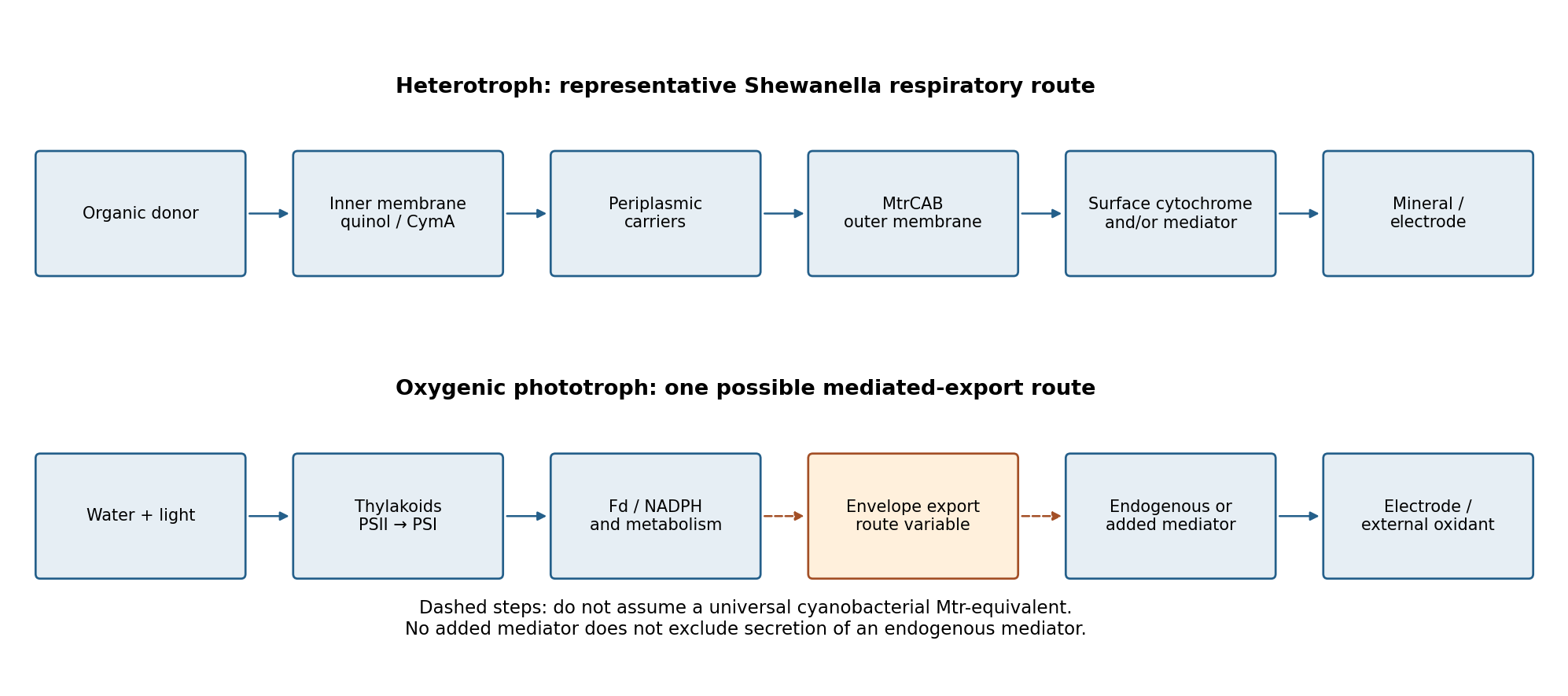
Original comparison of a characterized heterotrophic outer-membrane conduit with alternative phototrophic electron-export routes
. Details. 
Direct contact is one strategy. Surface cytochromes can reduce a mineral that is close enough, and extracellular conductive structures can extend electron transfer beyond the cell body. Some microbial nanowires are cytochrome-rich filaments or membrane-associated structures; the mechanism should be assigned to the organism and structure actually characterized. Calling every extracellular appendage a conducting pilus is unwarranted. Contact area, attachment and the conductivity of the surrounding biofilm can limit current even when the intracellular respiratory route is functional.
A second strategy uses a redox mediator. The cell reduces a soluble compound, which diffuses to a distant acceptor, transfers its electrons and returns in an oxidized form. Flavin-mediated transfer in Shewanella and phenazine-mediated transfer in some other bacteria illustrate how diffusible chemistry can complement direct contact. Some mediators also associate with proteins rather than remaining entirely free in solution. Mediator availability, diffusion, side reactions and loss into the environment therefore affect efficiency. A poised electrode and an insoluble mineral are not interchangeable acceptors: their accessible potentials, surface chemistry and spatial distribution differ.
For oxygenic phototrophs, light supplies a different upstream route. Photosystem II extracts electrons from water, and photosystem I generates reduced ferredoxin and downstream reducing power. In many cyanobacteria, these reactions occur on internal thylakoid membranes; an electron collected outside must therefore pass through additional metabolic and envelope steps. In eukaryotic algae, the chloroplast envelope and plasma membrane add further compartmental barriers. One should not transplant a Shewanella Mtr diagram into these organisms merely because both produce an electrode current.
The evidence for cyanobacterial export includes mediator-dependent reduction and sensitivity to envelope permeability. In one Synechocystis study, weakening outer-membrane attachment increased photocurrent, while replacing the culture supernatant with fresh medium removed that current under the tested conditions. Ferricyanide reduction provided a complementary readout. These results support a role for extracellular redox-active compounds and an envelope barrier, not identification of one universal cyanobacterial electron-export protein.[ref]
Order-of-magnitude enhancement in photocurrent generation of Synechocystis sp. PCC 6803 by outer membrane deprivation by Shoko Kusama and others. Outer-membrane perturbation, supernatant replacement and ferricyanide-reduction controls
The energetic roles also differ. Mineral-reducing heterotrophs can use an external acceptor in respiratory energy metabolism. A phototroph must retain enough reducing power for carbon fixation, nutrient assimilation and repair; maximal export is not automatically advantageous. Current can persist in darkness through metabolism of stored carbon, and secreted organic material can support heterotrophs that generate part of a measured community current. Oxygen evolution also changes local redox chemistry and can divert electrons away from the electrode.
Mechanistic experiments should separate these possibilities. Compare axenic cultures with mixed communities, light and dark conditions, intact and damaged cells, and cell-free supernatants. Use electrode-potential controls, viability assays, electron-transfer mutants and rescue, together with oxygen and carbon balances. Ferricyanide access must be interpreted relative to its membrane permeability. Most importantly, “no added mediator” does not prove direct transfer: cells can secrete their own mediator. The comparison is therefore between a relatively well-defined family of respiratory conduits and several phototrophic routes requiring organism-specific evidence, with the same general requirements of redox compatibility, envelope crossing and an accessible external sink.
Bacteria resist turgor through a load-bearing envelope and controlled osmotic balance, then remodel that envelope locally during growth and division without opening an unprotected gap. Rapid mechanosensitive release protects against sudden downshock; sustained wall synthesis and regulation protect during ordinary growth.
Water enters when the intracellular osmotic environment favours uptake, generating turgor pressure. A lipid membrane alone cannot generally sustain the large pressure difference of a normal walled bacterium. The covalent peptidoglycan mesh provides tensile resistance: glycan strands are connected by peptide crosslinks, distributing load over a continuous sacculus. Gram-positive bacteria generally possess a thick wall outside the cytoplasmic membrane. Gram-negative bacteria have a thinner peptidoglycan layer within a multilayer envelope, whose outer membrane and connections can also contribute to mechanical integrity. These architectures should not be treated as identical thin bags.
A simple mechanical model explains the need for reinforcement. For a thin cylindrical wall of radius and thickness under pressure difference , circumferential stress scales aswhile axial stress is about half that value. This idealization neglects the molecular mesh and envelope heterogeneity, but shows why a larger radius or a thinner load-bearing layer increases tensile demand. No pressure, radius or thickness values are supplied, so a numerical stress cannot be inferred from this paper.
Steady growth requires adding wall while preserving connectivity. Cytoplasmic precursor synthesis supplies glycan–peptide building blocks; membrane-associated transport presents them to polymerizing and crosslinking enzymes outside the cytoplasm. Penicillin-binding proteins and associated synthases connect the new material into the sacculus. Controlled cleavage by autolysins permits expansion and insertion, but cutting must be coordinated with synthesis and repair. Unregulated hydrolysis or failure of crosslinking can make turgor destructive. The wall is therefore renewed through spatially and temporally limited reactions, rather than opened wholesale and rebuilt afterward.
In many rod-shaped bacteria, the Rod complex and MreB organize lateral growth. Imaging linked circumferential motion of MreB-associated machinery to ongoing cell-wall synthesis, consistent with coordinated insertion around the cell rather than a static cytoskeletal scaffold alone.[ref]
Coupled, Circumferential Motions of the Cell Wall Synthesis Machinery and MreB Filaments in B. subtilis by Ethan C. Garner and others. Live-cell motion measurements and wall-synthesis perturbations
Species with other shapes use different arrangements; MreB is not a universal component of all bacteria.Division requires a second local remodeling programme. FtsZ polymers help organize the divisome at an appropriate site, where septal synthesis accompanies inward envelope growth. Daughter-cell separation must be delayed until enough new wall protects each daughter. Local hydrolases then cleave selected septal connections. Spatial regulation prevents a division-associated cleavage reaction from becoming a catastrophic breach across the cell sidewall. Membrane constriction, wall synthesis and separation are coupled processes; attributing all division force or protection to one cytoskeletal protein would miss this coordination.
Osmoregulation adjusts the load imposed on this structure. Under high external osmolarity, cells can accumulate ions and compatible solutes to retain water. Upon sudden transfer into dilute medium, the existing solute pool instead drives rapid water entry. MscS and MscL mechanosensitive ion channels open in response to membrane tension and release solutes, reducing the osmotic imbalance before slower transcriptional responses can act. Genetic loss-of-function and downshock experiments demonstrated that these channels protect against extreme turgor.[ref]
Protection against extreme turgor by MscS and MscL by N. Levina and others. Channel-deficient strains challenged by osmotic downshock
Their emergency role differs from routine growth control. A constitutively open large pore would lose valuable metabolites, so gating must be sensitive and reversible. Conversely, emergency release cannot replace a missing wall during sustained growth in an ordinary environment. Envelope-stress sensing, balanced precursor supply, repair and correctly timed hydrolysis remain necessary.
A useful experimental test measures lysis and survival after a defined downshock while independently measuring wall integrity and growth. Rescue with a functional channel distinguishes emergency relief from nonspecific osmotic adaptation, while perturbing a synthase or autolysin reveals the wall-remodeling contribution. Protection is an integrated system: maintain the barrier, regulate its internal pressure, and coordinate the cuts and additions required to grow and divide.
Pyocyanin is a diffusible redox-active phenazine whose ecological benefits and damaging effects arise from cycling between electron donors and acceptors. Its production is controlled by a regulatory network linking quorum signals to metabolic state; PqsE promotes the relevant RhlR output through a protein interaction that is distinct from its catalytic activity.
Pyocyanin gives many Pseudomonas aeruginosa cultures their blue coloration. The phenazine ring system accepts reducing equivalents from cellular metabolism and can pass them to oxygen or other accessible acceptors. In oxygenated settings, repeated redox cycling can generate reactive oxygen species and deplete reducing capacity. These effects can harm competing microorganisms and host cells, making pyocyanin a contributor to virulence. Its effects depend on concentration, oxygen availability and the surrounding antioxidant capacity; pigment production alone does not establish the severity of a particular infection.
For the producing bacterium, the same chemistry can help maintain redox balance when local oxidant supply is limited. Experiments comparing a phenazine-deficient strain with pyocyanin supplementation linked the molecule to intracellular redox state and changes in central carbon flux.[ref]
Pyocyanin Alters Redox Homeostasis and Carbon Flux through Central Metabolic Pathways in Pseudomonas aeruginosa PA14 by Alexa Price-Whelan and others. Mutant and supplementation tests of redox balance
In spatially structured biofilms, a redox mediator can connect poorly oxygenated regions with more accessible oxidants. That benefit has costs: synthesis consumes resources and uncontrolled redox cycling can damage the producer, so export and protective responses must be coordinated. The redox-sensitive regulator SoxR contributes to handling endogenous redox-active metabolites in this setting.Biosynthesis also separates pigment amount from regulation alone. The core phenazine biosynthesis loci produce precursors, and modifying enzymes including PhzM and PhzS generate pyocyanin. Cloning and heterologous reconstruction identified contributions of the core loci and the modifying reactions.[ref]
Functional Analysis of Genes for Biosynthesis of Pyocyanin and Phenazine-1-Carboxamide from Pseudomonas aeruginosa PAO1 by Dmitri V. Mavrodi and others. Functional analysis and heterologous phenazine-pathway reconstruction
A mutant can therefore lose blue pigment through a chemical pathway defect even when signal perception is intact. Oxygen-dependent finishing chemistry can likewise decouple transcription from the amount of final pigment.The canonical quorum sensing network contains interconnected Las, Rhl and quinolone systems. In many laboratory strains, the Las quorum-sensing system activates downstream signaling programmes. The Rhl quorum-sensing system uses a butyryl-homoserine-lactone signal with RhlR, while the Pqs quorum-sensing system responds through PqsR to quinolone signals. Positive feedback can amplify expression, but signal concentration reflects diffusion, retention and growth conditions as well as cell number. It is not a simple universal population counter, and the hierarchy can differ between strains.
PqsE is a particularly important connection. Although encoded in the quinolone-pathway locus, its effect on pyocyanin cannot be explained merely by supplying more quinolone. Binding-interface mutants retain catalytic activity yet fail to support the regulatory phenotype, whereas productive interaction promotes RhlR DNA binding. This separates a protein-interaction role from the enzyme's catalytic function.[ref]
The PqsE-RhlR Interaction Regulates RhlR DNA Binding to Control Virulence Factor Production in Pseudomonas aeruginosa by Kayla A. Simanek and others. Binding-interface mutants, DNA-binding and pyocyanin assays
A pathway diagram should therefore include both chemical signal production and the PqsE–RhlR regulatory partnership.Nutrient status, oxygen availability, growth phase and additional global regulators influence this network. These inputs make biological sense: secretion of a costly redox-active product can be useful under one combination of competition and redox stress and wasteful under another. They also explain why a single quorum-signal measurement does not predict pigment yield in every medium or clinical isolate.
To test regulation, measure signal production, relevant transcripts, pyocyanin itself and growth separately. Compare receptor mutants, biosynthetic mutants and PqsE interface mutants, and rescue at controlled expression levels. A catalytic-dead mutant paired with a binding-defective mutant is especially informative. Keep oxygen, pH and biomass matched, because pyocyanin's oxidation state and medium conditions affect its apparent colour. The mechanistic answer joins redox function, biosynthetic chemistry and conditional gene regulation; treating pyocyanin as merely a quorum-controlled toxin omits its metabolic and ecological roles.
Losing a parasitic lifestyle requires replacing the benefits supplied by the host while retaining enough performance to survive and reproduce in a new niche. The difficulty depends strongly on how much autonomy the lineage has already lost. Becoming harmless or mutualistic is also distinct from becoming free-living: a nonparasitic association can remain host-dependent.
The first task is to specify the proposed endpoint. A parasite that no longer damages its host might become a commensal, while a mutualist must confer a demonstrable benefit in the relevant setting. Neither transition necessarily restores host-independent growth. The harder transition to free living requires a complete sustainable life cycle without host-provided metabolism, physical shelter or reproductive opportunities. A resistant transmission stage that survives outside a host does not meet that standard if it cannot reproduce there.
Metabolic host dependence is often the strongest barrier. Host-associated lineages can lose biosynthetic pathways when the host reliably supplies their products. Returning to an external niche may therefore require uptake from a new environmental source, restoration of synthesis, or a partnership with another organism. Missing enzymes cannot necessarily be restored by changing one regulator: whole pathways may require transporters, cofactors, compartmentation and coordinated expression. Genome reduction can also remove regulatory and repair functions that were less useful in a protected environment.
The genome of Cryptosporidium parvum illustrates a highly modified parasite, with a reduced complement of metabolic functions relative to many free-living eukaryotes.[ref]
Complete genome sequence of the apicomplexan, Cryptosporidium parvum by Mitchell S. Abrahamsen and others. Genome evidence for a specialized host-associated metabolic repertoire
It is an example of functions that must be accounted for, not proof that every parasite has the same deficiencies. Other parasites retain substantial biosynthetic capacity and may face mainly ecological or regulatory barriers rather than wholesale metabolic reconstruction.Energy metabolism needs a functional replacement as well. An intracellular niche may supply suitable carbon substrates, oxygen conditions or directly useful metabolites. Outside the host, the organism must obtain energy under fluctuating conditions while balancing reducing equivalents and maintaining ion gradients. Reacquiring an ancestral organelle is not the only imaginable solution: an alternative pathway can in principle supply the indispensable function. However, a transporter alone cannot replace an absent energy-generating network unless suitable external substrates and redox partners are available.
Physical and behavioral adaptations create further constraints. A unicellular parasite may need autonomous nutrient capture, motility, osmoregulation and protection from desiccation or oxidative stress. A multicellular parasite with reduced feeding structures, sensory systems or locomotion could require anatomical and developmental changes as well. Structures optimized for host attachment or invasion can be costly or ineffective elsewhere. The organism also encounters predators, competitors and environmental variation that the host previously buffered.
Reproduction and transmission must be reorganized. If a developmental switch depends on a host cue, free-living reproduction requires an alternative trigger. If sexual stages occur only in a specific host, mating and completion of development must become possible elsewhere. New timing and dispersal traits must work with nutrient supply and seasonal conditions. Reducing virulence without solving these life-cycle dependencies does not create an independent lineage.
Evolutionary routes are possible but constrained. Retained ancestral genes can be redeployed, gene duplication can permit new functions, and horizontal gene transfer can sometimes add useful biochemical capacity. These routes require selectable intermediate states: an extensive reconstruction that yields no advantage until complete is difficult to assemble. A facultative association or a nutrient-rich environmental niche can provide stepping stones. Conversely, population bottlenecks, genetic drift and entrenched dependencies can reduce access to viable intermediate phenotypes.
Comparative biology must be interpreted carefully. Chromera velia is a photosynthetic relative of apicomplexan parasites, providing evidence about ancestral capabilities and the evolution of their lineage. Its existence does not show that a modern obligate parasite regained photosynthesis or reversed to free living.[ref]
A photosynthetic alveolate closely related to apicomplexan parasites by Robert B. Moore and others. Phylogenetic and plastid evidence from a photosynthetic relative
A claim of evolutionary reversal needs a well-supported phylogeny and exclusion of contamination or misidentified ancestral free-living relatives.Experimental evidence should be equally demanding. For host independence, demonstrate repeated reproduction and serial passage without host cells or unrecognized host-derived growth factors, then identify the resources and pathways sustaining it. For a transition to mutualism, measure effects on both partners across relevant conditions rather than equating reduced damage with mutual benefit. Nonparasitism is not achieved simply by deleting invasion genes: the lineage must establish a viable resource economy, complete reproduction and persist in the ecological setting that replaces its former relationship with the host.
Articles by others on the same topic
There are currently no matching articles.