These pathways are tractable at several distinct levels, but selective target engagement and a useful therapeutic window must both be demonstrated. A G protein-coupled receptor acts as a guanine nucleotide exchange factor for a heterotrimeric G protein: release of GDP permits GTP binding, changing the interactions of both the G protein alpha subunit and Gβγ with effectors. GTPase-activating proteins, including regulators of G protein signalling, accelerate return to the GDP-bound state. Gαs can stimulate adenylyl cyclase, Gαi can inhibit it, and Gαq can activate phospholipase C, linking receptor occupancy to different intracellular responses. The related small GTPases, such as Ras, also alternate between GDP- and GTP-bound states, but are monomeric switches with different activators and effectors. Strategies effective against one family cannot simply be assumed to work against the other.
The receptor is often the most accessible intervention point. An orthosteric antagonist competes with the endogenous ligand; an agonist activates a deficient response, while a partial agonist can produce an intermediate response and antagonize a higher-efficacy agonist. For example, beta-adrenergic receptor blockade reduces adrenergic stimulation of the heart. However, conserved binding pockets make receptor-subtype selectivity difficult, and the same receptor can have useful and harmful functions in different tissues. An allosteric modulator binds elsewhere and changes the affinity or efficacy of the endogenous ligand. This can exploit a less conserved pocket and preserve the timing of endogenous release; it does not automatically confer tissue specificity or a ceiling on toxicity. Structural studies of the beta-2 adrenergic receptor show why stabilizing particular receptor conformations can change coupling rather than merely change occupancy.[ref]
Structural insights into the dynamic process of β2-adrenergic receptor signaling by Aashish Manglik and others. Conformational intermediates examined by spectroscopy
biased agonism aims to favour one signalling output over another, for example G protein activation relative to arrestin recruitment. An opioid study found that TRV130 combined analgesia with reduced respiratory and gastrointestinal effects in rodent comparisons with morphine.[ref]
A G protein-biased ligand at the μ-opioid receptor is potently analgesic with reduced gastrointestinal and respiratory dysfunction compared with morphine by Scott M. DeWire and others. Preclinical signalling and equianalgesic comparisons
The inference that bias itself causes improved safety requires caution: different assays have different amplification and receptor reserve. Later direct measurements showed that low intrinsic G protein efficacy can explain favourable profiles of several proposed biased opioids.[ref]Low intrinsic efficacy for G protein activation can explain the improved side effect profiles of new opioid agonists by Alexander Gillis and others. Comparison of intrinsic efficacy and apparent bias
A convincing experiment therefore compares ligands with a common reference, matched receptor abundance and time courses, and proximal measurements of both pathways; it then tests benefit and toxicity at comparable effective exposures. An arrestin recruitment assay alone cannot predict an entire clinical adverse-effect profile.Direct inhibition of the switch is also possible. Competing at a nucleotide-binding site is difficult because intracellular nucleotides are abundant and binding is tight. Nevertheless, an alternative pocket can trap a particular state. YM-254890 binds an interdomain cleft of Gαq and inhibits nucleotide exchange by stabilizing the GDP-bound arrangement. Structural analysis, exchange measurements and tests against other G protein families connect binding to mechanism, rather than inferring Gαq inhibition from a fall in a distant calcium response.[ref]
Structural basis for the specific inhibition of heterotrimeric Gq protein by a small molecule by Akiyuki Nishimura and others. Structure and biochemical inhibition of GDP release
This illustrates chemical tractability, although inhibiting a widely used Gα family could impair normal signalling in many tissues. Targeting an interaction with a particular receptor, exchange factor or effector may give greater contextual selectivity.A complementary example is covalent inhibition of mutant Ras. AMG 510 exploits a pocket adjacent to cysteine 12 in KRAS G12C and favours the inactive GDP-bound protein. Its mutant-selective chemistry avoids requiring a nucleotide competitor, and biochemical, cellular and animal experiments connected the compound with suppression of signalling and tumour growth.[ref]
The clinical KRAS(G12C) inhibitor AMG 510 drives anti-tumour immunity by Jude Canon and others. Mutant-selective binding and antitumour experiments
This solution depends on the reactive cysteine and the accessibility of the trapped state; it is not a universal inhibitor of all Ras mutations. Exchange activity, pathway feedback, alternative signalling and additional mutations can change sensitivity. Moreover, a monomeric Ras inhibitor is evidence about a broader GTPase strategy, not evidence that all heterotrimeric G proteins have equivalent pockets.Other possible interventions include blocking selected Gβγ–effector contacts, enhancing a suitable GTPase-activating protein, preventing cell membrane recruitment, or inhibiting a downstream enzyme. Each trades accessibility against specificity: a downstream convergence point can bypass an inaccessible upstream lesion, but may suppress useful signals from many receptors. To select between these strategies, establish the disease-dependent molecular state, measure direct binding and exchange or hydrolysis, and confirm the predicted proximal output. Use an inhibitor-resistant rescue allele, an isogenic target-negative control, and counterscreens against related switches and unrelated cytotoxicity. Follow this with target engagement in the relevant tissue and measurements of normal physiological responses. The strongest therapeutic case combines a drug-accessible pocket or interface with a disease-specific dependence; pathway membership alone is insufficient.
weak biomolecular binding is useful because it makes molecular recognition reversible, responsive to concentration and compatible with rapid exchange. Here “weak” describes a relatively high dissociation constant for an individual biomolecular contact, not the fundamental weak force. For a simple reversible association ,Here is the association rate constant and is the dissociation rate constant. The bound fraction assumes free is known and binding sites are equivalent and independent; the lifetime assumes a single exponentially dissociating state without rebinding. A contact with is half occupied at a free partner concentration of , but only about 1% occupied at . Recruiting the partners to a cell membrane or scaffold can therefore turn binding on locally without changing their chemistry. Importantly, the same can result from different on- and off-rates: weak equilibrium binding does not by itself prove rapid dissociation.
This responsiveness supports signalling. Short recognition motifs in disordered regions can bind adaptor domains with modest affinity. A phosphorylation event can create a docking motif; subsequent dephosphorylation removes it. Partners can then exchange rather than remain permanently trapped in one complex. Several individually selective contacts allow the same protein to be recruited in different combinations and at different times. Sequence-specific hydrogen bonding, electrostatic complementarity and shape recognition still discriminate between partners, even when total binding free energy is modest. Conversely, nonspecific contacts can be useful during a search: reversible association with DNA confines a DNA-binding protein near possible targets, provided escape is fast enough to avoid sequestration on incorrect sites.
Weak contacts also solve turnover problems. An enzyme must stabilize a productive substrate arrangement and the transition state, yet release its product. Excessively tight ground-state or product binding can slow the overall cycle. A chaperone must capture exposed hydrophobic surfaces but subsequently release a client for folding or transfer. Thus maximal affinity is generally not the design objective; relative affinities and switching kinetics must match the sequence of tasks. Energy-consuming cycles can bias capture and release, while each individual binding step remains reversible.
Several weak contacts can collectively give strong, selective attachment through avidity. Once the first contact forms, tethering presents a second partner at an effective local concentration . In a simple two-contact model, the relative statistical weight of the doubly bound state contains a factor . Geometry, linker flexibility and accessibility determine this factor, so affinities cannot simply be added. Breaking one contact need not release the whole assembly; rapid local rebinding can stabilize an otherwise short-lived complex. Yet removing a modification or changing geometry can disassemble it. This is useful for a reversible scaffold, cell attachment or recognition of a particular pattern of modifications.
The yeast inhibitor Sic1 gives a particularly instructive example of weak recognition creating a regulatory threshold. Multiple phosphodegrons contribute to recognition by Cdc4, the substrate receptor of a ubiquitin ligase. Accumulation of phosphorylation can make degradation strongly responsive to cyclin-dependent kinase activity, whereas replacing the distributed weak recognition system by an overly strong motif can compromise appropriate timing.[ref]
Multisite phosphorylation of a CDK inhibitor sets a threshold for the onset of DNA replication by Piers Nash and others. Sic1 phosphodegrons, Cdc4 binding and cell-cycle threshold
The benefit is therefore a controlled decision, not merely stronger binding after adding more sites. The mechanism also illustrates why affinity measurements on one isolated peptide need not predict full-length substrate behaviour.Multivalent weak interactions can additionally produce a collective assembly transition. Experiments with nephrin, the adaptor Nck and N-WASP showed concentration- and valency-dependent assembly coupled to actin regulation.[ref]
Phase transitions in the assembly of multivalent signalling proteins by Pilong Li and others. Reconstitution of multivalent signalling assemblies
biomolecular phase separation can locally concentrate reaction partners while allowing exchange with the surroundings. However, visible droplets or fluorescence recovery alone do not establish that a cellular structure is a functional liquid phase. Reconstitution should vary concentration and valency, measure partitioning and reversibility, and include binding-defective mutants. Cellular tests must establish the relevant endogenous concentrations and show that disrupting the proposed contacts changes function without simply destroying the protein.Experimentally, isothermal titration calorimetry can estimate binding thermodynamics, while surface plasmon resonance or solution kinetic measurements can resolve association and dissociation. For weak contacts, high concentrations make aggregation, nonspecific surface binding and ligand depletion important controls; a failure to retain a complex during purification is not proof that it never forms. Measurements in dilute solution should be compared with full-length partners, cell membranes or scaffolds where appropriate. Weak interactions provide adjustable, combinatorial recognition; localization, multivalency and regulated modification convert that flexibility into reliable biological behaviour.
A defensible answer is a measured lower bound for a specified biological sample, accompanied by detection limits and unresolved ambiguities. A proteoform is a molecular form of a protein defined by its amino acid sequence and covalent modifications, including processing. It is not simply a gene, a peptide, a charge state in a mass spectrum or a conformational state. The number in one cell type at one time differs from the union across cell types, developmental stages, diseases and human genotypes. Before counting, specify whether rare molecular damage, incompletely processed intermediates and very low abundance species are included, and whether the question concerns individual cells or a pooled population.
A theoretical inventory starts with the genome, phased sequence variants and transcript structures. whole-genome sequencing identifies coding variation; RNA sequencing, especially full-length long-read sequencing, can connect alternative exons within individual transcripts. ribosome profiling supplies evidence that candidate reading frames are translated. However, an RNA isoform is not proof of a stable protein, and none of these methods alone establishes the combination of post-translational modifications on the mature chain. A schematic upper bound iswhere indexes distinct sequence forms and site permits an unmodified state plus mutually exclusive modified states. This assumes independence between sites and that every combination is realizable. Steric constraints, processing, mutually exclusive pathways and low occupancy invalidate that assumption in real cells. Multiplying all documented sites therefore estimates a possible space, not the number that exists.
bottom-up proteomics provides a broad experimental survey. Extract proteins under conditions that minimize proteolysis and preserve labile modifications; fractionate, digest with complementary proteases, and analyse peptides by liquid chromatography-mass spectrometry and tandem mass spectrometry. Search against a sample-specific sequence database and relevant modification hypotheses, then validate sites with diagnostic fragments and, where needed, synthetic standards. Modification-specific enrichment increases sensitivity but changes the sampled population and cannot supply an unbiased count by itself. Control peptide- and protein-level false discovery rates, distinguish unique from shared peptides, and report ambiguously localized modifications explicitly. Enlarging a search to every possible modification greatly increases the chance of a convincing but incorrect match.
The central limitation is loss of linkage. Suppose sites A and B occur on different digestion products. A mixture containing equal amounts of unmodified and doubly modified chains gives 50% modification at each site. A different mixture containing equal amounts of A-only and B-only chains gives exactly the same site occupancies, but contains different intact forms. No amount of more precise measurement of these two isolated peptides distinguishes the populations. A spanning peptide, a larger linked fragment or intact-chain evidence is required.
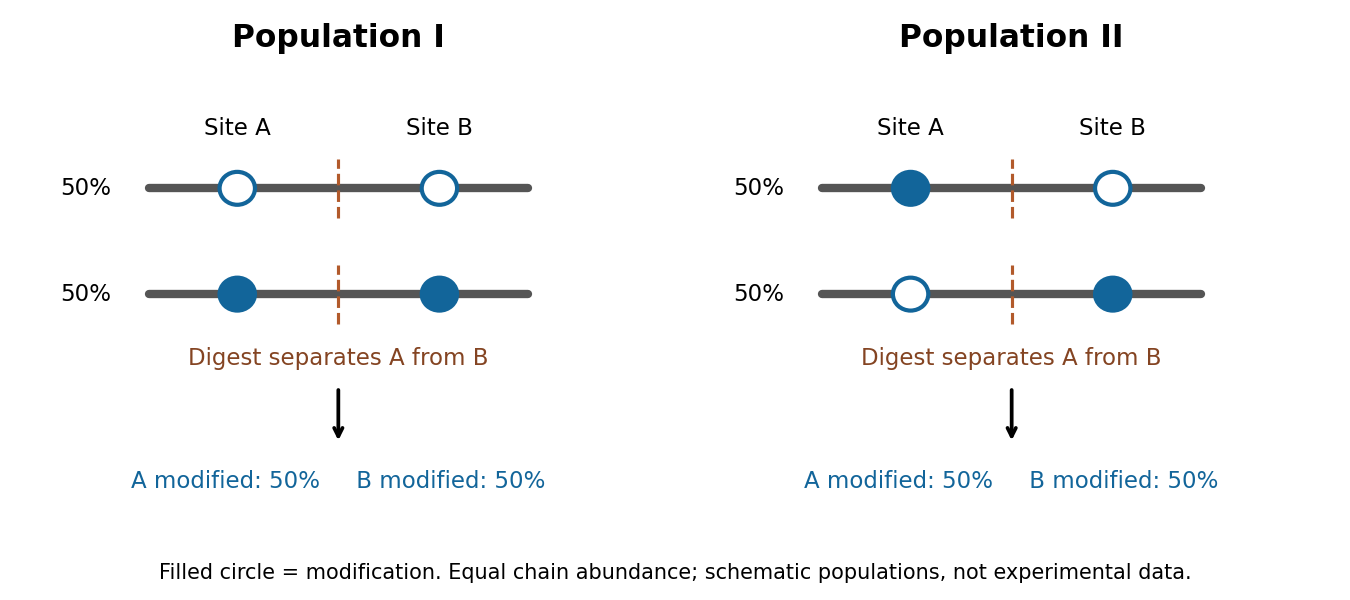

top-down proteomics addresses this by separating and measuring intact proteins before fragmenting their selected ions. High-resolution intact mass constrains the total composition, while sequence fragments connect modifications to the same molecule and localize them. Electron-based fragmentation can help retain modifications lost during energetic fragmentation. middle-down proteomics uses larger fragments to recover partial linkage when complete intact-chain characterization is difficult. John C. Tran and colleagues demonstrated discovery-scale intact-protein analysis, illustrating that sequence variants and modification patterns can be mapped together rather than reconstructed solely from disconnected peptides.[ref]
Mapping intact protein isoforms in discovery mode using top-down proteomics by John C. Tran and others. Intact-protein fractionation and identification of linked isoforms
Intact mass alone remains insufficient: positional isomers with the same mass require informative fragmentation or additional separation, and one envelope can contain unresolved forms.A practical programme would combine these measurements across well-defined human cell populations, using biological replicates, standardized handling and a documented range of physiological perturbations. It would use sequence-resolved RNA data to constrain searches, broad bottom-up data to locate promising variation, and targeted top-down or middle-down analysis to establish co-occurrence. Spike-in proteins spanning abundances and sizes would measure extraction loss and detection sensitivity. Time courses, immediate protein denaturation, protease and phosphatase inhibition, and processing blanks would help distinguish cellular modification from oxidation, protein deamidation or cleavage during preparation. Very large, hydrophobic and scarce proteins require specific extraction and separation strategies; their absence from a spectrum cannot be treated as biological absence.
Bulk and single-cell measurements answer different questions. A bulk sample may show two proteoforms expressed in different cells; it does not show that both occur in each cell. Conversely, detecting two modifications in one cell does not demonstrate that they occupy the same protein molecule. Single-cell sensitivity and molecular linkage must therefore be evaluated separately. Quantitative standards and targeted follow-up can establish whether a new low-abundance assignment is reproducible rather than a one-off incorrect match.
Finally, merge identifications by molecular identity rather than by peptide count, search-engine entry or ion charge. Record fully characterized forms separately from groups sharing an unresolved mass or site pattern, and control identification error at the proteoform level. Plot discovery against sampling depth, tissues and perturbations; any extrapolation to unseen forms requires explicit assumptions about abundance and sampling heterogeneity. Sequence prediction supplies candidates, peptide analysis supplies coverage, and intact or linked-fragment evidence establishes combinations. A universal exact count cannot be inferred by multiplying modification sites or summing database entries.
I would increase the supply of correctly matured translation elongation factor P in a bacterial production system whose target proteins contain EF-P-sensitive proline motifs. This is a concrete proposal to relieve a catalytic bottleneck while preserving the machinery that selects the correct aminoacyl-tRNA. Its benefit should be tested for the chosen products rather than asserted for every protein or organism.
The rationale is that adjacent prolines are difficult substrates for peptide-bond formation. EF-P binds the ribosome near the peptidyl-tRNA and assists productive peptide-bond formation at susceptible sequences. Lili K. Doerfel and colleagues used defined biological translation reactions and engineered substrates to connect EF-P with rapid synthesis through consecutive prolines; Susanne Ude and colleagues showed relief of polyproline-dependent stalling and physiological regulation of the bacterial protein CadC.[ref]
EF-P is essential for rapid synthesis of proteins containing consecutive proline residues by Lili K. Doerfel and others. Defined peptide-bond formation and proline-containing substrates
[ref]Translation elongation factor EF-P alleviates ribosome stalling at polyproline stretches by Susanne Ude and others. Polyproline stalls and CadC expression
Increasing functional EF-P is therefore mechanistically different from weakening decoding discrimination or accelerating rejection-sensitive steps indiscriminately.I would first establish the limiting step in a reconstituted bacterial biological translation system, holding the mRNA, ribosome concentration, initiation factors, charged tRNA supply and energy regeneration constant. Titrate correctly modified EF-P against the unmodified or inactive factor. For an Escherichia coli production strain, coordinate EF-P expression with its native maturation enzymes: increasing an inactive, insufficiently modified pool may add burden without relieving stalls. Introduce the change in a tunable manner and verify both EF-P abundance and its modification state by targeted mass spectrometry. This is an engineering proposal based on demonstrated factor function; the cited experiments do not establish that overexpression will improve every industrial production strain.
A simple throughput calculation makes the scope explicit. If a ribosome needs for ordinary elongation and termination, and an additional at susceptible stalls, the completion capacity of productive ribosomes is approximatelyThis neglects initiation limitation, traffic and variation between ribosomes. As an illustrative calculation, reducing stall time from 20 s to 2 s when the remaining cycle takes 30 s raises the capacity by at unchanged quality. A product without substantial EF-P-sensitive stalls would show little direct benefit. Moreover, extra ribosomes do not necessarily increase output if they collide behind a slow site; relief of the bottleneck may free ribosomes as well as accelerate individual chains.
Preserving error control requires more than measuring total protein. aminoacyl-tRNA synthetase editing controls charging identity, while ribosomal initial selection and kinetic proofreading help discriminate cognate from near-cognate tRNAs. These should remain intact. If an independent per-residue missense probability is for a chain of length , the error-free fraction is approximately ; even a small per-residue deterioration can matter for a long protein. EF-P acts principally on difficult peptidyl transfer, but altered dwell times can still change ribosomal frameshifting, folding and quality control. The proposal promises a testable route to low-error acceleration, not an automatic absence of side effects.
The central controls would use the same target sequence, promoter and untranslated regions with or without added active EF-P. An inactive or maturation-defective factor tests whether catalytic assistance, rather than nonspecific protein overexpression, accounts for the gain. A motif-free reporter tests specificity. A proline-substitution reporter can test the mechanism, but cannot substitute for testing the unchanged production target because it changes the product itself. Measure growth and resource burden and include several EF-P doses: excessive factor supply may become inhibitory or wasteful. Use matched biological replicates and establish that mRNA abundance or stability has not changed enough to explain the result.
Measure elongation using time-resolved synthesis and normalized ribosome profiling, looking for relief at the predicted stall sites and reduced collisions. Profiling alone does not measure completed protein flux. Pulse–chase measurements and calibrated mass spectrometry of full-length products should establish completion, while an activity assay tests correct folding. fluorescence alone is inadequate because fluorophore maturation and degradation also affect signal. Separate assays should quantify missense incorporation, stop-codon readthrough and frameshifts, with positive error controls and detection limits. Mass-spectrometric error measurements require standards because erroneous and correct peptides need not ionize equally.
Finally, compare soluble active yield, not just synthesis speed: some pauses aid cotranslational folding, and relieving them can lower useful output. If substrate or charged tRNA supply becomes limiting, rebalance those components rather than weakening kinetic proofreading. A successful result is a reproducible increase in completed, correctly folded target molecules per unit time, with no material increase in independently measured error classes. Extension to other sequence bottlenecks would require their own mechanistic diagnosis.
NMR of membrane proteins became practical through coordinated improvements in sample preparation, isotope labelling, relaxation control, instrumentation and solid-state methods. The obstacle is not simply that cell membranes are insoluble. Hydrophobic surfaces must remain shielded, while the protein must retain function and form a sufficiently homogeneous sample. In solution, the protein plus its detergent or lipid assembly tumbles slowly; rapid transverse relaxation then broadens resonances until assignments and structural restraints become difficult to obtain.
Recombinant expression and controlled isotope labelling allow selective observation of the protein against its environment. Uniform nitrogen-15 and carbon-13 labelling supports multidimensional assignments. deuteration reduces much proton–proton dipolar relaxation; reintroducing selected protons or labelled methyl groups retains sensitive reporters while limiting the relaxation network. selective methyl labelling is particularly useful for large complexes, but the sparse reporters do not automatically supply enough restraints for a unique complete structure. Exchangeable amide protons may also need back-exchange after growth in deuterated medium, and buried sites can exchange incompletely. Sample production, rather than the spectrometer alone, is therefore a central technical development.
The membrane mimic must balance biological fidelity and spectroscopic tractability. Detergent micelles shield hydrophobic surfaces and can produce relatively small assemblies; inappropriate detergents may alter packing, activity or oligomeric state. bicelles combine bilayer-forming lipids with components that stabilize their edges, and lipid bilayer nanodiscs use a scaffold to enclose a bilayer patch. Smaller, well-defined nanodiscs reduce the additional rotational burden. Franz Hagn and colleagues engineered optimized small nanodiscs and obtained high-resolution NMR information on the membrane protein OmpX, connecting scaffold design with a more tractable lipid-embedded sample.[ref]
Optimized phospholipid bilayer nanodiscs facilitate high-resolution structure determination of membrane proteins by Franz Hagn and others. Small scaffold design and OmpX structure determination
No mimic is automatically native: compare ligand binding, transport or catalytic activity with an appropriate cell membrane preparation, and check concentration-dependent aggregation and oligomerization.transverse relaxation-optimized spectroscopy selects a slowly relaxing component of a coupled spin system. For suitable nuclei and fields, dipolar and chemical shift anisotropy contributions partly cancel for one component while reinforcing others. Combined with deuteration, this preserves narrower lines in systems that would otherwise be inaccessible. The original TROSY experiments established the relaxation-interference principle rather than merely increasing signal by averaging longer.[ref]
Attenuated T2 relaxation by mutual cancellation of dipole-dipole coupling and chemical shift anisotropy indicates an avenue to NMR structures of very large biological macromolecules in solution by Konstantin Pervushin and others. Theory and experimental demonstration of relaxation interference
Methyl-based variants exploit favourable methyl relaxation properties and selective labelling. Increasing magnetic field improves sensitivity and frequency dispersion, but also changes relaxation contributions; it is not correct to assume that every resonance becomes narrower at every higher field.High-field magnets, stable radiofrequency electronics and cryogenic detection probes increase accessible sensitivity and resolution. Three-dimensional and higher-dimensional experiments spread overlapping signals and connect resonances through known covalent pathways. Once assignments are secure, nuclear Overhauser effects provide distance information, while residual dipolar couplings and paramagnetic relaxation enhancement can add orientational and longer-range constraints. chemical shift perturbations report changes in local environment on ligand binding, but do not by themselves determine a contact geometry. Each additional measurement restricts the structural model in a different way, which is particularly valuable when only a sparse set of membrane-protein resonances remains visible.
solid-state nuclear magnetic resonance provides a complementary route that does not require rapid overall tumbling. proteins can be studied in bilayers or other immobilized assemblies, using pulse sequences and sample orientation or magic angle spinning to control anisotropic interactions. The magic angle satisfies , giving . Spinning averages appropriate orientation-dependent terms, while decoupling, isotope dilution or deuteration and fast spinning reduce broadening from dense spin networks. Proton detection at very high spinning rates improves sensitivity; Loren B. Andreas and colleagues demonstrated structures of fully protonated proteins using fast-spinning proton-detected experiments, an important general methodological advance rather than a demonstration that every cell membrane sample is thereby solved.[ref]
Structure of fully protonated proteins by proton-detected magic-angle spinning NMR by Loren B. Andreas and others. Proton detection with approximately 100 kHz magic-angle spinning
dynamic nuclear polarization can additionally enhance signal through electron-to-nuclear polarization transfer, although radicals and cryogenic conditions can affect line widths and the conformational states observed.The outcome is both structural and functional information. Spectra can distinguish conformations, map ligand responses and measure exchange even when no single static structure describes the system. Empty micelles or scaffold-only nanodiscs help identify environmental signals; unlabelled samples, independent assignments and distance-restraint validation guard against incorrect peaks and overfitting. Compare preparations and activity before and after long acquisitions, because aggregation or degradation can selectively remove signals. A missing peak may reflect exchange broadening or overlap, not an absent residue. The enabling combination is a functional and homogeneous cell membrane environment with an isotope and pulse-sequence strategy matched to the size and dynamics of the assembly; solution and solid-state NMR cover complementary regimes.
Biophysical measurements show that enzymes occupy enzyme conformational ensembles; establishing which motions control function requires linking those ensembles to particular kinetic steps. Motions range from picosecond side-chain fluctuations to microsecond–millisecond loop rearrangements and slower domain transitions. They can govern substrate access, productive alignment, chemistry or product release. These roles must be distinguished: the steady-state turnover rate describes the entire catalytic cycle and need not equal the rate of bond making or breaking.
crystallography identifies the structural framework and can reveal alternative loop positions or ligand-dependent states. Room-temperature measurements and time-resolved experiments can capture changes hidden by a single cryogenic model. Nevertheless, a displacement parameter combines motion, static disorder and modelling uncertainty, and a series of structures is not itself a trajectory or a rate measurement. Spectroscopic measurements in solution are particularly useful because they measure fluctuations and exchange while the enzyme remains in a defined chemical state.
nuclear magnetic resonance resolves dynamics at individual sites. longitudinal nuclear spin relaxation and transverse relaxation and heteronuclear nuclear Overhauser effects constrain fast fluctuations; a model-based protein NMR order parameter describes the amplitude of bond-vector motion after accounting for overall tumbling. NMR relaxation dispersion measures how exchange contributes to relaxation as refocusing conditions change. A two-state analysis can constrain an exchange rate , state populations and a chemical shift difference. Measurements at multiple fields and temperatures help separate these parameters, but alternative models and insensitive time windows remain limitations. The inferred minor-state chemical shifts can be compared with separately characterized ligand-bound structures; one should not equate a dispersion curve with a fully resolved molecular movie.
In dihydrofolate reductase, relaxation measurements detected sparsely populated states related to other intermediates of the catalytic cycle, supporting a pre-existing landscape from which ligand binding can select conformations.[ref]
The dynamic energy landscape of dihydrofolate reductase catalysis by David D. Boehr and others. Relaxation dispersion across catalytic intermediates
This connects conformational selection with enzymatic progression without excluding subsequent induced fit. In cyclophilin A, comparison of the free enzyme and catalytic conditions showed an intrinsic network of conformational exchange whose rates were associated with turnover.[ref]Intrinsic dynamics of an enzyme underlies catalysis by Elan Z. Eisenmesser and others. NMR comparison of free enzyme and catalytic exchange
Matching rates is informative but not sufficient to prove that a particular motion limits chemistry: the measured exchange may be a coupled consequence, or another step can occur on a similar timescale.Kinetic methods provide the essential bridge. stopped-flow mixing follows a rapid fluorescence or absorbance response after substrate addition; rapid quench-flow terminates reactions at selected delays and measures chemical products. Binding, conformational change and chemical conversion can thus be fitted to competing kinetic schemes rather than all assigned to a single observed exponential. A pre-steady-state burst can reveal fast chemistry followed by slower release, although its amplitude also depends on the active enzyme fraction and mechanism. temperature jumps perturb an existing equilibrium on shorter timescales and expose relaxation back toward it. isotope substitution can help identify a chemical step, but changes in observed isotope effects must be interpreted within the complete kinetic scheme.
Single-molecule Förster resonance energy transfer adds information lost in population averages. A donor–acceptor pair reports a distance-sensitive efficiency,where the characteristic distance depends on the dyes and their photophysical environment. Trajectories can reveal state dwell times, heterogeneous pathways and ordering of domain transitions relative to a turnover reporter. Labels must preserve activity; donor-only and acceptor controls, corrections for detection efficiencies, and tests for blinking or bleaching are necessary. A FRET change can arise from dye orientation or local quenching, so corroborating distances or structural data are required before assigning a specific domain movement. A mean efficiency also cannot simply be converted into the mean molecular distance because the relation is nonlinear.
hydrogen-deuterium exchange mass spectrometry maps changes in protection and solvent accessibility across an enzyme, usefully locating regions altered by substrate binding or mutation. Exchange also depends on hydrogen bonding, local opening equilibria and chemical conditions, so it is not a direct universal clock for internal motion. molecular dynamics can connect observed sites to candidate atomic pathways and predict further tests. Its force field, sampling and treatment of chemistry limit inference; a conventional classical trajectory does not demonstrate bond-breaking kinetics by itself.
Causal perturbation is stronger than correlation when coupled to these measurements. In the DHFR “dynamic knockout” study, the N23PP/S148A variant retained a closely similar active site ground-state structure but lost much active site millisecond exchange and showed slower hydride transfer. The S148A comparison was especially informative: it also altered the large closed-to-occluded transition yet retained more exchange and much faster chemistry.[ref]
A dynamic knockout reveals that conformational fluctuations influence the chemical step of enzyme catalysis by Gira Bhabha and others. Figures 3–4 and mutant comparison of hydride-transfer rates
This argues against identifying the gross loop transition itself as the obligatory chemical event. Controls must still examine stability, binding, active site geometry and altered electrostatic or solvation ensembles: a mutation is not an isolated dial for “motion”.A coherent mechanistic account therefore combines structural states, populations, exchange rates, independently resolved chemical kinetics and perturbations that make successful predictions. In an activated-rate description , changing access to productive arrangements can alter the relevant free-energy barrier or pre-equilibrium population. Motions do not provide a new energy source outside thermal fluctuations and chemical free energy. Internal motions can gate access, organize reactive configurations and permit release; which role matters is an experimental question for each enzyme and each step.
A DNA library synthesis method determines which variants can be reached, how often they are sampled, and which evolutionary paths remain available. The nominal number of DNA molecules is less informative than the distribution of functional amino acid sequences presented to the assay. directed evolution couples diversification to a genotype-phenotype linkage, screening or selection, and recovery of successful genotypes. Construction controls the accessible moves through protein sequence space and therefore interacts with assay capacity, starting sequence and epistasis; it is part of the evolutionary strategy rather than an interchangeable preliminary step.
error-prone PCR explores substitutions throughout an existing gene without requiring prior structural knowledge. R. Craig Cadwell and Gerald F. Joyce demonstrated controlled PCR mutagenesis using a ribozyme sequence, establishing a general route for generating variant templates.[ref]
Randomization of genes by PCR mutagenesis by R. Craig Cadwell and Gerald F. Joyce. Altered PCR fidelity and distribution of mutations
For protein evolution, polymerase preferences, sequence context and the genetic code make amino acid changes uneven: a substitution requiring two nucleotide changes is less accessible than a single-base neighbour. Increasing the mutation rate reaches more distant variants but often increases inactive products and makes attribution difficult. Insertions and deletions can also change the reading frame. Existing useful sequence combinations are usually retained at a low mutation load, but extensive remodelling is hard to reach by successive selections if intermediate genotypes are deleterious.An idealized Poisson distribution with mean mutation count makes this trade-off quantitative:At , about 37% of molecules have no change and 37% have one; at , only about 5% are unchanged and about 80% contain two or more changes. This is a planning model, not a guarantee that a real PCR DNA library is unbiased or independent at every site. Early PCR events can generate many related descendants, and the number of nucleotide mutations is not the number of distinct amino acid substitutions.
Oligonucleotide-directed saturation mutagenesis concentrates the assay budget at specified sites, for example an active site pocket or an interface. degenerate codons are convenient but biased. NNK and NNS each encode 32 codons, including one stop codon, with unequal multiplicities for different amino acids. At independently synthesized sites the ideal fraction lacking these introduced stops is , even before assembly errors or deleterious substitutions. A DNA library of amino acid combinations can therefore contain many redundant codons and uneven representation. Trinucleotide mixtures assemble complete chosen codons and can exclude stops, equalize amino acid sampling, or deliberately favour a chemically relevant subset. Bernhard Virnekas and colleagues developed such trinucleotide phosphoramidites for mixed-oligonucleotide synthesis.[ref]
Trinucleotide phosphoramidites: ideal reagents for the synthesis of mixed oligonucleotides for random mutagenesis by Bernhard Virnekas and others. Whole-codon synthesis for controlled amino-acid mixtures
Controlled diversity is valuable, but restricting sites according to an incomplete structural model can miss beneficial remote mutations.DNA shuffling offers a different move: genetic recombination among already useful or homologous sequences. Random fragmentation followed by annealing and polymerase extension reconstructs genes from overlapping parental fragments. Willem P. C. Stemmer demonstrated reassembly and genetic recombination, including chimeric sequences, providing a practical route to combine sequence blocks rather than relying only on isolated substitutions.[ref]
DNA shuffling by random fragmentation and reassembly: in vitro recombination for molecular evolution by Willem P. C. Stemmer. Fragmentation, gene reassembly and recombinant products
This can unite improvements acquired in separate lineages and remove unwanted changes by genetic recombination with a parent. However, crossovers favour compatible homologous regions, closely related parents may add little diversity, and breaking a coadapted combination can lower fitness. Positive or negative epistasis means the fitness of a recombinant cannot be predicted by adding the effects of its parental substitutions.Designed synthetic genes and pooled oligonucleotide assembly can specify more extensive combinations, deletions, insertions or carefully chosen paths between distant sequences. This can test combinations inaccessible to single-base steps and explicitly balance beneficial candidates against exploratory variants. The cost is that synthesis, assembly and amplification introduce errors and abundance differences; a designed sequence is not necessarily a correctly constructed or well represented molecule. Long constructs may need assembly from overlapping fragments, and different fragment yields can skew the DNA library. A finite screen also prevents exhaustive exploration simply by purchasing a larger pool.
Sampling makes these differences concrete. If a target variant has DNA library frequency , screening independent clones finds it with probabilityFor equally frequent variants, the expected number of distinct variants observed is . Screening 1000 clones from a uniform two-site amino acid DNA library with visits about 92% of the variants on average; from a three-site DNA library with , it visits only about 12%. These are expected fractions, not probabilities that every variant has been sampled. Roughly clones give a 95% chance of observing one specified rare variant when is small. Synthesis bias and clonal duplication can make the effective coverage substantially worse.
The course of evolution should therefore be planned alongside screening. Begin with a mutation load or site set that the assay can actually cover, sequence the unselected DNA library to measure mutation spectra, stop frequency, parental carry-over and representation, and compare those frequencies with selected output. Use matched expression conditions and retain genotype-phenotype linkage: selection for growth, expression or display can otherwise enrich a variant that performs poorly as a purified enzyme. Reconstruct hits independently, sequence the complete gene, measure soluble protein and validate the desired activity or specificity at controlled protein concentration. Include parental and known inactive controls and, where relevant, more than one substrate or environmental condition. Subsequent rounds can recombine verified hits, adjust mutation load or target sites suggested by the first round. The best synthesis method maximizes useful, testable diversity under the assay budget and enables appropriate paths through the fitness landscape; maximal random diversity alone is not the objective.
Artificial recruitment separates recognition of an RNA target from the activity of the recruited regulator. In an RNA tethering assay, a reporter carries binding hairpins for a defined RNA-binding module, such as MS2 coat protein. Fusing the candidate regulator to that module places it on the reporter without requiring its normal sequence-recognition mechanism. The experiment asks whether recruitment is sufficient to change RNA processing, localization, stability or biological translation, and which parts of the regulator produce that change. It does not establish that the endogenous protein normally finds that RNA or that artificial occupancy has a physiological affinity.
A basic design compares a reporter with and without intact hairpins, expressing either the coat protein alone or the fusion at matched levels. Measure reporter RNA and protein separately, with an untethered reporter as an internal control. protein output alone is ambiguous: a reduction can reflect fewer RNA molecules, lower biological translation per molecule, altered protein stability or general toxicity. In a simple constant-rate model,where and are RNA and protein amounts, is RNA synthesis, and the other coefficients describe RNA decay, biological translation and protein loss. Thus one protein endpoint cannot identify which rate changed. Time-resolved RNA measurements, poly(A)-tail analysis and a direct synthesis assay discriminate these possibilities. Place hairpins in several non-disruptive positions and vary their number, because an array can change RNA structure, sterically impede machinery or create nonphysiological multivalency. Confirm fusion integrity, localization and RNA association; a nonfunctional fusion is not evidence that the candidate lacks regulatory activity.
A foundational application concerned poly(A)-binding protein. Jeffery M. Coller and colleagues tethered yeast Pab1p to a reporter's 3′ region and showed stabilization even without a poly(A) tail. Domain analysis separated the stabilization activity from the domains required for normal poly(A) recognition, while biological translation dependence showed that protection was coupled to the translated state.[ref]
mRNA stabilization by poly(A) binding protein is independent of poly(A) and requires translation by Jeffery M. Coller and others. Tethered Pab1p, tail-independent stabilization and domain tests
The important inference is that an RNA element can act by recruiting an effector: the poly(A) sequence is not intrinsically required for every downstream stabilizing action. This is stronger mechanistic information than a correlation between long tails and stable RNA, although artificial recruitment does not imply that natural poly(A) tails have no other functions.Tethering also revealed positional logic in nonsense-mediated decay. Jens Lykke-Andersen and colleagues recruited human UPF proteins to a β-globin reporter downstream of its termination codon and induced RNA decay. Pulse–chase measurements established decay, and dependence on biological translation, downstream positioning and functional UPF machinery connected the effect with surveillance rather than nonspecific destruction.[ref]
Human Upf proteins target an mRNA for nonsense-mediated decay when bound downstream of a termination codon by Jens Lykke-Andersen and others. Reporter decay, position controls and UPF dependence
Recruitment can therefore supply an otherwise missing recognition signal. Together with association of UPF proteins with spliced RNA, the result helped connect a nuclear processing history to cytoplasmic interpretation of termination. It does not show that every natural surveillance substrate requires an exon junction complex or that tethered UPF proteins act without other factors.A further use is to order the steps of microRNA silencing. Natural recognition involves a guide-loaded Argonaute complex and recruitment of GW182. Tethering GW182 or its silencing domain bypasses guide–target pairing; mutating interaction surfaces or depleting downstream complexes then tests whether recruited GW182 can promote repression and deadenylation. Biochemical interaction and functional analyses showed direct recruitment of cytoplasmic deadenylase complexes, including CCR4-NOT complex, by GW182.[ref]
GW182 proteins directly recruit cytoplasmic deadenylase complexes to miRNA targets by Joerg E. Braun and others. Direct deadenylase interactions and silencing requirements
Combined evidence distinguishes deadenylase recruitment from a model in which tail shortening occurs only indirectly after translational arrest. Nevertheless, repression and decay can be coupled, and their order must be measured rather than inferred from one endpoint.Domain deletions, catalytic mutants and interaction-defective variants make the approach particularly informative. If removing an RNA-binding domain destroys natural regulation but tethering restores it, that domain may chiefly mediate recruitment. If an effector-domain mutation remains inactive despite confirmed tethering, it identifies a post-recruitment requirement. Recruitment of an upstream component that fails when a downstream component is depleted provides an epistasis test; rescue with a depletion-resistant downstream factor strengthens the ordering. Expression and folding controls are essential because a deletion can destabilize the entire protein. Conversely, a tethered factor may simply recruit an endogenous partner, so sufficiency of a fusion does not establish autonomous catalytic action.
The strongest interpretation combines these manipulations with endogenous binding maps, mutation of natural RNA sites and physiological loss-of-function/rescue experiments. The resulting contribution is a modular view of regulation: RNA recognition chooses the substrate, while separable interaction or catalytic domains determine the outcome, and RNA position can change that outcome. Tethering establishes conditional sufficiency after recruitment; native targeting and physiological necessity require complementary experiments.
TFx induction makes it a candidate regulator, not yet a cause of neuronal differentiation. I would test when and where it acts, whether it is necessary or sufficient for a specific developmental transition, and which directly regulated genes explain the phenotype. The initial time-course result could instead reflect increasing neuronal abundance, selective survival, a response to differentiation, or expression of an inactive isoform.
First validate the observation in independent differentiations using quantitative RNA measurements and a specificity-validated protein assay. Examine transcript isoforms, protein abundance and nuclear localization over time, comparing neural precursors, differentiating neurons and other biological cell populations. single-cell RNA sequencing combined with imaging can determine whether TFx increases within a lineage or merely marks a population that becomes more common. Actual sampling times and lineage labels should anchor the analysis: a pseudotime ordering alone does not establish chronology or ancestry. Use independent donors or clones and differentiation batches as biological replicates, while tracking biological cell number, proliferation and apoptosis. A bulk increase caused by loss of another population is different from TFx activation within surviving precursors.
For necessity, reduce TFx using at least two independent perturbations, for example CRISPR interference and an independent guide or RNA interference reagent, or generate a verified gene knockout where viable. Rescue with a perturbation-resistant TFx expressed near its normal level. An inducible degron would provide faster and more sharply timed protein depletion than waiting for an existing pool to disappear after transcriptional inhibition. Perturb before commitment, during neuronal maturation and after maturation, using matched induction controls. A defect confined to the early window suggests a role in commitment; a late defect could instead concern maturation or maintenance. Constitutive loss followed by a late endpoint cannot distinguish these possibilities and can select compensatory biological cells.
The readout must define the affected transition. Count precursor and neuronal states, measure cell-cycle exit, neurite architecture and subtype markers, and assess mature physiology with patch-clamp recording and synaptic assays where appropriate. A marker-positive biological cell is not necessarily a functional neuron. Measure survival alongside fate: fewer neurons after TFx depletion could arise because neurons die rather than because precursors fail to differentiate. Track labelled starting biological cells through the transition and compare proportions as well as absolute output. If TFx changes only a particular neuronal subtype, a generic pan-neuronal assay could miss or misclassify its function.
For sufficiency, induce TFx at controlled levels in competent precursors under subthreshold differentiation conditions, and test whether it accelerates or redirects the transition. Include an empty-vector control, a DNA-binding-defective TFx variant and, if the domain architecture permits, a transcriptional-effector-defective variant. Test a second cellular context rather than assuming that all biological cells possess the required cofactors. Defined transcription-factor combinations can convert mouse fibroblasts into functional neurons, as demonstrated by Thomas Vierbuchen and colleagues, but this is an experimental precedent rather than evidence that the unspecified TFx is one of those factors.[ref]
Direct conversion of fibroblasts to functional neurons by defined factors by Thomas Vierbuchen and others. Factor-combination screen and physiological neuronal validation
Failure of TFx alone to induce neurons would not exclude an essential combinatorial role; strong overexpression could also create an activity absent at endogenous levels.Next identify the direct regulatory programme. Map TFx-associated DNA with an endogenous epitope tag and CUT&RUN or chromatin immunoprecipitation, validating antibody specificity against TFx-depleted biological cells and including appropriate background controls. The targeted nuclease strategy underlying CUT&RUN provides a route to map protein-associated genomic regions at low background.[ref]
An efficient targeted nuclease strategy for high-resolution mapping of DNA binding sites by Peter J. Skene and Steven Henikoff. Targeted nuclease mapping of protein-associated DNA
Combine binding with short-interval nascent-RNA measurements after acute TFx removal, before a large fate or survival shift occurs. Occupancy plus an early expression response prioritizes direct candidates; binding alone does not prove regulation, and a response without detected binding may be indirect or reflect an undetected distal site.ATAC-seq before and after perturbation can test whether TFx changes accessibility, while histone-mark measurements and cofactor interaction assays refine the mechanism. Work on ASCL1 reprogramming showed hierarchical factor action and context-dependent chromatin engagement, motivating tests of whether TFx acts as a pioneer transcription factor or requires already accessible DNA.[ref]
Hierarchical mechanisms for direct reprogramming of fibroblasts to neurons by Orly L. Wapinski and others. Chromatin engagement and hierarchical transcription-factor activity
Increased accessibility after TFx expression alone does not prove direct opening; first establish binding and an early response at that locus.Finally edit a candidate TFx-binding motif at an endogenous enhancer, quantify target expression and differentiation, and compare with a matched neutral edit. Rescue a TFx-loss phenotype with the proposed downstream target or programme, while testing whether that target is required for TFx-induced differentiation. Such genetic ordering connects a molecular target to the biological effect; a plasmid reporter alone omits the native chromatin context. A justified conclusion would specify the transition, biological cell type, timing and direct targets supported by perturbation and rescue, while distinguishing differentiation from survival and maturation.
RNA couples iron availability to the production of proteins that acquire, store, export and use iron. The clearest mammalian mechanism uses structured iron-responsive elements in untranslated regions and iron-regulated binding proteins. The RNA element encodes a regulatory address and its position determines the response; the main sensing machinery is protein-based, so this system should not be described as an autonomous iron-binding RNA riboswitch.
An iron-responsive element is a stem-loop with conserved sequence and structural features recognized by iron regulatory proteins. At low available iron, RNA-binding IRP1 and IRP2 are active. IRP1 is bifunctional: an iron–sulfur-cluster-containing form acts as cytosolic aconitase, whereas loss of the functional cluster permits high-affinity RNA binding. Biochemical disassembly of its cluster connected these two activities directly.[ref]
Cellular regulation of the iron-responsive element binding protein: disassembly of the cubane iron-sulfur cluster results in high-affinity RNA binding by David J. Haile and others. Cluster state and RNA-binding activity
IRP2 does not use the same aconitase switch. Under iron- and oxygen-replete conditions, the FBXL5 ubiquitin-ligase pathway promotes IRP2 degradation; instability of the iron-sensitive FBXL5 regulator during iron depletion helps preserve IRP2.[ref]An E3 ligase possessing an iron-responsive hemerythrin domain is a regulator of iron homeostasis by Ameen A. Salahudeen and others. FBXL5 sensing, stability and IRP2 degradation
Redox and oxygen conditions can therefore modify the relation between total cellular iron and RNA-binding activity.The canonical 5′ example is ferritin mRNA. Binding of an IRP near the cap prevents efficient recruitment of the translation-initiation machinery, lowering ferritin synthesis when iron is scarce. This avoids committing a limited resource to storage. When iron is plentiful, reduced IRP occupancy releases repression, allowing more ferritin to store iron and limit its reactive pool. Deletion analysis and transfer of a synthetic ferritin element to another reporter established a cis-acting signal sufficient to confer iron-responsive biological translation.[ref]
Identification of the iron-responsive element for the translational regulation of human ferritin mRNA by Matthias W. Hentze and others. Ferritin leader deletion and synthetic-element transfer
This response can change biological translation before a major change in transcript abundance occurs.At the 3′ end of transferrin receptor 1 mRNA, multiple IREs participate in a stability-control region. IRP binding during iron shortage protects the message from destabilization, increasing receptor production and iron uptake. At higher iron, loss of protection permits more rapid decay and reduces uptake. John L. Casey and colleagues showed that the transferrin-receptor 3′ region conferred iron-regulated RNA abundance and that isolated elements placed in a 5′ reporter context instead conferred translational control.[ref]
Iron-responsive elements: regulatory RNA sequences that control mRNA levels and translation by John L. Casey and others. Context-dependent reporter regulation by ferritin-like stem-loops
Thus similar recognition chemistry supports opposite outputs through different transcript positions and associated machinery.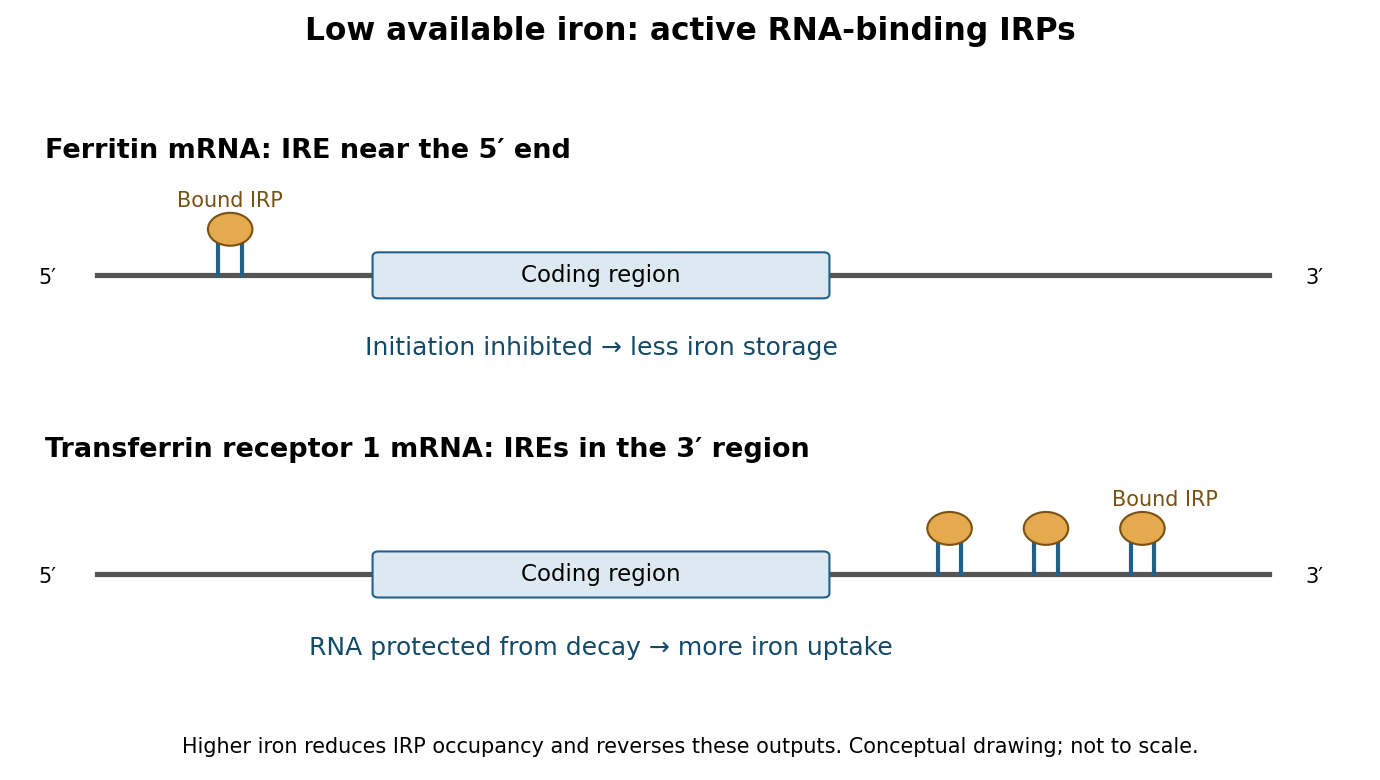
Low iron produces coordinated but opposite outputs from 5′ and 3′ iron-responsive elements
. Details. 
The network also adjusts use and release. A 5′ IRE in erythroid ALAS2 mRNA couples synthesis of a haem-pathway enzyme to iron availability, helping limit production of porphyrin precursors when metal incorporation is restricted.[ref]
Identification of a novel iron-responsive element in murine and human erythroid delta-aminolevulinic acid synthase mRNA by Thomas Dandekar and others. Erythroid ALAS leader element and iron-dependent translation
IRE-containing ferroportin transcripts can reduce iron export through translational repression during deficiency.[ref]Ferroportin IRE regulation study by Athina Lymboussaki and others. IRE deletion reporters distinguish protein-output regulation from RNA abundance
These are transcript-specific rules, not universal predictions from a gene name: alternative transcripts can lack an IRE, and ferroportin is also regulated at the protein level by systemic signals. The central RNA logic coordinates uptake with conservation, rather than simply maximizing the expression of every iron-related protein.Regulation beyond the mammalian IRE system illustrates a broader eukaryotic principle. In budding yeast, iron deficiency induces the RNA-binding regulator Cth2, which recognizes AU-rich elements in selected 3′ regions and accelerates degradation of messages encoding iron-consuming metabolic functions. This remodels resource allocation rather than protecting an uptake message. Sergi Puig and colleagues combined expression and RNA-turnover analysis with RNA-element recognition to establish targeted degradation during deficiency.[ref]
Coordinated remodeling of cellular metabolism during iron deficiency through targeted mRNA degradation by Sergi Puig and others. Cth2-dependent turnover of iron-utilization transcripts
It is therefore misleading to generalize that iron shortage always stabilizes iron-related RNA: the direction depends on the transcript and its physiological role.To establish these mechanisms experimentally, compare iron chelation with iron restoration, measuring available iron, IRP–RNA binding, transcript half-life and newly synthesized protein separately. Match reporter transcription and mutate recognition features without inadvertently changing general RNA stability. For a stem-loop, a compensatory paired mutation helps distinguish loss of structure from loss of a specific sequence contact. Electrophoretic binding assays with purified protein, cellular crosslinking and rescue with functional versus binding-defective IRP variants connect recognition to regulation. RNA-abundance measurements alone cannot establish translational repression, and chelators can cause broad stress, so unrelated control reporters and viability measurements are needed. The decisive principle is position-dependent RNA control: low iron can repress storage and export biological translation while preserving uptake RNA and reducing expendable iron-consuming programmes.
Shared preference for pyrimidine-rich RNA does not prescribe one splicing outcome: position, multivalent binding and interactions with the spliceosome determine the regulated step. Sex-lethal acts in the Drosophila sex-determination programme, whereas PTBP1 regulates many mammalian precursor RNAs in a cell-type-dependent manner. Their effects must be interpreted against competing splice sites and the proteins normally recognizing them.
During early spliceosome assembly, U1 snRNP recognizes a 5′ splice site, while factors including U2AF help recognize a polypyrimidine tract and 3′ splice-site region and promote assembly around the branch point. Alternative sites compete within this context. Binding of another RNA-binding protein can occlude an essential interaction, organize a repressive complex or favour use of a competing site; recognition need not be determined solely by an isolated site's consensus strength.
A particularly clear SXL mechanism operates on precursor RNA encoding Transformer protein. In the absence of SXL, U2AF recognizes a strong default 3′ site, producing an unproductive transcript. In female biological cells, SXL binds the pyrimidine-rich region at that site and competes with U2AF. The weaker alternative female site can then be used, producing functional Transformer protein. Reconstituted splicing experiments showed the antagonism, and adding a U2AF effector domain to SXL converted its activity from repression toward activation.[ref]
The protein Sex-lethal antagonizes the splicing factor U2AF to regulate alternative splicing of transformer pre-mRNA by Juan Valcárcel and others. In vitro splice-site switch and effector-domain fusion
The domain-fusion result is important: related RNA recognition can direct different outcomes because the proteins recruit different downstream activities. SXL need not directly activate the female acceptor to shift usage toward it; repression of the stronger competitor is sufficient in this substrate.SXL also maintains its own productive expression through exclusion of a male-specific exon containing a premature stop. This provides positive feedback in female biological cells. It is not adequately described as another instance of simple U2AF displacement. Work on the SXL autoregulatory substrate identified a specialized arrangement of AG dinucleotides and a pyrimidine tract: U2AF and SPF45 recognize different features, and interaction with SXL inhibits SPF45-dependent progression at the second catalytic step.[ref]
Splicing regulation at the second catalytic step by Sex-lethal involves 3′ splice site recognition by SPF45 by María José Lallena and others. Autoregulatory exon 3 and second-step inhibition
SXL can consequently alter site selection after early assembly has occurred. Accumulation of a first-step intermediate in an appropriate biochemical assay distinguishes such a block from failure to recruit the spliceosome initially. The same regulator can use different mechanisms on different RNAs.PTBP1 has four RNA recognition motifs and commonly binds CU-rich sequences at more than one position. Structural work showed distinct RNA-recognition arrangements and an organization of its third and fourth domains compatible with bridging separated RNA segments.[ref]
Structure of PTB bound to RNA: specific binding and implications for splicing regulation by Florian C. Oberstrass and others. RNA-bound domain structures and implications for recognition
Förster resonance energy transfer, NMR and splicing assays subsequently supported RNA looping by these domains: contacts on either side of a segment can organize an RNA geometry that disfavors exon use.[ref]RNA looping by PTB: evidence using FRET and NMR spectroscopy for a role in splicing repression by Rajan Lamichhane and others. Looping measurements and functional tests
These observations support a physical repression mechanism, but a short model RNA loop does not prove that every endogenous PTBP1-regulated exon is looped out.Other PTBP1 arrangements can interfere with early assembly or communication between sites without directly replacing U2AF at the same tract. Binding near or within an alternative exon can impair its definition, whereas in another arrangement PTBP1 can favour exon inclusion, including by suppressing a competing event. Genome-wide perturbation and positional analyses revealed both activation and repression associated with different binding contexts.[ref]
Position-dependent alternative splicing activity revealed by global profiling of alternative splicing events regulated by PTB by Miriam Llorian and others. Global splicing responses and position-dependent activity
Thus neither “all pyrimidine binders are repressors” nor “PTBP1 always causes skipping” is a valid general rule. protein abundance, RNA architecture, neighbouring factors and related PTBP family members change the effective regulatory complex.To discriminate mechanisms, map direct contacts by crosslinking and immunoprecipitation, measure exon-junction usage after acute depletion, and rescue with wild-type or selected RNA-binding/interface mutants. Use a minigene splicing reporter to mutate individual tracts, change their spacing or move them relative to a regulated exon, then confirm important effects at the endogenous locus. Assays of U2AF or U1 snRNP association and native spliceosomal assembly can reveal an early block; time-resolved splicing-intermediate analysis can reveal a late one. Control reporter transcription and precursor abundance, and account for nonsense-mediated decay, because an unstable mature isoform can conceal the splice choice that generated it. Mutants must retain expression and the intended remaining contacts. SXL supplies examples of both competition and late catalytic control; PTBP1 illustrates multivalent, context-dependent organization of splice-site recognition. RNA affinity is only one part of specificity.
I would test three separable claims: that a distinct assembly exists, that particular mRNAs are recruited or retained there, and that this recruitment causally alters their biological translation. Establishing one claim does not establish the others. In particular, a fluorescent punctum need not be a phase-separated liquid, and enrichment of untranslated RNA need not mean that the assembly caused repression.
Begin by tagging a candidate resident at its endogenous locus, verifying that the tagged protein retains its normal abundance and function. Identify additional resident proteins and RNAs with independent probes, assess ultrastructure or cell membrane exclusion where necessary, and follow assembly and dissolution over physiological time courses. Measure concentration dependence, partitioning and exchange rather than classifying the structure from roundness alone. fluorescence recovery after photobleaching reports mobility and exchange, but recovery can occur in non-liquid assemblies; fusion and rapid recovery are supporting observations rather than decisive tests. Avoid interpreting dissolution by 1,6-hexanediol as specific evidence, because it can perturb other cellular structures and processes. If phase separation is proposed, purified-component reconstitution should establish appropriate concentration, salt and RNA dependences, including sequence and valency controls and comparison with estimated cellular concentrations.
To identify recruited mRNAs, combine granule enrichment with RNA sequencing, controlling nonspecific recovery and input transcript abundance. Validate candidates by single-molecule fluorescence in situ hybridization using endogenous RNAs, negative-control RNAs and probes spanning different transcript regions. Three-dimensional segmentation and randomized spatial controls help distinguish genuine enrichment from chance overlap in a crowded cytoplasm. A useful RNA partition coefficient is , estimated from molecule numbers and accessible volumes rather than uncorrected total intensity. A small assembly can have high concentration but contain only a small fraction of the cellular transcript, so report both enrichment and the fraction of molecules recruited.
Live imaging using an MS2- or PP7-tagged RNA can measure entry, exit, dwell time and transport relative to the assembly. Compare the labelled transcript with the untagged endogenous distribution: repeated hairpins, coat-protein binding and fluorescent-protein expression can alter processing or mobility. Track whole particles in three dimensions where possible to separate actual residence from transient passage through an imaging plane. A localization element identified in a candidate 3′ region can be deleted or transferred to a neutral reporter, with matched RNA abundance and integrity, to test sequence-dependent targeting. crosslinking and immunoprecipitation of the proposed recruitment factor then tests direct contact rather than mere colocalization.
biological translation should be measured on the same RNA molecules wherever possible. A reporter bearing RNA-label sites and an N-terminal repeated peptide tag, such as SunTag, makes an mRNA visible separately from its nascent chains. A bright nascent-chain focus at an RNA can report ongoing biological translation, while completed proteins diffuse away. Puromycin-mediated release and initiation-block/run-off controls validate the translation-dependent signal; tag maturation, antibody-fragment availability and altered peptide behaviour need controls. Fixed-cell protein abundance or a ribosomal-protein stain is inadequate: either can be present without active biological translation at the identified RNA.
This caution has experimental force. Single-molecule work by Daniel Mateju and colleagues showed that some stress-granule-associated mRNAs undergo biological translation, including complete biological translation cycles, rather than being obligatorily silent.[ref]
Single-Molecule Imaging Reveals Translation of mRNAs Localized to Stress Granules by Daniel Mateju and others. Simultaneous RNA tracking and nascent-chain imaging
For the proposed new assembly, compare the probability and rate of biological translation before entry, during residence and after exit, with matched cytoplasmic molecules of the same transcript. If loss of biological translation consistently precedes recruitment, the assembly may sort previously repressed RNA. If recruitment precedes a reproducible biological translation change, that supports a different direction of action but still requires perturbation to exclude a common upstream cause.Causality requires a perturbation that separates recruitment or condensation from other functions. Acutely deplete an assembly scaffold and rescue with wild-type protein or a separation-of-function variant that retains RNA binding and normal abundance but fails to assemble, or conversely assembles but cannot recruit the chosen RNA. Verify those properties directly. Studies of G3BP1/G3BP2-deficient biological cells showed that stress-granule assembly requirements depend on the initiating stress, motivating matched tests of the upstream stress response rather than assuming one knockout removes every granule type.[ref]
G3BP–Caprin1–USP10 complexes mediate stress granule condensation and associate with 40S subunits by Nancy Kedersha and others. Double-deficient cells, rescue and stress-specific assembly
Measure global biological translation, stress signalling, RNA stability and biological cell viability alongside the local reporter. Loss of a granule accompanied by wholesale loss of biological translation machinery is not a specific test of granule function.An orthogonal manipulation could inducibly recruit the same RNA to the assembly or release it, using inert recruitment controls and a non-condensing scaffold. Artificial clustering can itself obstruct biological translation, so this establishes conditional sufficiency only. Reversible manipulation and rescue, together with endogenous cis-element edits, provide stronger evidence. A convincing result connects a defined RNA-recruitment mechanism to a reversible biological translation change while preserving RNA abundance and upstream cellular state; phase behaviour and regulatory function should be concluded separately.
chromatin has organization across overlapping length scales, and each assay measures a particular aspect rather than a universal “openness”. Local DNA exposure, histone occupancy, chemical state, long-range proximity and position within the nucleus are related but distinct. A strong experimental design chooses the relevant scale and combines a genomic assay with an independent structural or functional measurement.
At the molecular scale, DNA wraps around a histone octamer to form a nucleosome core, with roughly 147 base pairs protected; linker DNA connects neighbouring units, and linker histones can affect their organization. The core contains two copies each of H2A, H2B, H3 and H4. Crystallography established the detailed DNA–histone arrangement using a defined nucleosome core particle.[ref]
Crystal structure of the nucleosome core particle at 2.8 Å resolution by Karolin Luger and others. Atomic structure of the reconstituted core particle
Such structures explain local contacts, but a purified core does not specify the arrangement of an entire chromosome in a living nucleus. histone variants, tail modifications and ATP-dependent remodelling change stability and access without requiring DNA-sequence changes.For local accessibility, ATAC-seq uses transposase-mediated insertion of sequencing adapters into accessible DNA. It maps accessible promoters and regulatory elements, and its fragment-length distribution can contain signatures of nucleosome-free regions and neighbouring nucleosomes. The original assay combined rapid accessibility mapping with information about nucleosome organization.[ref]
Transposition of native chromatin for fast and sensitive epigenomic profiling of open chromatin, DNA-binding proteins and nucleosome position by Jason D. Buenrostro and others. ATAC-seq development and accessible-region profiling
DNase I hypersensitivity provides a related cleavage-based measure. Both have sequence bias and depend on preparation and enzyme exposure; a footprint can reflect enzyme preferences or protected binding, and is not a direct identification of the occupying transcription factor. Compare biological replicates, enzyme-dose controls, appropriate background and biological cell composition. Accessibility does not prove that an element regulates a particular gene.nucleosome mapping by MNase-seq addresses occupancy and spacing more directly: partial micrococcal-nuclease digestion preferentially removes exposed linker DNA, and sequencing protected fragments maps nucleosome-associated regions. Digestion titration is essential because over-digestion can preferentially lose fragile nucleosomes and create apparent depletion; MNase also has sequence preferences and can recover other protected particles. Compare fragment sizes, histone enrichment and an independent accessibility assay. Chemical mapping or defined in vitro reconstitution can refine particular nucleosome positions, while single-molecule measurements can expose heterogeneity hidden in a population average.
Chemical states require different assays. histone acetylation and methylation at particular residues can correlate with distinct regulatory states; they are not interchangeable with physical accessibility. chromatin immunoprecipitation followed by sequencing, or targeted CUT&RUN, maps association of a histone modification or protein with genomic regions. antibody specificity, histone abundance, input/background and calibrated normalization matter, especially when the modification changes globally. In CUT&RUN, an antibody recruits a nuclease to release nearby DNA, reducing some backgrounds associated with bulk chromatin fragmentation.[ref]
An efficient targeted nuclease strategy for high-resolution mapping of DNA binding sites by Peter J. Skene and Steven Henikoff. Principle and validation of targeted chromatin cleavage
DNA methylation can be measured by appropriately controlled bisulfite-based or direct-read approaches; standard bisulfite measurements do not automatically distinguish every modified cytosine species. These assays locate a chemical mark, not the geometric folding of the fibre.At the level of nucleosome arrays, regular compact fibres can form in some reconstituted or specialized conditions. A universal hierarchy in which every interphase chromosome passes through a uniform 30-nm fibre is not supported. electron tomography and related imaging can examine the distribution and packing of chromatin directly. ChromEMT combined DNA-selective staining with electron tomography and revealed irregular chromatin chains and variable compaction in biological cells.[ref]
ChromEMT: Visualizing 3D chromatin structure and compaction in interphase and mitotic cells by Horng D. Ou and others. In situ chromatin ultrastructure and compaction
Fixation, staining, sectioning and limited sampled volumes must be considered; cryogenic and super-resolution approaches provide complementary views. Dense staining also need not imply a distinct biochemical chromatin state.Longer-range folding produces loops and domains of enhanced contact. chromosome conformation capture crosslinks, digests and ligates spatially associated fragments; targeted variants test selected loci, whereas Hi-C samples contacts genome-wide. Contact matrices reveal local domains and broad A/B compartmentalization. High-resolution in situ Hi-C mapped chromatin loops and their association with CTCF orientation and cohesin.[ref]
A 3D map of the human genome at kilobase resolution reveals principles of chromatin looping by Suhas S. P. Rao and others. In situ contact maps, loop anchors and domain structure
A topologically associating domain is a region with preferential internal contacts under a stated analysis, not necessarily a stable, sharply bounded object in every biological cell. Contact frequency is neither an absolute distance nor proof that two sites directly interact. Restriction-site distribution, crosslinking, ligation, coverage and bin size affect resolution and interpretation.Perturbation can distinguish mechanisms underlying similar-looking domains. Acute cohesin loss eliminated loop domains while compartment organization persisted, showing that local loop organization and large-scale compartmental segregation are separable.[ref]
Cohesin loss eliminates all loop domains by Suhas S. P. Rao and others. Acute depletion, loss of loops and persistence of compartments
Imaging by DNA fluorescence in situ hybridization can measure distance distributions between chosen loci and test heterogeneity; live labels track dynamics but can perturb loci. Agreement between contact enrichment and a shift in distance distributions is stronger than either assay alone, although the observables still differ.At nuclear scale, chromosomes occupy territories and regions associate preferentially with the nuclear lamina or nucleolus. DNA imaging maps territories and radial positions, while lamina-association assays such as DamID map sequences near a labelled nuclear compartment over an integration interval. The original DamID approach tethered a DNA adenine methyltransferase to a chromatin protein to record nearby genomic regions.[ref]
Identification of in vivo DNA targets of chromatin proteins using tethered Dam methyltransferase by Bas van Steensel and Steven Henikoff. Targeted methylation as a proximity record
Such maps record proximity and history rather than a single fixed structure. Mitotic condensation is a distinct organization with additional constraints and chromosome-shaping machinery, not simply maximally closed interphase chromatin. The appropriate pairing is exposure assays for local access, protected-fragment assays for nucleosomes, protein/mark profiling for composition, contact assays for genomic proximity and imaging for spatial organization, with perturbations to connect organization to function.ribosome profiling turned initiation from a small set of reporter-based examples into a genome-wide, condition-dependent map, while specialized variants extended observation from translating ribosomes to start-site selection and scanning. The central distinction is that ordinary footprints locate occupied ribosomes; they do not directly label every initiation event or measure the movement of a scanning small subunit.
In a typical experiment, rapidly preserve biological translation complexes, digest exposed RNA, isolate ribosome-protected fragments and sequence them alongside matched total RNA. Assign each footprint to a ribosomal position using length-specific offsets calibrated on established coding regions. Enrichment over coding sequences and three-nucleotide periodicity support active elongation. The initial yeast work demonstrated genome-wide biological translation measurements and widespread regulation not inferable from mRNA abundance alone.[ref]
Genome-wide analysis in vivo of translation with nucleotide resolution using ribosome profiling by Nicholas T. Ingolia and others. Footprint method and translational responses in yeast
Counts normalized to transcript abundance provide an operational translation-efficiency measure,For treatment comparisons, a count model testing the interaction between assay type and treatment is preferable to unstable ratios at low counts. More occupancy can result from increased initiation or slower passage, so changes in elongation, premature termination and global normalization must be considered before assigning a TE change specifically to initiation.A major advance was recognition of pervasive translated upstream open reading frames and alternative starts. Mammalian stem-cell profiling found many leader-region biological translation events, including near-cognate starts, and alternative coding products.[ref]
Ribosome profiling of mouse embryonic stem cells reveals the complexity and dynamics of mammalian proteomes by Nicholas T. Ingolia and others. Mammalian footprints, leader translation and alternative initiation
Initiation upstream of an annotated start can add an N-terminal extension; downstream in-frame initiation can remove targeting or regulatory sequences, while another frame creates a different product. This exposed a coding and regulatory landscape missed by annotation based only on a single longest open reading frame. A footprint-supported short ORF is not automatically a stable functional microprotein: start-codon mutation, peptide evidence and phenotype are separate tests.Ordinary elongation profiles often make the exact starting site ambiguous. Brief harringtonine treatment permits much ongoing elongation to run off while newly initiating ribosomes accumulate near starts, generating start-associated peaks. lactimidomycin-based initiation profiling preferentially enriches early ribosomes and, when compared with an elongation-inhibitor profile, improves discrimination of initiation sites. Sooncheol Lee and colleagues used this strategy to map alternative mammalian start sites at high resolution.[ref]
Global mapping of translation initiation sites in mammalian cells at single-nucleotide resolution by Sooncheol Lee and others. Parallel initiation- and elongation-inhibitor profiling
These approaches reveal that the first AUG is not invariably chosen: local sequence context, near-cognate codons and competing upstream sites influence selection. However, drug uptake, exposure time and sequence-dependent trapping can change the observed distribution. A high peak can reflect capture efficiency or dwell time rather than a proportionate initiation flux, so compare time courses, untreated profiles and reporters with mutated candidate starts.The regulatory significance of upstream biological translation is particularly clear during stress. In the GCN4 leader, biological translation of a short upstream frame can be followed by retention of a scanning small subunit. Reacquisition of the eIF2–GTP–initiator-tRNA ternary complex determines whether it reinitiates at an inhibitory upstream frame or proceeds to the main coding region. Amino-acid limitation lowers ternary-complex availability and changes that competition. Profiling measures occupancy on upstream and main regions simultaneously, testing redistribution across endogenous transcripts rather than relying only on reporter output. The reinitiation mechanism predates profiling; the advance is transcriptome-wide evidence for its deployment and condition dependence. Similarly, changes in cap-dependent recruitment can be mapped by perturbing mTORC1 signalling: profiling identified selectively regulated transcript programmes rather than a uniform effect on every mRNA.[ref]
The translational landscape of mTOR signalling steers cancer initiation and metastasis by Andrew C. Hsieh and others. mTOR perturbation and selective translational programmes
An important limit is that standard 80S footprints do not directly demonstrate scanning. translation complex profiling addresses this by preserving and separately profiling small-subunit-associated and 80S complexes. In yeast, Stuart K. Archer and colleagues mapped small-subunit occupancy along leaders and around initiation and recycling transitions, providing evidence for otherwise difficult-to-trap intermediates.[ref]
Dynamics of ribosome scanning and recycling revealed by translation complex profiling by Stuart K. Archer and others. Small-subunit and ribosome profiling across the translation cycle
This makes different predictions from a model that treats every leader footprint as elongation. Nevertheless, the measurement is a distribution of captured complexes, not a movie of one subunit; crosslinking and footprint-length choices can affect which states are recovered.Validation is therefore integral to the mechanistic conclusions. Use rapid, consistent harvesting, biological replicates, multiple footprint lengths and matched RNA-seq; inspect rRNA contamination, mapping ambiguity and frame periodicity. Test start-site edits at the endogenous locus or in reporters preserving the relevant leader. Measure the predicted N termini or protein isoforms where possible, and use run-off or independent synthesis measurements to separate initiation changes from altered elongation. A structured RNA or another protected ribonucleoprotein can also produce a short sequencing fragment, especially in a very short proposed ORF. biological cell mixtures and transcript-isoform changes can create apparent alternative initiation, so transcript architecture must be resolved. Profiling has revealed the extent and plasticity of initiation-site choice and upstream biological translation; perturbations and specialized capture methods are needed to turn an occupancy map into an initiation mechanism.
I would establish whether the alteration drives cancer, whether the established cancer depends on it, and whether that dependence offers a selective intervention point. These are different questions. A recurrent alteration can be a passenger; a genuine initiating driver can become dispensable after progression; and an essential protein can be equally essential in normal tissue.
First validate the genomic observation with an independent assay and matched normal DNA. Distinguish a somatic mutation from inherited variation, sequencing error and contamination. For gene amplification, resolve the altered interval, copy number and tumour purity, and determine whether the candidate is the focus of a recurrent, narrowly amplified segment or simply accompanies a neighbouring driver in a broad gain. Measure RNA, protein and relevant activity: increased DNA dosage need not increase active protein. For mutations, inspect the spectrum and allelic configuration. Recurrent clustered missense changes can suggest altered activity, whereas dispersed truncations and loss of the remaining allele can suggest tumour-suppressor inactivation. Neither pattern is conclusive without accounting for sequence context, background mutation rate and selection. Large genes, highly mutable sites and poorly repaired regions can recur without being selected; analyses of mutational heterogeneity and somatic selection show why a simple recurrence ranking is insufficient.[ref]
Mutational heterogeneity in cancer and the search for new cancer-associated genes by Michael S. Lawrence and others. Background heterogeneity and false candidate-driver discovery
[ref]Universal patterns of selection in cancer and somatic tissues by Iñigo Martincorena and others. Selection estimates accounting for mutation opportunity
Relate the alteration to cancer type, stage, co-occurring lesions and clonal architecture. Single-cell or spatial assays can establish whether it is in the malignant compartment and whether every tumour biological cell carries it. Correct variant fractions for purity and copy number before inferring clonality. A clonal lesion may be early, but clonality alone does not prove causality; a passenger can hitchhike in an expanding clone. Association with outcome should be assessed within appropriate clinical and molecular strata rather than interpreted from a mixture of unrelated tumour types.
For functional necessity, use several independently altered cell lines and patient-derived organoids, together with lineage-matched unaltered cancers and nonmalignant controls. Reduce the candidate with orthogonal perturbations and rescue with a perturbation-resistant allele at a near-physiological level. Measure proliferation, cell-cycle distribution, apoptosis, differentiation and the proposed pathway output separately. In an amplified region, a particularly important control is to avoid equating CRISPR cutting toxicity with gene dependence: many DNA breaks at multiple copies can suppress growth independently of the encoded gene. Aguirre and colleagues demonstrated this copy-number-dependent response.[ref]
Copy-number-dependent CRISPR toxicity study by Andrew J. Aguirre and others. Amplified targets and gene-independent antiproliferative effects
CRISPR interference or RNA interference, combined with rescue and appropriately matched cutting controls, helps distinguish protein dependence from this artefact. Guide-specific off-target effects and incomplete depletion also require direct checks.Test sufficiency and allele specificity by introducing the observed allele into a relevant nonmalignant background, preferably through endogenous editing, or by increasing expression to the measured tumour level. Compare wild type, each recurrent mutant and appropriate inactive variants at matched abundance. For a suspected tumour suppressor, recreate the observed heterozygous or biallelic loss rather than assuming every mutation is equivalent to a knockout. A kinase-domain mutant might activate signalling, a truncation might remove negative regulation, and another allele might abolish function. Physiological assays of acinar organization, growth-factor dependence or invasion can reveal transformation phenotypes missed by a two-dimensional growth assay. Failure to transform one biological cell type alone does not exclude a driver requiring cooperating lesions or the correct developmental state.
Then connect genotype to mechanism. Identify affected enzymatic activity, binding partners, localization and downstream signalling, using time-resolved perturbation to separate primary changes from consequences of dying biological cells. Restore a downstream effector to test whether it bypasses loss of the candidate, or inhibit that effector to test whether it is required for the mutant phenotype. Rescue with an inhibitor-resistant target allele is strong evidence for a drug's intended mechanism. A correlation between mutation and a distant transcriptional signature is weaker. Genetic and pharmacological results should agree at exposures that establish target engagement rather than general cytotoxicity.
Finally test initiation and maintenance in suitable in vivo settings: tissue-appropriate engineered mice, orthotopic organoid transplantation or patient-derived xenografts, with the immune context chosen for the hypothesis. Inducing an allele before tumour development tests initiation; turning it off after established growth tests maintenance. Quantify tumour latency, burden, invasion and metastatic outcome with random allocation, blinded assessment and independent biological replicates. Measure effects on normal tissue to define a therapeutic window, and examine resistant outgrowth for bypass mechanisms. The strongest conclusion combines statistically credible human selection, allele-specific causal perturbation, mechanistic rescue and disease-selective dependence across appropriate models.
cancer largely reuses normal cellular machinery, but its organization and evolutionary behaviour are not adequately described as one homeostatic control simply being turned up or down. Growth, survival, metabolism, plasticity and tissue remodelling all have normal functions. Malignancy arises when their coordination with the needs of the organism is lost, and selection can then generate new combinations, altered molecular activities and pathological ecological interactions.
Normal proliferation depends on extracellular signals and internal cell-cycle controls. Constitutive receptor or Ras signalling, increased cyclin activity or weakened RB–E2F restraint can make a biological cell divide under conditions in which its neighbours would arrest. These changes exploit existing DNA replication and mitotic machinery rather than inventing a new way to duplicate a genome. Equally, normal apoptosis removes damaged or inappropriate biological cells; a tumour can survive by suppressing this response. Loss of p53 can compromise a network linking stress to arrest, repair, death and other restraints. Mice lacking p53 develop spontaneous tumours despite largely normal development, directly demonstrating the importance of an existing protective programme.[ref]
Mice deficient for p53 are developmentally normal but susceptible to spontaneous tumours by L. A. Donehower and others. Tumour susceptibility after p53 loss
This does not mean that every cancer must eliminate every p53 output or that all p53 mutations have the same effect.Many other properties have similarly recognizable antecedents. glycolysis, nutrient uptake and autophagy support normal growth and stress adaptation; their deployment can help cancer biological cells tolerate fluctuating resources. Angiogenic signals normally support development and repair, but sustained production can recruit vessels into a growing tumour. Motility, matrix remodelling and reversible changes in adhesion participate in development and wound repair. cancer can recruit them for invasion, with surrounding fibroblasts and immune biological cells contributing signals and physical routes. Collective breast-cancer invasion, for example, can depend on a conserved basal epithelial programme rather than a completely new locomotor apparatus.[ref]
Collective invasion in breast cancer requires a conserved basal epithelial program by Kevin J. Cheung and others. Basal-marker leader cells and functional invasion experiments
Immune suppression also uses normal regulatory pathways, although suppressing antitumour immunity conflicts with organismal protection.The homeostatic interpretation is most useful when it emphasizes constraints and feedback. Normal tissue renewal couples production to biological cell loss and spatial organization. A mutation increasing division, reducing death or changing competitive interactions can unbalance this system even without maximal activation of every pathway. Selection acts on net clonal success, not only on instantaneous proliferation. A slowly cycling population that survives therapy or colonizes a new site may be favoured under particular conditions. Conversely, an excessively strong oncogenic signal can trigger senescence or apoptosis, so successful cancers often combine activating changes with escape from compensating restraints. Different combinations can converge on similar phenotypes.
However, “nothing new” becomes misleading at the molecular level. Some alterations generate a qualitatively changed activity. Cancer-associated IDH1 mutants acquire the ability to reduce alpha-ketoglutarate to R-2-hydroxyglutarate, rather than simply increasing the enzyme's ordinary reaction. metabolite profiling and biochemical assays established this altered catalytic activity.[ref]
Cancer-associated IDH1 mutations produce 2-hydroxyglutarate by Lenny Dang and others. Tumour-associated metabolite and mutant-enzyme activity
gene fusions can join recognition and signalling domains in new regulatory arrangements, while new enhancer contacts or altered splicing can change which molecular combinations are expressed. These innovations still obey familiar chemistry and use inherited components, but that is true of biological innovation generally; it does not make them equivalent to a reversible normal homeostatic response.cancer is also an evolving population within a changing environment. Genetic and epigenetic variation permit selection for survival during hypoxia, immune attack or treatment. The selected phenotype can depend on the surrounding stroma and on interactions among tumour subclones. Normal wound-healing responses may stop when repair is complete, whereas a tumour can maintain the signals or continually regenerate the damage that recruits them. Altered metabolism, inflammation and genomic instability can create feedback that changes the environment itself. This is not a single biological cell merely ignoring one stop signal, and one successful clone need not benefit either neighbouring cancer biological cells or the host.
Experimentally, the distinction matters. If an existing normal programme is misregulated, correcting the upstream input or restoring feedback may normalize behaviour, but normal tissues using the same programme may also be affected. If an altered protein has a tumour-specific pocket or catalytic dependence, that difference may provide selectivity. Genotype-matched perturbations, measurements of the normal counterpart and tests in tissue context discriminate these cases. A list of cancer-associated phenotypes alone does not determine whether the causal change is quantitative, qualitative or ecological. cancer usually repurposes normal processes, but malignancy emerges from altered control, molecular changes and selection among biological cells; “simply deregulation” understates that causal complexity.
Invasion is a crucial enabling step for the natural dissemination of most solid cancers, but it is neither synonymous with metastasis nor sufficient to complete it. A carcinoma must escape its original epithelial compartment and negotiate surrounding tissue before disseminated biological cells can form a distant lesion. An invasive primary tumour can nevertheless fail at circulation survival, distant tissue entry or colonization.
The metastatic cascade is a sequence of conditional transitions: local escape, access to blood or lymph, survival during transport, arrest and entry at a distant site, and successful outgrowth. Schematically,where is escape, transport, establishment of a surviving disseminated biological cell and sustained colonization. This is a chain of conditional probabilities, not an assumption that the stages are independent. An intervention can strongly affect one factor while leaving another limiting step dominant. Consequently, invasiveness and overall metastatic efficiency need not rank tumour populations identically.
Local invasion requires altered relationships with neighbouring biological cells and extracellular matrix. cancer biological cells may remodel matrix, traverse pre-existing paths or recruit stromal biological cells that facilitate movement. Adhesion changes, actomyosin forces, polarity and protease activity can contribute in different proportions depending on tissue geometry. Histological breach of a basement membrane is important evidence of invasive carcinoma, but a static section does not reveal whether the tumour biological cell itself degraded the barrier or exploited a route created by another biological cell. Intravital imaging, three-dimensional culture and perturbation of both tumour and stromal compartments help identify the mechanism.
Invasion does not require every biological cell to become an isolated mesenchymal migrant. biological cells can move collectively while maintaining junctions, with leader and follower biological cells performing different tasks. organoid and tumour experiments showed that basal-marker-positive leader biological cells can drive collective breast-cancer invasion, and functional perturbation of the programme impaired that behaviour.[ref]
Collective invasion in breast cancer requires a conserved basal epithelial program by Kevin J. Cheung and others. Collective strands, leader-cell programme and perturbation
Such evidence links a specific invasion mechanism to tissue behaviour, while leaving open which additional properties allow those invading biological cells to form distant colonies.An epithelial-to-mesenchymal transition can assist dissemination in some contexts, but epithelial-to-mesenchymal transition and invasion should not be treated as interchangeable variables. EMT-associated changes can alter motility, survival and therapy response; partial states can retain epithelial cohesion. In a breast-cancer lineage-tracing model, metastases occurred without passage through the reporter-defined epithelial-to-mesenchymal transition state, while that state was associated with chemoresistance.[ref]
Epithelial-to-mesenchymal transition is not required for lung metastasis but contributes to chemoresistance by Kari R. Fischer and others. Lineage tracing, lung metastasis and treatment response
The inference is limited by the state the reporter detects: failure to mark a biological cell is not proof that no transient or partial transition occurred. Other experimental work found that the timing of epithelial-to-mesenchymal transition activation and reversal affected dissemination and metastatic growth, emphasizing that a useful escape programme can differ from a useful colonization programme.[ref]Spatiotemporal regulation of epithelial-mesenchymal transition is essential for squamous cell carcinoma metastasis by Jeff H. Tsai and others. Temporal manipulation of EMT and metastatic progression
These findings challenge a universal epithelial-to-mesenchymal transition requirement, not the requirement to cross relevant anatomical barriers.A direct test of invasion's importance must preserve the stages being investigated. Start with an orthotopic primary tumour and inducibly perturb a proposed invasion factor after comparable tumours have formed. Quantify primary burden, local boundary crossing, circulating biological cells, early distant seeds and later colonies separately. A reduction in metastases accompanied by much smaller primaries could simply reflect fewer biological cells available to disseminate. Conversely, a perturbation that leaves growth unchanged but reduces escape and subsequent seeds supports an invasion-specific contribution. Rescue and independent perturbations help exclude nonspecific loss of viability or adhesion.
Intravenous injection is a complementary bypass experiment: it tests transport survival and later establishment while omitting much primary-site invasion and intravasation. If a mutant fails from a primary tumour but succeeds after injection, that supports an early-stage defect. If it fails in both assays, it may affect a later step or several processes. Injection is not a demonstration that invasion is dispensable for spontaneous metastasis. The route also changes the first capillary bed encountered and introduces an artificial bolus. Where feasible, temporally restricted perturbation, primary-tumour resection and tracking of individually labelled disseminated clones can further distinguish escape from dormancy and outgrowth.
The anatomical context matters. Blood cancers already occupy migratory compartments, so their dissemination cannot be forced into the same basement-membrane-escape model as an epithelial carcinoma. Within solid cancers, the rate-limiting step can also differ by organ and tumour state. Invasion provides access to the metastatic route in most solid tumours; distant colonization is an additional, demanding phenotype. Its importance is established by stage-specific causal measurements, not by equating an invasion assay, an epithelial-to-mesenchymal transition marker or a vascular injection result with the whole metastatic process.
Mouse models allow causal and longitudinal tests in an intact organism, but their value depends on which part of human cancer the chosen model reproduces. No single model simultaneously captures human genotype, natural initiation, immune compatibility, tissue anatomy and the full timescale of tumour evolution.
A major strength is experimental control. Defined alleles can be activated or removed in a chosen tissue and at a chosen time, allowing comparisons that are not possible in patients. Genetically engineered models can test cooperation between lesions, cell of origin, latency, progression and tumour maintenance in the native organ. Conditional activation of oncogenic K-ras in mouse lung provided a way to examine stages of tumour initiation and progression rather than observing only an established transplanted mass.[ref]
Analysis of lung tumor initiation and progression using conditional expression of oncogenic K-ras by Erica L. Jackson and others. Conditional activation and staged lung pathology
A reversible or inducible intervention after tumour formation can then distinguish an initiation requirement from a maintenance dependency. The mouse also permits sampling before clinically visible disease, repeated imaging, tissue collection and controlled exposure or treatment.The host environment is another advantage. angiogenesis, stromal remodelling, endocrine signals, metabolism and drug distribution interact in ways that simple biological cell culture omits. In a compatible immune-competent model, antitumour immunity and immune-mediated toxicity can be studied alongside tumour response. Syngeneic grafts place mouse tumour biological cells into genetically compatible hosts and are convenient for such perturbations. Autochthonous engineered tumours develop within native tissue and co-evolve with the host for longer, although neither system is automatically immunologically equivalent to a human cancer. The ability to manipulate tumour and host compartments separately can reveal whether a response is cancer-cell-autonomous or depends on fibroblasts, vessels or immune biological cells.
Human xenografts provide a different advantage. Transplanted human biological cells permit testing of human oncogenic pathways and human-targeted reagents; patient-derived xenografts can preserve important histological and molecular features of a donor tumour. Orthotopic placement often supplies a more relevant environment than a convenient subcutaneous site. Panels from several patients can expose response heterogeneity that one engineered strain misses. Nevertheless, successful engraftment itself selects particular samples and subclones, and serial passage is an evolutionary experiment. Ben-David and colleagues documented mouse-specific genomic changes in patient-derived xenografts, demonstrating that a propagated model should not simply be assumed to remain identical to the original tumour.[ref]
Patient-derived xenografts undergo mouse-specific tumor evolution by Uri Ben-David and others. Longitudinal copy-number changes during xenograft propagation
Compare early and late passages with the donor, and use the passage appropriate to the question.The greatest xenograft limitation for many questions is the host. Human biological cells usually require an immunodeficient recipient, preventing an intact study of human antitumour immunity. Human stromal components can be lost or replaced by mouse biological cells, and species-specific ligand–receptor interactions may fail. Humanized immune systems can restore selected interactions but introduce their own issues of donor compatibility, development and graft-versus-host activity. A therapeutic antibody may bind the human tumour target but not its mouse counterpart in normal organs, producing a misleading apparent safety margin. Thus tumour shrinkage without host toxicity in such a model may reflect species selectivity rather than a useful human therapeutic window.
Engineered and syngeneic models also have limitations. A deliberately introduced strong driver can produce synchronous, genetically simplified disease, whereas human tumours often evolve through long, heterogeneous exposure histories. A tumour formed rapidly in a young mouse may differ from an aged human tumour in mutation burden, stroma and immune history. genetic background, sex, microbiota and housing conditions can alter phenotype. Species differences in lifespan, organ structure, metabolism, telomere regulation and drug pharmacokinetics further limit direct extrapolation. The tumour spectrum after p53 loss, for example, is informative about tumour suppression but does not by itself reproduce the distribution of human TP53-mutant cancers.[ref]
The endpoint and intervention must fit the biological question. Subcutaneous growth measures a local mass under an artificial geometry; tail-vein injection measures selected post-entry metastatic steps. Neither establishes a treatment effect on natural invasion or initial dissemination. Drug tests should establish exposure and target engagement in both tumour and relevant normal tissue, use clinically motivated schedules where possible, and measure survival or durable disease control as well as short-term volume. Rapidly growing implants may make some treatments look more effective than they are against slow, heterogeneous human disease.
Good design uses random allocation after a defined eligibility point, blinded measurement, prespecified endpoints and justified numbers of independent animals. Multiple tumours within one mouse are not automatically independent treatment replicates. Match or record relevant background variables and validate the intended allelic change and molecular phenotype. Ethical constraints favour well-chosen questions and informative longitudinal measurements rather than duplicating a weak model at larger scale. Combine mouse results with human genomics, patient-derived cultures or organoids and, ultimately, human evidence. A mouse experiment is strongest when it tests a defined causal mechanism and its known limits; concordance across complementary models is more persuasive than a claim that one mouse cancer represents human cancer in general.
Direction arises from switching between mutually incompatible states, with feedback providing memory and regulated destruction resetting the system. Different transitions use related logic, but a steep response, a bistable switch and an irreversible molecular event are not identical. The cell cycle also requires checkpoints and once-per-cycle licensing so that the ordered biochemical states produce a correct sequence of physical events.
At the G1/S transition, growth signals promote cyclin-dependent kinase activity and relieve RB-mediated restraint on E2F. E2F-dependent expression of additional cell-cycle components can reinforce the transition. More generally, activation of a kinase together with removal of its inhibitor creates positive feedback. In yeast, multisite phosphorylation of Sic1 permits recognition by the Cdc4 ubiquitin-ligase system and degradation of an inhibitor of S-phase kinase. This supplies a threshold that prevents weak or premature signals from launching the next programme.[ref]
Multisite phosphorylation of a CDK inhibitor sets a threshold for the onset of DNA replication by Piers Nash and others. Phosphorylation-dependent Sic1 recognition and timing
The detailed regulators vary across organisms and biological cell types; the conserved point is a coordinated transition from an inhibited state to one that reinforces its own activation.Mitotic entry gives an experimentally accessible example of bistability. cyclin B binding increases the available CDK1 complex, but Wee1-dependent inhibitory phosphorylation can keep it inactive. Cdc25 removes the inhibitory phosphate. Active CDK1 promotes Cdc25 activity and suppresses Wee1, giving a positive-feedback loop and a double-negative loop. Over a suitable input range, both a low-activity and a high-activity state can be stable. If cyclin input rises from interphase, activation occurs at a higher threshold than the input required to maintain a pre-existing mitotic state. These distinct thresholds constitute hysteresis and prevent small fluctuations from repeatedly reversing a committed transition.
In egg extracts, nondegradable cyclin could be supplied while CDK activity was approached from different initial states. The same cyclin input then supported different persistent activities depending on history, directly distinguishing hysteresis from a single steep but history-independent response.[ref]
Building a cell cycle oscillator: hysteresis and bistability in the activation of Cdc2 by Joseph R. Pomerening and others. History-dependent activity at matched nondegradable cyclin input
These are extract measurements, not universal numerical thresholds for every intact biological cell. A useful conceptual representation iswhere represents effective activating input. hysteresis supplies memory within this interval; it does not mean that the switch can never be reset.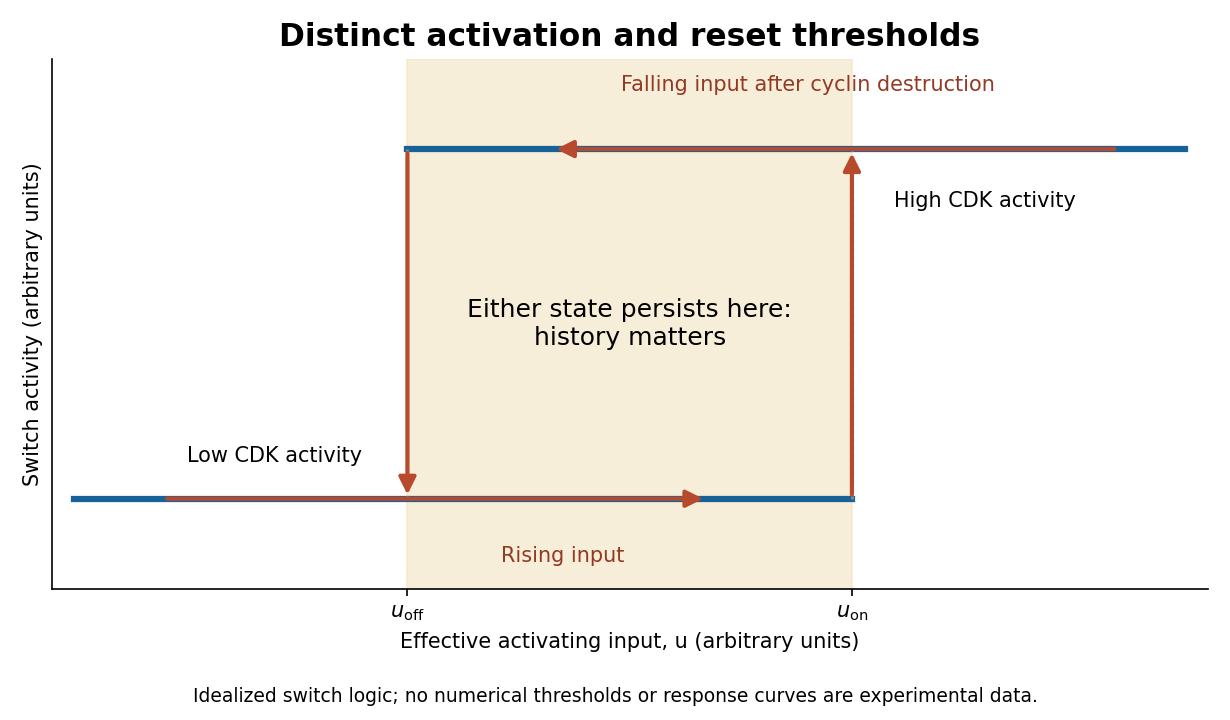
Hysteretic activation preserves state until a separate reset crosses the lower threshold
. Details. 
Reset is achieved by coupling activation to delayed negative feedback and proteolysis. Mitotic kinase activity helps prepare activation of the anaphase-promoting complex with Cdc20, while the spindle checkpoint prevents productive progression until attachment conditions are met. Once this restraint is satisfied, APC/C-dependent ubiquitination promotes destruction of securin and cyclin B. securin loss allows separase to cleave cohesin, making sister-chromatid separation possible. Experiments identifying cohesin cleavage connected regulated proteolysis to a physical transition that simple reversal of a phosphorylation state cannot undo.[ref]
Sister-chromatid separation at anaphase onset is promoted by cleavage of the cohesin subunit Scc1 by Frank Uhlmann and others. Cohesin cleavage and anaphase onset
Chromatids cannot be returned to a pre-anaphase chromosome merely by reducing separase activity.cyclin B destruction lowers CDK1 activity, allowing phosphatases to reverse mitotic phosphorylation and promoting an interphase state. Activation of anaphase-promoting complex with Cdh1 at low kinase activity can help keep cyclins low, while high kinase activity opposes that state. Thus low-CDK and high-CDK programmes are mutually antagonistic. Cyclin synthesis eventually provides a new activating input. Early experiments in extracts showed the importance of cyclin synthesis and destruction, including failure of normal exit with nondegradable cyclin.[ref]
The role of cyclin synthesis and degradation in the control of maturation promoting factor activity by Andrew W. Murray and others. Cyclin synthesis, degradation and nondegradable variants
A bistable activation module combined with an appropriate delayed reset can generate an ordered oscillation; a bistable module held at constant input need not oscillate on its own.replication licensing enforces another essential directionality. At low CDK activity, origin recognition complex with Cdc6 and Cdt1 loads MCM2-7 double hexamers, establishing competence to replicate. In S phase, activating kinases promote origin firing while high CDK activity and additional controls prevent renewed licensing. In animal biological cells, geminin inhibition of Cdt1 and regulated degradation help separate these states. Purified-protein reconstitution demonstrated loading of the replication-helicase precursor as a distinct biochemical event.[ref]
Concerted loading of Mcm2-7 double hexamers around DNA during DNA replication origin licensing by Dirk Remus and others. Origin licensing by double-hexamer loading
Separating licensing from firing allows many origins to be prepared but prevents fired regions from being copied repeatedly during the same cycle. Lowering mitotic kinase activity must eventually restore licensing competence for the next cycle, rather than permit uncontrolled rereplication during the current S phase.Checkpoint pathways modify or hold these switches when DNA is unreplicated, damaged or chromosomes are improperly attached; they do not supply the entire oscillator. Energy-consuming phosphorylation cycles, ubiquitination, proteolysis and resynthesis make the system a driven process, while feedback stabilizes distinct states. Thresholds provide commitment, hysteresis provides memory, destruction and cleavage enforce selected transitions, and licensing/checkpoints couple those transitions to one correct round of replication and segregation.
Replication fidelity uses successive discrimination and repair systems, because no single enzyme detects every error. The important distinctions are between an incorrect base pair, a slipped sequence register, the wrong sugar incorporated into DNA, a damaged template and an incompletely or incorrectly restored chromosome. Repair must also identify which information should be retained: recognizing a mismatch without strand discrimination could fix the wrong sequence.
A polymerase can select an incorrect deoxynucleoside triphosphate and insert the wrong base through imperfect discrimination, transient base configurations or an altered active site environment. If the mismatch is extended and survives into another replication round, it can become a stable base substitution. Many replicative polymerases possess a separate 3′→5′ exonuclease proofreading site. A mismatched primer end tends to slow extension and transfer toward this site; removal of the terminal nucleotide permits another attempt at correct synthesis. This is distinct from the polymerase's forward synthetic reaction and from proofreading in biological translation. In mice, selective disruption of DNA polymerase δ proofreading increased mutation and tumour susceptibility, demonstrating an organismal consequence of unrepaired copying errors.[ref]
High incidence of epithelial cancers in mice deficient for DNA polymerase δ proofreading by Robert E. Goldsby and others. Proofreading-domain mutation, mutator phenotype and tumour development
Post-replicative DNA mismatch repair corrects many errors that escape the polymerase. In eukaryotes, MutSα, formed by MSH2 and MSH6, recognizes base mismatches and many short insertion–deletion loops; MutSβ, containing MSH2 and MSH3, has an important role in larger loops. Recruitment of MutL complexes, strand incision, excision, resynthesis and ligation replaces a stretch of the newly synthesized strand. Nascent-strand discontinuities and replication-associated factors including PCNA help direct the process. Purified human activities reconstituted nick-directed repair from defined substrates, showing how a mismatch and a strand-break signal can support directional replacement.[ref]
Human mismatch repair: reconstitution of a nick-directed bidirectional reaction by Nicoleta Constantin and others. Reconstitution using defined nicked substrates and human factors
The classic Escherichia coli MutH system instead uses transiently undermethylated daughter DNA at suitable sites; that methyl-directed mechanism is not a universal description of eukaryotic DNA mismatch repair or even of every bacterium.replication slippage creates a different substrate. In repetitive sequence, transient misalignment can leave an extra loop in the nascent or template strand. A retained nascent-strand loop can produce an insertion; copying past a looped-out template segment can produce a deletion. Short repeats are therefore vulnerable to length changes, and coding-region insertions or deletions can cause a frameshift if their length is not a multiple of three. DNA mismatch repair recognizes many such loops, although substrate size and structure affect efficiency. Yeast mismatch-repair mutants destabilized simple repetitive tracts, linking repair defects with microsatellite instability.[ref]
Destabilization of tracts of simple repetitive DNA in yeast by mutations affecting DNA mismatch repair by Micheline Strand and others. Repeat-length instability in repair mutants
This is a DNA-sequence frameshift mechanism, distinct from a ribosome changing reading frame during biological translation.The layers can be represented by conditional escape probabilities,where the second and third factors refer to escape among errors reaching the corresponding stage. As a purely illustrative calculation, per copied base. These are not asserted universal measured rates: mismatch identity, sequence, polymerase and repair state all matter. The multiplicative logic explains why disabling a later layer can reveal errors that had previously escaped detection without eliminating DNA synthesis itself.
Polymerases can also incorporate a ribonucleotide instead of a deoxyribonucleotide. base pairing may be correct, so ordinary mismatch recognition is insufficient. RNase H2 can initiate ribonucleotide excision repair by incising near an embedded ribonucleotide, followed by DNA synthesis, removal of the displaced segment and ligation. Reconstitution established this dedicated pathway.[ref]
RNase H2-initiated ribonucleotide excision repair by Justin L. Sparks and others. RNase H2-initiated incision and downstream repair reactions
RNase H1 processing of an RNA–DNA hybrid should not be equated with removal of a single isolated ribonucleotide. Separately, normal RNA primers on Okazaki fragments must be processed and the remaining nicks sealed; persistent primers, flaps or unligated junctions threaten chromosome integrity even without an incorrect base.A chemically damaged template can miscode or stall a fork. Small base lesions can be addressed by base excision repair, whereas nucleotide excision repair removes a damaged oligonucleotide around many bulky, helix-distorting lesions. These pathways repair chemical damage, not every mismatch made on an undamaged template. Replication across an oxidized base can require coordinated recognition of the lesion and the incorrectly paired partner so that repair does not convert damage into a fixed mutation. translesion synthesis permits passage across some lesions with specialized polymerases; it is damage tolerance, not necessarily lesion removal or error-free copying. template switching can provide another route around a block.
Stalled or collapsed forks can leave gaps, broken DNA and structural rearrangements. homologous recombination can use a sister chromatid to restore information and restart appropriate substrates; inappropriate pairing or template switching can instead change sequence organization. non-homologous end joining can restore continuity after a break but need not preserve every base, particularly when end processing is required. Replication checkpoints help stabilize forks and delay progression, while under-replication or rereplication requires control of origin use as well as lesion processing. Numerical chromosome-segregation errors are a related genome-stability problem but are not corrected by simply excising one mismatched base. Base selectivity and proofreading act during synthesis, mismatch and ribonucleotide repair address distinct residual substrates, and damage/fork-repair pathways restore templates and continuity with different fidelity limits.
Yes: a microRNA can suppress tumour formation or progression by restraining an oncogenic programme, but that role must be demonstrated for a defined microRNA, tissue and genetic context. Reduced expression in a tumour or growth inhibition after massive microRNA mimic transfection is suggestive rather than sufficient evidence of an endogenous tumour-suppressor function.
microRNAs are short regulatory RNAs whose guide strands associate with Argonaute. Recognition through sequence complementarity, often involving a microRNA seed region and a target's 3′ untranslated region, can recruit translational repression and RNA decay machinery. Canonical precursor processing involves Drosha and Dicer, although not every microRNA follows every canonical step. A microRNA can affect many transcripts, and a transcript can receive input from several microRNAs. Therefore modest coordinated repression of several growth or survival factors can have a substantial phenotype even without complete elimination of one target. Suppression is a property of the regulatory network, not of an RNA being universally “anticancer”.
The let-7 family supplies a mechanistic example. Experiments connecting let-7-responsive sequences in Ras transcripts with regulation of Ras expression linked a developmental regulatory RNA to a conserved growth pathway.[ref]
RAS is regulated by the let-7 microRNA family by Steven M. Johnson and others. Target-site reporters, developmental genetics and human RAS regulation
Reduced let-7 in lung cancer is compatible with loss of this restraint, but the inverse expression relationship alone would not show causation. Functional experiments restoring let-7 in relevant lung-cancer systems suppressed tumour development, providing a stronger test of tumour-suppressive capacity.[ref]Suppression of non-small cell lung tumor development by the let-7 microRNA family by Manish S. Kumar and others. Functional let-7 manipulation in lung-tumour models
Expression should still be compared with a physiological range, and one must distinguish preventing tumour initiation from treating an established tumour.Genetic loss gives a complementary direction of evidence. The miR-15a and miR-16-1 cluster lies within a recurrently deleted region associated with chronic lymphocytic leukaemia. Deletion of the corresponding mouse regulatory region or the microRNA cluster increased B-cell proliferative abnormalities and produced clonal lymphoproliferative disease in a subset of animals.[ref]
DLEU2 microRNA cluster deletion study by Ulf Klein and others. Separate deletions of the broader region and the miRNA cluster; B-cell proliferation and disease
Comparing the smaller cluster deletion with a larger deletion matters because neighbouring genes can contribute to a human copy-number association. Disease after specific microRNA loss supports endogenous restraint more directly than an expression signature does; incomplete penetrance and latency imply cooperation and context rather than an automatic one-step conversion of every b cell.The p53–miR-34 connection illustrates both strength and limitation of a proposed pathway. p53 activation can induce miR-34-family transcription, and ectopic miR-34 family can restrain proliferation or promote death in suitable biological cells, connecting a transcriptional tumour suppressor with post-transcriptional repression.[ref]
A microRNA component of the p53 tumour suppressor network by Lin He and others. p53-dependent miR-34 induction and growth-related responses
Yet mice lacking all three miR-34 family members retained substantial p53-dependent arrest and apoptosis and did not show the predicted general increase in tumour susceptibility in the tested settings.[ref]Intact p53-dependent responses in miR-34-deficient mice by Carla P. Concepcion and others. Triple-family deletion and in vivo tumour-suppression tests
This does not prove that miR-34 family cannot suppress a tumour in any setting. It shows that a gain-of-function phenotype and placement downstream of p53 do not establish that the microRNA family is an indispensable general mediator of p53 tumour suppression.A convincing analysis combines several evidence types. Measure mature guide RNA in defined malignant and normal biological cell populations, distinguishing it from precursor abundance and changes in stromal composition. Determine whether deletion, promoter silencing or altered processing explains loss. Reduce or delete the endogenous microRNA and test initiation or progression in a suitable model, with restoration from a controlled expression system. Compare related family members to expose redundancy. Use seed-mutant controls and multiple reagents to distinguish sequence-specific regulation from delivery toxicity or innate immune activation; deleting an entire processing enzyme is not a specific test of one microRNA because it affects many regulatory RNAs.
To identify consequential targets, combine binding evidence, early RNA/protein responses and target-site tests. A 3′-region reporter whose seed-complementary site is mutated supports direct sequence-dependent regulation, but the decisive endogenous test is to edit the site or express a suitably controlled microRNA-resistant target and ask whether it rescues the phenotype. Failure of one target to rescue can reflect regulation of several cooperating targets rather than absence of specificity. Conversely, rescuing only bulk proliferation does not establish which target controls invasion or metastasis. Measure relevant tissue phenotypes and target protein levels, not merely a pathway enrichment score from predicted targets.
Tumour-suppressive activity also does not guarantee an effective therapy. Delivery must reach the relevant biological cells and release the RNA into the correct compartment without excessive exposure of normal tissues. A clinical miR-34a microRNA mimic study encountered serious immune-mediated toxicity, illustrating that an endogenous regulatory rationale does not establish safe systemic replacement.[ref]
Phase 1 study of MRX34, a liposomal miR-34a mimic, in patients with advanced solid tumours by David S. Hong and others. Clinical safety findings and limits of replacement therapy
Target abundance, isoform-specific 3′ regions and competing pathways can change the effect of the same microRNA between tumours. microRNAs can be genuine tumour suppressors; the strongest evidence is specific endogenous loss, controlled restoration and mechanistic target tests, interpreted alongside genetic redundancy and tissue context.An organelle maintains a reproducible molecular and functional organization while continuously replacing its components. Identity is therefore a regulated steady state, rather than a permanent collection of molecules. A useful explanation must connect selective delivery and retrieval to local biochemical reactions, physical boundaries and inheritance.
For a membrane-bounded organelle, the lipid bilayer separates its contents from the cytosol, preserves membrane-protein topology and permits lumenal conditions to differ from the surroundings. A lysosome, for example, requires an acidic lumen and retained hydrolases as well as a membrane. Its vacuolar proton ATPase establishes acidity, while counterion conductance and regulated transport prevent unbounded charge accumulation. An endoplasmic reticulum lumen instead supports protein folding and calcium storage. These environments determine which reactions occur and help stabilize the appropriate resident proteins. A boundary alone is insufficient: an empty vesicle can have the same basic bilayer architecture without the same biological identity.
Membrane composition creates selective recruitment sites. Local phosphoinositide synthesis and dephosphorylation produce membrane domains recognized by particular lipid-binding proteins. Phosphatidylinositol 3-phosphate is associated with early endosomal domains, whereas phosphatidylinositol 4-phosphate contributes to Golgi organization. These distributions reflect localized enzymes and regulated turnover, not an immutable lipid barcode. Other properties—including sterol abundance, bilayer thickness and curvature—can favour some membrane proteins over others. Membrane contact sites and lipid transfer proteins redistribute selected lipids while preserving the separation of the two compartments.
Rab GTPases provide a second layer of recognition. Membrane recruitment and nucleotide exchange generate an active Rab domain; effectors then promote vesicle tethering, motor recruitment and sorting. A Rab and its effectors can reinforce one another's localization. GTP hydrolysis and extraction provide opposing reactions that prevent uncontrolled spread. SNARE proteins, together with tethering factors and the appropriate lipid environment, subsequently favour fusion of compatible membranes. Specificity is combinatorial: neither a Rab nor a SNARE should be treated as a unique address sufficient by itself.
Membrane trafficking would progressively mix organelles without selective retrieval. COPII exports selected cargo from the endoplasmic reticulum, while COPI-dependent and other retrieval pathways return escaped residents and trafficking machinery. Resident proteins can be retained through interactions or retrieved using recognizable sorting information. The Golgi similarly balances forward cargo movement with recycling of processing enzymes. Endosomes sort some receptors back to the surface through recycling carriers while directing other material toward degradation. Such exchange preserves an organelle's characteristic composition without requiring every incoming molecule to remain there.
Identity can also change in an organized sequence. In endosome maturation, a compartment can lose Rab5 and acquire Rab7 while retaining internalized material. Live imaging of this Rab conversion argues that an early identity is actively replaced, rather than the same early compartment retaining an unchanging molecular label forever.[ref]
Rab Conversion as a Mechanism of Progression from Early to Late Endosomes by Jochen Rink and others. Live-cell Rab-marker conversion during cargo progression
A cell maintains distinct early and late populations even though individual compartments pass between them. Thus stable system-level organization and changing individual organelles are compatible.Some compartments use additional rules. Mitochondria and chloroplasts combine organelle protein import, genome expression, membrane growth and division; their identity cannot be reduced to vesicle fusion specificity. Peroxisomes import matrix proteins and receive membrane constituents through their own biogenesis pathways. Organelle positioning, fission and inheritance keep these functions distributed through growth and division, while damage recognition and turnover remove defective components.
Experimentally, one should distinguish causation from marker correlation. Acute inhibition of a localized lipid enzyme or Rab regulator can be followed by live imaging, cargo transport, lumenal pH measurements and rescue with a functional allele. A convincing identity change alters function and multiple independent features, rather than merely displacing a fluorescent marker. The central principle is selective flux plus local self-organization, balanced by retrieval and turnover.
First establish that proteins cross the organelle boundary; then define its resident proteome and determine which residents arrive by import. A protein detected near an organelle may be a surface binder, contaminant, transient visitor or locally synthesized product. These possibilities require different controls.
Start with an operational definition of the new organelle: its location, boundary, ultrastructure and reproducible biochemical enrichment. Fluorescence microscopy with independent markers and electron microscopy can determine whether it is membrane-bounded and whether it contacts or engulfs other compartments. A condensate without a membrane can recruit proteins by partitioning; that should not be mistaken for translocation through a membrane. Purification by density-gradient centrifugation or affinity isolation should include markers for likely contaminants and measurements of organelle integrity. An enriched fraction is a starting material, not evidence of import by itself.
Choose candidate proteins from fractionation, imaging or sequence predictions and make minimally perturbing labeled versions. Follow newly synthesized protein using a pulse-chase experiment and independently verify its position relative to the organelle boundary. Loss of a cytosolic precursor followed by accumulation of an internal mature form is suggestive, but proteolytic processing alone does not demonstrate translocation. Tags can obscure targeting signals or change folding, so compare different tag positions and validate endogenous localization where possible.
The key biochemical test is an organelle import assay coupled to a protease protection assay. Incubate isolated intact organelles with a labeled precursor, then remove externally accessible protein with protease. Imported lumenal or matrix protein should be protected in intact organelles but become sensitive after detergent disruption. Surface-bound controls must remain accessible; an independent internal marker tests organelle sealing. Include organelle-free incubations to identify protease-resistant aggregates, and verify that detergent does not simply inactivate the protease. Carbonate extraction or membrane fractionation can distinguish an integral membrane product from a soluble internal one. For membrane proteins, map protected fragments and terminal accessibility rather than demanding protection of the entire chain.
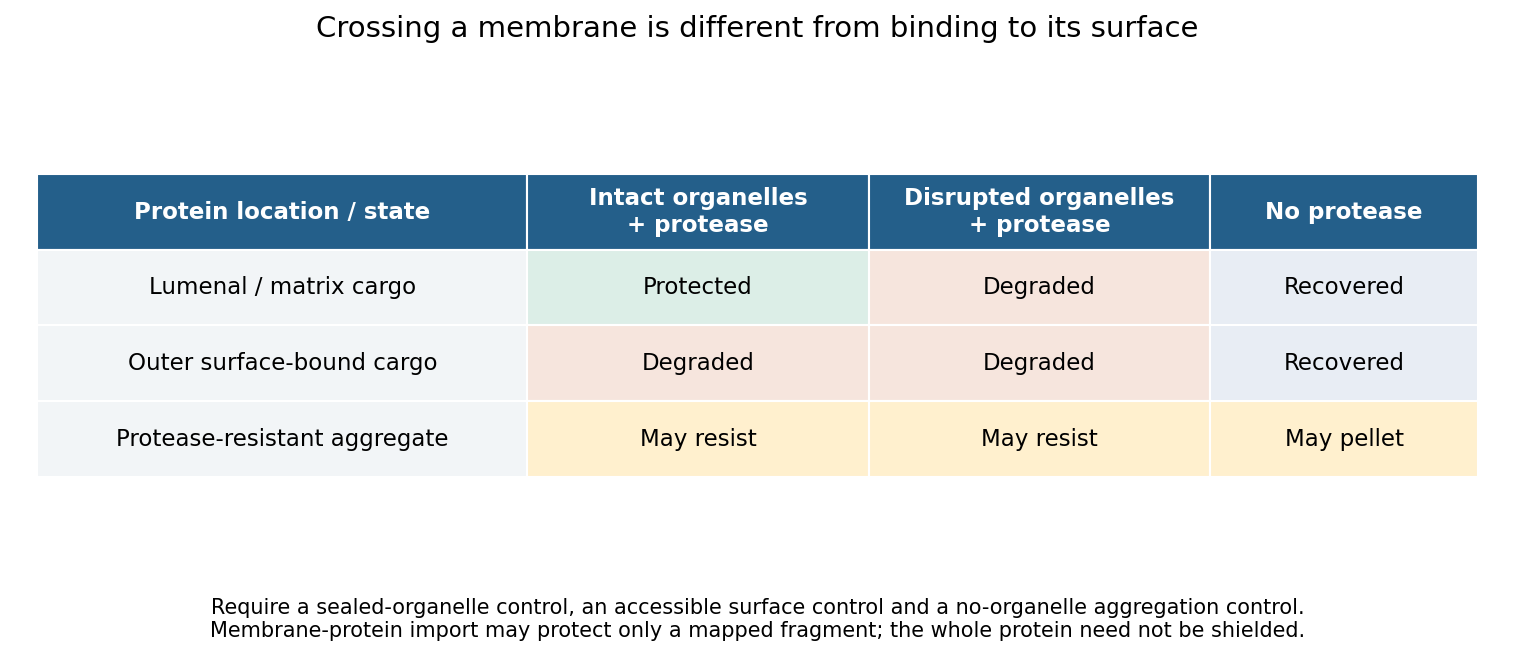
Original control logic separating protein import from surface binding and protease-resistant contamination
. Details. 
Perturbation then tests the mechanism. Compare incubation time and temperature; deplete and restore relevant energy sources; dissipate a membrane potential only after confirming that this treatment preserves membrane integrity; and compete with an excess of unlabeled substrate. Energy requirements must be discovered rather than assumed. Mitochondrial matrix entry, ER translocation and peroxisomal import use different machinery. In particular, stable folding is not a universal barrier: primary peroxisome experiments demonstrated import of stably folded substrates.[ref]
Import of stably folded proteins into peroxisomes by P. A. Walton and others. Import tests challenging a universal unfolding requirement
Mutating a candidate targeting signal should reduce import, while appending that signal to a suitable reporter can test sufficiency. Disrupting a candidate receptor or translocation component, followed by rescue with the wild-type protein, tests necessity. Because a blocked pathway may destroy the organelle indirectly, pair import measurements with morphology, membrane integrity and the import of unrelated controls. An import-defective allele that leaves the compartment otherwise functional is more informative than complete organelle loss. A negative isolated-organelle result does not exclude import if purification removed a required factor; compare with an intact-cell assay. Conversely, protection shows internalization but does not alone distinguish direct protein translocation from delivery inside a vesicle or engulfed compartment. Route-specific perturbations and topology measurements must resolve that distinction.
For the protein complement, combine quantitative spatial proteomics with complementary methods. Measure protein abundance across an entire fractionation gradient and identify proteins with reproducible localization profiles, rather than accepting every protein in a single pellet. Compare intact-organelle protease treatment with disrupted controls, and compare wild type with an import-defective condition. Analyze both soluble and membrane fractions. Liquid chromatography-mass spectrometry identifies peptides, but poorly soluble, scarce or unusual proteins may escape detection, so fractionation and acquisition strategies should be varied.
An internally localized TurboID or other proximity labeling enzyme can reveal proteins accessible in the relevant compartment in living cells. A cytosolic control, a catalytically inactive labeling construct and matched expression levels help identify background. Proximity labeling establishes accessibility and neighborhood, not translocation or stable residency by itself; labeling radius, reagent access and perturbation by the enzyme must be considered.[ref]
Finally distinguish resident, imported and all imported. A resident may have been synthesized by an organelle genome; an imported protein may only transit through the compartment. Time-resolved labeling, precursor processing, localization and dependence on a defined import pathway can classify these cases. Report coverage across growth conditions, detection limits and a confidence tier for each candidate. No single proteomic experiment proves absolute completeness, but convergent topology, kinetic and genetic evidence can produce a well-supported import catalogue.
Maturation best explains major changes in Golgi cisternal identity and early-to-late endosomal progression, but neither pathway is a conveyor belt with no stable domains or transport carriers. The useful comparison concerns what persists—membrane, cargo or resident machinery—and what the experiments actually follow.
In a stable-compartment model, each compartment retains its processing identity while cargo moves onward in vesicles or tubules. In cisternal maturation, cargo can remain within a cisterna while its resident enzymes and trafficking machinery change, turning an early cisterna into a later one. This requires selective recycling of resident machinery in the opposite direction. Both models therefore depend on membrane trafficking; observing vesicles alone does not distinguish them. A static image of separate cis and trans markers is likewise compatible with a population of maturing cisternae.
A decisive experiment follows an individual structure over time using early and late resident markers. In budding yeast, live imaging showed initially early-marker-positive Golgi cisternae losing that marker and acquiring a late marker. This is strong evidence for changing cisternal identity within the tracked object.[ref]
Golgi maturation visualized in living yeast by Eugene Losev and others. Live imaging of early-to-late resident-marker replacement
A complementary experiment follows synchronized cargo together with residents. Cargo retention while residents are replaced favours maturation; cargo movement between objects whose residents remain stable favours transfer between persistent processing domains.Large cargo makes a strong mechanistic test. A long procollagen assembly cannot simply be assumed to enter a small conventional coated vesicle. Maturation can move such cargo through the stack without packaging it into small forward carriers at every step. However, cargo size does not by itself prove that every soluble cargo uses the same route. Tubular connections, larger carriers and rapid exchange of small cargo can coexist with maturation. The geometry and spatial resolution of stacked mammalian Golgi also differ from those of dispersed yeast cisternae, so one should not transfer every kinetic detail between systems without testing it.
For the Golgi, the strongest synthesis is therefore a dynamic population of processing compartments with changing identity, coupled to resident recycling and cargo-dependent transport. COPI and other retrieval pathways can maintain enzyme gradients while COPII supplies new material from the endoplasmic reticulum. A named cis, medial or trans region can persist statistically even when its component membranes and proteins do not. Bulk transport, rapid cargo exchange and local stable zones need not be mutually exclusive.
The endocytic pathway poses a related but distinct problem. An early endosome receives material from the surface and separates recycling cargo from cargo retained for degradation. A strictly stable early-endosome model predicts that degradative material must leave in carriers while early identity persists. A maturation model predicts that a cargo-bearing domain changes into a late endosome, alongside removal of material that should recycle.
Time-resolved Rab5 and Rab7 measurements demonstrated replacement of an early Rab machinery by a late one on cargo-bearing endosomes. This Rab conversion provides direct evidence for maturation rather than inferring it solely from differently labeled endpoint compartments.[ref]
Rab Conversion as a Mechanism of Progression from Early to Late Endosomes by Jochen Rink and others. Rab5 loss and Rab7 acquisition on progressing endosomes
The associated changes in lipids, acidity, motility, fusion machinery and internal membrane organization make this a functional transition, rather than a marker swap alone.Yet recycling domains can bud or tubulate from a maturing endosome. Some cargos return to the plasma membrane; others use retromer-associated retrieval routes; still others enter intralumenal vesicles and continue toward lysosomes. A maturing degradative region can therefore coexist with relatively persistent sorting activities elsewhere in the same network. Endosome fusion and fission also mean that an object tracked by microscopy may exchange membrane extensively.
To discriminate mechanisms, combine live tracking of residents and cargo with pulse-chase kinetics, acute perturbations of retrieval machinery and quantitative membrane accounting. Apparent marker conversion caused by two unresolved objects crossing must be excluded. Conversely, failure to observe conversion at low time resolution is not proof of stability. The evidence favours maturation as a major organizing principle, with selective sorting, retrieval and exchange explaining how cells retain steady trafficking functions while individual compartments change.
Myosins convert a nucleotide-driven actin-binding cycle into movement, force or anchoring. Their different cellular roles arise from variations in motor kinetics, directionality, lever-arm geometry, oligomerization and cargo binding. A class name alone does not specify a universal stepping speed or duty ratio.
A myosin usually contains an actin-binding motor domain with an ATPase active site, a neck associated with light chains, and a tail involved in cargo association or assembly. The myosin lever arm amplifies small motor-domain rearrangements. The tail can connect the motor to a membrane, receptor, organelle or another myosin molecule. Some isoforms are autoinhibited until cargo binding, calcium-dependent regulation or phosphorylation favours an active conformation.
The mechanochemical cycle can be organized around actin affinity. In a strongly bound nucleotide-free state, ATP binding weakens actin attachment and promotes detachment. ATP hydrolysis prepares a detached or weakly bound ADP–phosphate state. Subsequent actin interaction and transitions around phosphate release stabilize strong binding and generate the myosin power stroke. ADP release and the next ATP-binding event complete the cycle. The exact ordering and rates of structural transitions and phosphate release depend on isoform and load; the cycle should not be reduced to a claim that ATP cleavage itself is the instantaneous mechanical stroke.
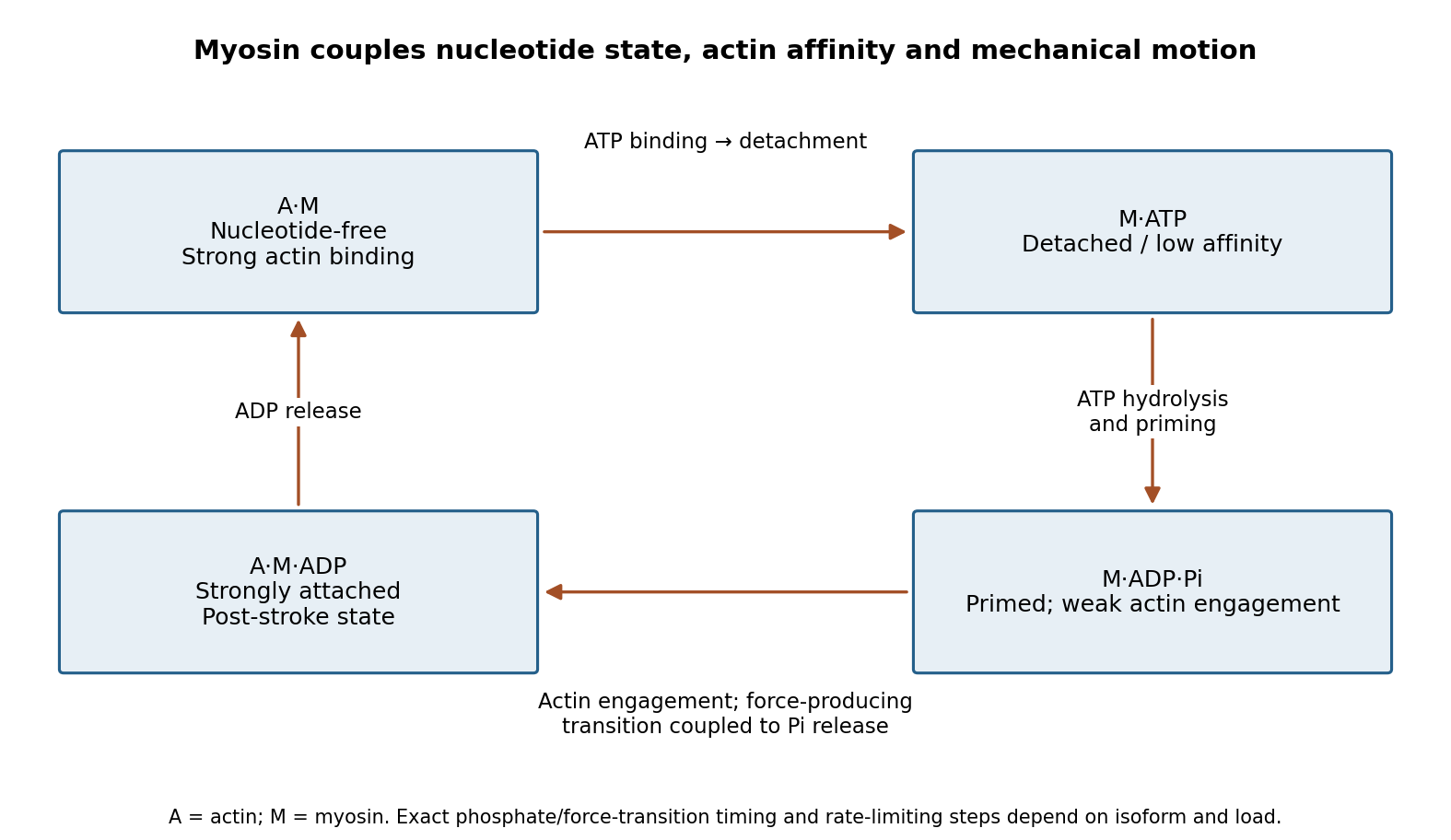
Original myosin actin-affinity and nucleotide cycle, separating ATP binding, hydrolysis and the force-producing transition
. Details. 
Directionality depends on motor geometry and the polarity of actin. Most characterized myosins move toward the barbed end, but Myosin VI moves toward the pointed end. Motor assays established this reversed direction directly, showing that “myosin” does not imply a single transport direction.[ref]
Myosin VI is an actin-based motor that moves backwards by A. L. Wells and others. Directionality assays on polarized actin
In a cortex with complex actin architecture, filament orientation must therefore be known before predicting net cargo movement.The myosin duty ratio is the fraction of a cycle spent strongly bound. A single low-duty motor repeatedly loses its track, whereas an assembly of many such motors can maintain collective contact. Myosin II illustrates this strategy: bipolar filaments bind oppositely oriented actin arrays and generate sliding or tension. In muscle, ordered filament geometry converts sliding into contraction. In nonmuscle cells, related contractile networks contribute to the division furrow, junction remodeling, migration and cortical tension. If the network is anchored, the same sliding mechanism can produce an approximately isometric force rather than large displacement.
Cargo transport poses a different requirement. Dimeric Myosin V motors coordinate their heads so that one remains attached while the other advances. A high-duty coordinated cycle supports myosin processivity, enabling repeated steps before dissociation. Single-fluorophore localization followed one labeled head moving by roughly twice the centre-of-mass step, supporting alternating hand-over-hand motion rather than equal short advances of both heads.[ref]
Myosin V Walks Hand-Over-Hand: Single Fluorophore Imaging with 1.5-nm Localization by Ahmet Yildiz and others. Single-head localization distinguishing walking mechanisms
The approximate 36 nm centre-of-mass repeat reflects the actin track and motor geometry; it is not a step size shared by all myosins.Transport and tension holding overlap. Load can slow nucleotide release and prolong strong binding, allowing some motors to act as dynamic anchors. Myosin VI can participate in endocytic membrane organization or cargo movement, depending on its partners and assembly state. Class-I myosins couple membranes to cortical actin and can regulate membrane tension and local transport. Specialized myosins organize sensory structures or long-range organelle positioning. These roles depend as much on tail-associated adaptors and local actin arrangement as on the catalytic head.
Regulation matches activity to demand. Light-chain phosphorylation can promote nonmuscle myosin II activation and filament assembly. Calcium-sensitive light chains, including calmodulin in appropriate classes, alter motor regulation or lever-arm organization. Cargo-associated adaptors can relieve autoinhibition and assemble transport complexes. Motor number, opposing loads, actin turnover and competition with other transport systems further determine the outcome.
Useful experiments separate these contributions. Actin-gliding assays establish direction and movement, single-molecule tracking measures stepping and run length, and force measurements reveal load-dependent kinetics. ATPase assays alone establish chemical turnover but not productive movement. In cells, rescue with a motor-defective or cargo-binding-defective protein can distinguish catalytic force production from a structural scaffolding role. The unifying mechanism is a coordinated affinity-and-conformation cycle; the biological output can be motion, sustained tension or controlled coupling of membranes to the cytoskeleton.
The SRP–receptor interaction is a regulated delivery and handover reaction, not merely a binding equilibrium. GTP binding and hydrolysis provide timing, conformational control and recycling so that a hydrophobic nascent chain reaches an available translocon before it aggregates or is released at the wrong place.
The signal recognition particle recognizes an appropriate exposed signal sequence or membrane-spanning segment on a ribosome-associated nascent chain. Its conserved SRP54 subunit contains a signal-binding region and a GTPase domain; bacterial Ffh is the corresponding homolog. The partner GTPase is the SRP receptor alpha subunit in the eukaryotic ER system or FtsY in bacteria. Thus the targeting machinery integrates information from the emerging chain, the ribosome and a membrane-associated receptor. Productive delivery also requires a translocon, not just any membrane surface.
GTP loading permits the two homologous GTPases to assemble into a complex. They then undergo further rearrangements and mutually stimulate their hydrolysis reactions. This is more elaborate than a one-step association of two preformed active surfaces: different nucleotide-bound conformations distinguish cargo capture, membrane delivery, handover competence and termination. Correct cargo and a suitable membrane/translocon environment can alter the kinetics of these transitions. The pathway can therefore respond to whether the chain is appropriate and whether a downstream acceptor is ready.
The timing matters. If hydrolysis occurs too early, SRP and receptor may dissociate before cargo transfer. If dissociation is prevented indefinitely, a stable complex can trap the machinery instead of making another delivery. Efficient targeting consequently requires both a sufficiently long-lived delivery intermediate and a route for its timely disassembly. Experiments with GTPase mutants separated receptor interaction or hydrolysis behaviour from successful cargo unloading, demonstrating that formation of a stable complex is not itself the endpoint of targeting.[ref]
Conformational changes in the GTPase modules of the signal reception particle and its receptor drive initiation of protein translocation by Shu-ou Shan and others. Mutant targeting and translocation assays separating binding from productive handover
This provides a form of kinetic discrimination. A wrong nascent chain can dissociate or fail to progress through a sequence of conformational checkpoints, while an appropriate chain promotes forward passage. Energy-consuming termination and recycling prevent every encounter from being governed solely by the final binding affinity. The logic resembles kinetic proofreading, but one should distinguish a general analogy from a demonstrated proofreading scheme: identifying a particular rejection step requires rates and fluxes, not merely observing GTP consumption. Not every incorrect interaction necessarily consumes the same number of GTP molecules.
A useful comparison is a passive docking model. At equilibrium, strong SRP–receptor affinity would favour occupancy but could impede turnover, and it would not establish that the cargo has been delivered to a conducting channel. In the actual cycle, nucleotide states connect the binding interface to signal-sequence release and receptor recycling. Hydrolysis makes a directional, dissipative cycle possible when cellular nucleotide ratios are maintained. It should not be described as GTP physically pushing the polypeptide through the membrane; translocation and membrane insertion use additional interactions and, depending on the substrate and system, other energy inputs.
A decisive experimental design measures several outputs separately: SRP–receptor association, GTP hydrolysis, transfer of a labeled nascent chain to the translocon, and protection or processing of the resulting product. Compare a nonhydrolyzable nucleotide analog with mutants that alter specific conformational transitions, and control for ribosome binding and membrane integrity. A reagent that stabilizes docking but reduces completed import shows why affinity alone is an inadequate readout. Testing repeated targeting cycles also distinguishes one successful handover from efficient recycling.
The answer is therefore coordination and reliable turnover. Energy expenditure links recognition to an available membrane insertion pathway, controls the lifetime of delivery intermediates, helps reject unproductive encounters and returns the machinery to a reusable state. The strength of this explanation is that it predicts experimentally separable failures—binding without handover, premature release, and stalled recycling—rather than assigning GTP the vague role of supplying energy to an otherwise simple contact.
Cytochrome P450s are versatile haem-containing oxidation enzymes that can install chemically difficult, highly selective functional groups. Photosynthetic microorganisms can supply their reducing equivalents and metabolic precursors, but useful production requires coordinated enzyme expression, electron delivery, substrate supply and product handling.
A Cytochrome P450 contains an iron–haem centre coordinated by a protein cysteine thiolate. The characteristic spectrum of its reduced carbon-monoxide complex gives the family its name. A common monooxygenation can be writtenOne oxygen atom enters the product and the other is reduced to water. Electron transfer and protonation activate bound oxygen, generating a powerful oxidant such as P450 compound I. Hydrogen abstraction followed by oxygen rebound can hydroxylate a C–H bond, but the family also supports other reactions, including epoxidation and successive oxidation steps. The exact chemistry is enzyme- and substrate-dependent; not every P450 simply performs a single hydroxylation.
This selectivity is valuable for complex natural products. Closely related substrates can differ in the position and stereochemistry of oxygenation, and an enzyme can distinguish sites that are difficult to separate by ordinary chemical synthesis. Oxygenated terpenoid intermediates, drug precursors and other specialized metabolites are therefore attractive targets. The opportunity is selective chemistry, not a guarantee that every plant pathway will be cheap to reproduce in a microbial host.
In an oxygenic photosynthetic chassis, light absorption by photosystem II supports extraction of electrons from water. Transfer through the photosynthetic chain and photosystem I generates reduced ferredoxin, which can feed a compatible P450 directly or contribute to NADPH production for an appropriate reductase system. The distinction matters: native microsomal P450s often use a flavoprotein reductase, whereas engineered direct ferredoxin delivery can bypass that partner. Electrons must still reach the P450 at adequate rates and with correct coupling to substrate oxidation.
There is a clear experimental proof of principle. A plant CYP79A1 catalytic domain was fused to the photosystem-associated PsaM anchor in a cyanobacterium, positioning it near the thylakoid electron supply. Activity was observed in light-driven experiments. This demonstrates functional rerouting of photosynthetic reducing power into a plant P450 reaction, rather than establishing commercial production of a finished pharmaceutical.[ref]
A production design starts from the entire pathway. Supply a suitable scaffold from endogenous metabolism or introduced enzymes, express the required P450s with compatible membrane anchors and redox partners, and include any downstream transferases or other finishing enzymes. CYP79A1, for example, participates in the pathway to dhurrin; expressing it alone establishes one activity, not the completed multienzyme pathway. For a new high-value oxygenated terpenoid, one must similarly verify every intermediate rather than equating scaffold accumulation with final-product synthesis.
Several constraints can dominate performance. Plant membrane enzymes may fold poorly, insert in the wrong orientation or fail to acquire haem. An abundant P450 may remain inactive because its substrate or electron donor is limiting. Competition with carbon fixation and essential redox metabolism can make maximal electron diversion harmful to growth. Uncoupled oxygen activation can generate reactive oxygen species instead of product. Excess light may increase oxidative damage, while high cell density limits light penetration. Oxygen supply is required for ordinary P450 monooxygenation even though the host produces oxygen photosynthetically.
Optimization should therefore measure carbon flux, enzyme abundance, redox state and products together. Adjust expression ratios, redox-partner choice, subcellular localization and induction timing; relieve precursor bottlenecks without starving essential pathways; and consider export or product capture to limit toxicity. A bioreactor must balance mixing, illuminated surface area, gas exchange and biomass density.
Useful controls include dark incubation, a catalytic-site mutant, pathway-minus strains and perturbation of photosynthetic electron supply while monitoring cell viability. Mass spectrometry and authentic standards establish product identity; oxygen uptake or a fluorescent reporter alone does not. Finally report titre, productivity, carbon yield and stability over repeated cultivation. Light-powered enzyme activity is the biochemical entry point; reliable, selective and economically recoverable product formation is the engineering goal.
Plant lipid diversity is generated by combinatorial biosynthesis in several compartments, selective exchange and remodeling, and evolutionary diversification of the underlying enzymes. Its functions extend from membrane mechanics and photosynthesis to storage, barriers and signaling, so no single adaptive explanation covers every lipid species.
At the simplest level, different acyl chains vary in length, double-bond number and position, and chemical substitution. Plastid fatty acid synthase builds chains carried by an acyl carrier protein. Chain termination and export determine which products enter further metabolism. Endoplasmic-reticulum fatty acid elongase enzymes extend selected acyl substrates, creating very-long-chain products used in surface and membrane lipids. Fatty acid desaturases introduce double bonds into particular substrates, while specialized enzyme variants can introduce hydroxyl groups or other unusual chemistry. Substrate specificity, reaction order and cellular location therefore generate many distinct acyl pools from a comparatively limited set of carbon precursors.
Chains are only one dimension. Acyltransferases assemble them onto glycerol or other backbones with positional specificity. Headgroup pathways generate glycerophospholipids and galactolipids, while distinct pathways produce sphingolipids and sterols. A lipid name such as phosphatidylcholine denotes a class, not a unique molecular species: two acyl chains can each vary, and their positions can matter. Storage triacylglycerols likewise combine many possible acyl groups. Functional diversity is therefore much larger than the number of lipid headgroups.
Compartmentation constrains which combinations occur. Plastid and ER assembly pathways use different enzymes and precursor pools, and products move between them. Monogalactosyldiacylglycerol and digalactosyldiacylglycerol are major constituents of photosynthetic membranes, whose requirements differ from those of the plasma membrane or a storage oil body. Acyl editing replaces chains on existing lipids, connecting synthesis to remodeling rather than simply producing a fixed end product. Selective transport, turnover and developmental expression create tissue-specific compositions even when the genome is unchanged.
An important test of functional importance comes from manipulating the enzymes rather than correlating lipid abundance with habitat. An Arabidopsis thaliana desaturase-deficient mutant lacking trienoic fatty acids was able to grow under permissive conditions but lost normal chloroplast performance during prolonged chilling. This supports a role for those acyl structures in maintaining photosynthetic function at low temperature.[ref]
Trienoic Fatty Acids Are Required to Maintain Chloroplast Function at Low Temperatures by Jean-Marc Routaboul and others. Desaturase-mutant physiology under low-temperature treatment
The inference is more precise than “unsaturated lipids are always better”: excessive unsaturation can also increase susceptibility to oxidation, and requirements depend on temperature and membrane function.Nutrient availability supplies another driver. Phospholipid synthesis requires phosphorus, whereas galactolipids can provide membrane material without a phosphate headgroup. Under phosphate deprivation, organelle lipid analyses detected redistribution of digalactosyldiacylglycerol into mitochondrial membranes. This demonstrates regulated compositional plasticity rather than requiring a new species to evolve every time phosphate becomes scarce.[ref]
Other selective pressures concern life on land and interactions with other organisms. Cutin, suberin and plant cuticular wax contribute to control of water loss, permeability and surface protection. Their chain lengths and oxygenation patterns affect packing and barrier properties. Seed oils store energy and carbon for establishment, while lipid-derived signals coordinate development and responses to damage. Pathogens, herbivores, drought, salinity and changing light environments can favour different combinations. A lipid useful as a defensive precursor may impose a cost on growth or oxidation resistance, creating trade-offs rather than one universal optimum.
Evolution can generate new chemistry through gene duplication, altered substrate specificity, changes in expression and retargeting of enzymes between compartments. A duplicated desaturase-like enzyme, for example, can retain the original reaction in one copy while another explores related substrate chemistry. Selection can preserve a useful product or tissue-specific role, while drift and biochemical side reactions also contribute to observed diversity. Cross-species lipid differences alone do not establish their adaptive value.
To separate these explanations, combine quantitative lipidomics, isotope tracing, enzyme biochemistry, genetic perturbation and physiological rescue. Compare plants at matched developmental stages and environments, because plastic remodeling can otherwise be mistaken for an evolved difference. The chemistry arises from modular enzymes and compartmentalized flux; the evolutionary explanation requires connecting particular molecular variants to performance in a defined ecological setting.
Both heterotrophic bacteria and oxygenic phototrophs must connect intracellular reducing power to an external acceptor across insulating cell-envelope layers. The best-characterized heterotrophic systems use dedicated respiratory redox conduits, whereas cyanobacterial export often involves mediators and incompletely resolved routes whose activity competes with photosynthetic metabolism.
In a Gram-negative heterotroph, oxidation of organic substrates supplies electrons to intracellular carriers and the inner-membrane quinone pool. An insoluble iron oxide or an electrode cannot enter the cytoplasm or simply accept an electron through the lipid phase. Extracellular electron transfer must bridge the inner membrane, periplasm and outer membrane before reaching the mineral or electrode surface. This is a sequence of chemically coupled steps, not unrestricted electronic conductivity through the whole cell.
Shewanella oneidensis provides a useful mechanistic example. Quinol oxidation connects through CymA and periplasmic carriers to the outer-membrane MtrCAB assembly. Its cytochromes place redox-active haem groups on the inward and outward sides of a porin-associated structure; surface MtrC can exchange electrons with external acceptors. Reconstitution of oriented MtrCAB in proteoliposomes demonstrated transfer from an internal electron-carrier pool to external Fe(III) oxides, directly testing the membrane-crossing function rather than inferring it from a mutant phenotype alone.[ref]
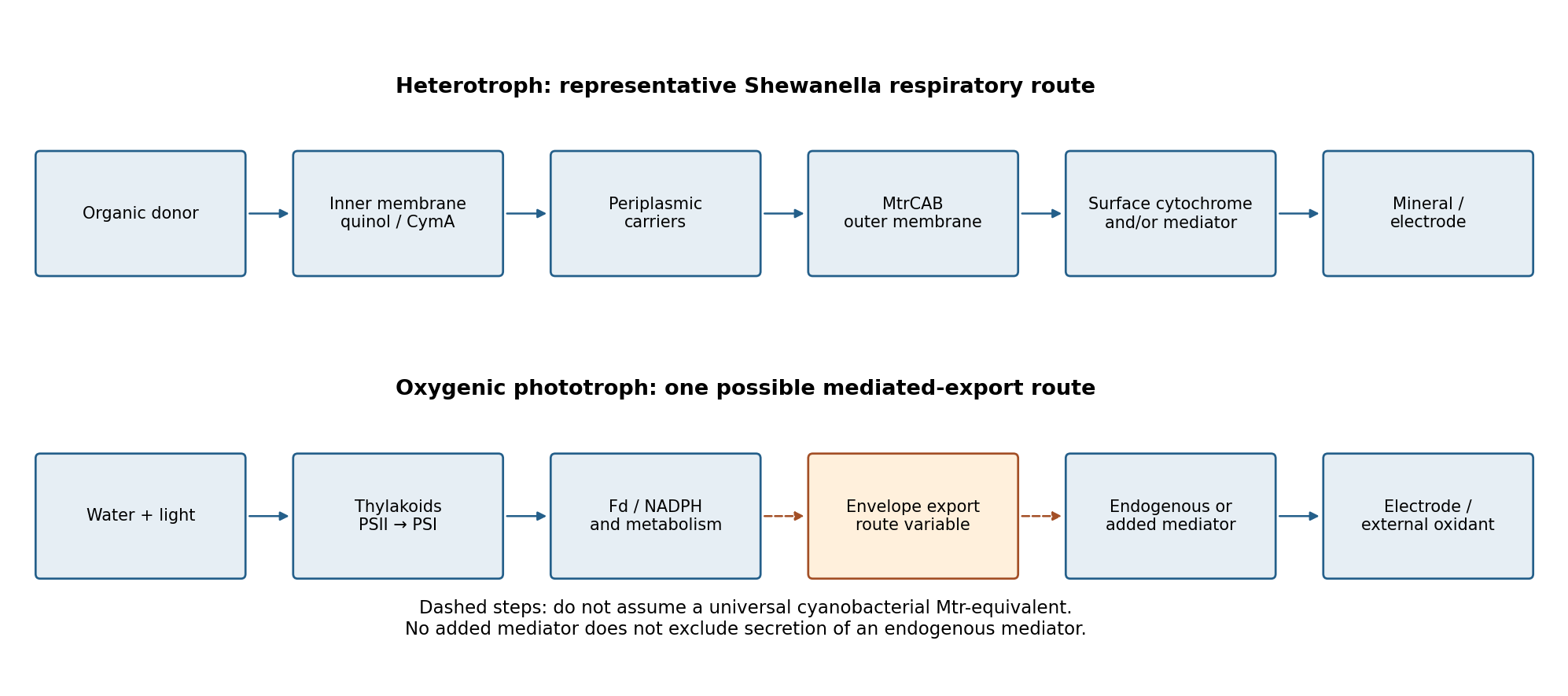
Original comparison of a characterized heterotrophic outer-membrane conduit with alternative phototrophic electron-export routes
. Details. 
Direct contact is one strategy. Surface cytochromes can reduce a mineral that is close enough, and extracellular conductive structures can extend electron transfer beyond the cell body. Some microbial nanowires are cytochrome-rich filaments or membrane-associated structures; the mechanism should be assigned to the organism and structure actually characterized. Calling every extracellular appendage a conducting pilus is unwarranted. Contact area, attachment and the conductivity of the surrounding biofilm can limit current even when the intracellular respiratory route is functional.
A second strategy uses a redox mediator. The cell reduces a soluble compound, which diffuses to a distant acceptor, transfers its electrons and returns in an oxidized form. Flavin-mediated transfer in Shewanella and phenazine-mediated transfer in some other bacteria illustrate how diffusible chemistry can complement direct contact. Some mediators also associate with proteins rather than remaining entirely free in solution. Mediator availability, diffusion, side reactions and loss into the environment therefore affect efficiency. A poised electrode and an insoluble mineral are not interchangeable acceptors: their accessible potentials, surface chemistry and spatial distribution differ.
For oxygenic phototrophs, light supplies a different upstream route. Photosystem II extracts electrons from water, and photosystem I generates reduced ferredoxin and downstream reducing power. In many cyanobacteria, these reactions occur on internal thylakoid membranes; an electron collected outside must therefore pass through additional metabolic and envelope steps. In eukaryotic algae, the chloroplast envelope and plasma membrane add further compartmental barriers. One should not transplant a Shewanella Mtr diagram into these organisms merely because both produce an electrode current.
The evidence for cyanobacterial export includes mediator-dependent reduction and sensitivity to envelope permeability. In one Synechocystis study, weakening outer-membrane attachment increased photocurrent, while replacing the culture supernatant with fresh medium removed that current under the tested conditions. Ferricyanide reduction provided a complementary readout. These results support a role for extracellular redox-active compounds and an envelope barrier, not identification of one universal cyanobacterial electron-export protein.[ref]
Order-of-magnitude enhancement in photocurrent generation of Synechocystis sp. PCC 6803 by outer membrane deprivation by Shoko Kusama and others. Outer-membrane perturbation, supernatant replacement and ferricyanide-reduction controls
The energetic roles also differ. Mineral-reducing heterotrophs can use an external acceptor in respiratory energy metabolism. A phototroph must retain enough reducing power for carbon fixation, nutrient assimilation and repair; maximal export is not automatically advantageous. Current can persist in darkness through metabolism of stored carbon, and secreted organic material can support heterotrophs that generate part of a measured community current. Oxygen evolution also changes local redox chemistry and can divert electrons away from the electrode.
Mechanistic experiments should separate these possibilities. Compare axenic cultures with mixed communities, light and dark conditions, intact and damaged cells, and cell-free supernatants. Use electrode-potential controls, viability assays, electron-transfer mutants and rescue, together with oxygen and carbon balances. Ferricyanide access must be interpreted relative to its membrane permeability. Most importantly, “no added mediator” does not prove direct transfer: cells can secrete their own mediator. The comparison is therefore between a relatively well-defined family of respiratory conduits and several phototrophic routes requiring organism-specific evidence, with the same general requirements of redox compatibility, envelope crossing and an accessible external sink.
Bacteria resist turgor through a load-bearing envelope and controlled osmotic balance, then remodel that envelope locally during growth and division without opening an unprotected gap. Rapid mechanosensitive release protects against sudden downshock; sustained wall synthesis and regulation protect during ordinary growth.
Water enters when the intracellular osmotic environment favours uptake, generating turgor pressure. A lipid membrane alone cannot generally sustain the large pressure difference of a normal walled bacterium. The covalent peptidoglycan mesh provides tensile resistance: glycan strands are connected by peptide crosslinks, distributing load over a continuous sacculus. Gram-positive bacteria generally possess a thick wall outside the cytoplasmic membrane. Gram-negative bacteria have a thinner peptidoglycan layer within a multilayer envelope, whose outer membrane and connections can also contribute to mechanical integrity. These architectures should not be treated as identical thin bags.
A simple mechanical model explains the need for reinforcement. For a thin cylindrical wall of radius and thickness under pressure difference , circumferential stress scales aswhile axial stress is about half that value. This idealization neglects the molecular mesh and envelope heterogeneity, but shows why a larger radius or a thinner load-bearing layer increases tensile demand. No pressure, radius or thickness values are supplied, so a numerical stress cannot be inferred from this paper.
Steady growth requires adding wall while preserving connectivity. Cytoplasmic precursor synthesis supplies glycan–peptide building blocks; membrane-associated transport presents them to polymerizing and crosslinking enzymes outside the cytoplasm. Penicillin-binding proteins and associated synthases connect the new material into the sacculus. Controlled cleavage by autolysins permits expansion and insertion, but cutting must be coordinated with synthesis and repair. Unregulated hydrolysis or failure of crosslinking can make turgor destructive. The wall is therefore renewed through spatially and temporally limited reactions, rather than opened wholesale and rebuilt afterward.
In many rod-shaped bacteria, the Rod complex and MreB organize lateral growth. Imaging linked circumferential motion of MreB-associated machinery to ongoing cell-wall synthesis, consistent with coordinated insertion around the cell rather than a static cytoskeletal scaffold alone.[ref]
Coupled, Circumferential Motions of the Cell Wall Synthesis Machinery and MreB Filaments in B. subtilis by Ethan C. Garner and others. Live-cell motion measurements and wall-synthesis perturbations
Species with other shapes use different arrangements; MreB is not a universal component of all bacteria.Division requires a second local remodeling programme. FtsZ polymers help organize the divisome at an appropriate site, where septal synthesis accompanies inward envelope growth. Daughter-cell separation must be delayed until enough new wall protects each daughter. Local hydrolases then cleave selected septal connections. Spatial regulation prevents a division-associated cleavage reaction from becoming a catastrophic breach across the cell sidewall. Membrane constriction, wall synthesis and separation are coupled processes; attributing all division force or protection to one cytoskeletal protein would miss this coordination.
Osmoregulation adjusts the load imposed on this structure. Under high external osmolarity, cells can accumulate ions and compatible solutes to retain water. Upon sudden transfer into dilute medium, the existing solute pool instead drives rapid water entry. MscS and MscL mechanosensitive ion channels open in response to membrane tension and release solutes, reducing the osmotic imbalance before slower transcriptional responses can act. Genetic loss-of-function and downshock experiments demonstrated that these channels protect against extreme turgor.[ref]
Protection against extreme turgor by MscS and MscL by N. Levina and others. Channel-deficient strains challenged by osmotic downshock
Their emergency role differs from routine growth control. A constitutively open large pore would lose valuable metabolites, so gating must be sensitive and reversible. Conversely, emergency release cannot replace a missing wall during sustained growth in an ordinary environment. Envelope-stress sensing, balanced precursor supply, repair and correctly timed hydrolysis remain necessary.
A useful experimental test measures lysis and survival after a defined downshock while independently measuring wall integrity and growth. Rescue with a functional channel distinguishes emergency relief from nonspecific osmotic adaptation, while perturbing a synthase or autolysin reveals the wall-remodeling contribution. Protection is an integrated system: maintain the barrier, regulate its internal pressure, and coordinate the cuts and additions required to grow and divide.
Pyocyanin is a diffusible redox-active phenazine whose ecological benefits and damaging effects arise from cycling between electron donors and acceptors. Its production is controlled by a regulatory network linking quorum signals to metabolic state; PqsE promotes the relevant RhlR output through a protein interaction that is distinct from its catalytic activity.
Pyocyanin gives many Pseudomonas aeruginosa cultures their blue coloration. The phenazine ring system accepts reducing equivalents from cellular metabolism and can pass them to oxygen or other accessible acceptors. In oxygenated settings, repeated redox cycling can generate reactive oxygen species and deplete reducing capacity. These effects can harm competing microorganisms and host cells, making pyocyanin a contributor to virulence. Its effects depend on concentration, oxygen availability and the surrounding antioxidant capacity; pigment production alone does not establish the severity of a particular infection.
For the producing bacterium, the same chemistry can help maintain redox balance when local oxidant supply is limited. Experiments comparing a phenazine-deficient strain with pyocyanin supplementation linked the molecule to intracellular redox state and changes in central carbon flux.[ref]
Pyocyanin Alters Redox Homeostasis and Carbon Flux through Central Metabolic Pathways in Pseudomonas aeruginosa PA14 by Alexa Price-Whelan and others. Mutant and supplementation tests of redox balance
In spatially structured biofilms, a redox mediator can connect poorly oxygenated regions with more accessible oxidants. That benefit has costs: synthesis consumes resources and uncontrolled redox cycling can damage the producer, so export and protective responses must be coordinated. The redox-sensitive regulator SoxR contributes to handling endogenous redox-active metabolites in this setting.Biosynthesis also separates pigment amount from regulation alone. The core phenazine biosynthesis loci produce precursors, and modifying enzymes including PhzM and PhzS generate pyocyanin. Cloning and heterologous reconstruction identified contributions of the core loci and the modifying reactions.[ref]
Functional Analysis of Genes for Biosynthesis of Pyocyanin and Phenazine-1-Carboxamide from Pseudomonas aeruginosa PAO1 by Dmitri V. Mavrodi and others. Functional analysis and heterologous phenazine-pathway reconstruction
A mutant can therefore lose blue pigment through a chemical pathway defect even when signal perception is intact. Oxygen-dependent finishing chemistry can likewise decouple transcription from the amount of final pigment.The canonical quorum sensing network contains interconnected Las, Rhl and quinolone systems. In many laboratory strains, the Las quorum-sensing system activates downstream signaling programmes. The Rhl quorum-sensing system uses a butyryl-homoserine-lactone signal with RhlR, while the Pqs quorum-sensing system responds through PqsR to quinolone signals. Positive feedback can amplify expression, but signal concentration reflects diffusion, retention and growth conditions as well as cell number. It is not a simple universal population counter, and the hierarchy can differ between strains.
PqsE is a particularly important connection. Although encoded in the quinolone-pathway locus, its effect on pyocyanin cannot be explained merely by supplying more quinolone. Binding-interface mutants retain catalytic activity yet fail to support the regulatory phenotype, whereas productive interaction promotes RhlR DNA binding. This separates a protein-interaction role from the enzyme's catalytic function.[ref]
The PqsE-RhlR Interaction Regulates RhlR DNA Binding to Control Virulence Factor Production in Pseudomonas aeruginosa by Kayla A. Simanek and others. Binding-interface mutants, DNA-binding and pyocyanin assays
A pathway diagram should therefore include both chemical signal production and the PqsE–RhlR regulatory partnership.Nutrient status, oxygen availability, growth phase and additional global regulators influence this network. These inputs make biological sense: secretion of a costly redox-active product can be useful under one combination of competition and redox stress and wasteful under another. They also explain why a single quorum-signal measurement does not predict pigment yield in every medium or clinical isolate.
To test regulation, measure signal production, relevant transcripts, pyocyanin itself and growth separately. Compare receptor mutants, biosynthetic mutants and PqsE interface mutants, and rescue at controlled expression levels. A catalytic-dead mutant paired with a binding-defective mutant is especially informative. Keep oxygen, pH and biomass matched, because pyocyanin's oxidation state and medium conditions affect its apparent colour. The mechanistic answer joins redox function, biosynthetic chemistry and conditional gene regulation; treating pyocyanin as merely a quorum-controlled toxin omits its metabolic and ecological roles.
Losing a parasitic lifestyle requires replacing the benefits supplied by the host while retaining enough performance to survive and reproduce in a new niche. The difficulty depends strongly on how much autonomy the lineage has already lost. Becoming harmless or mutualistic is also distinct from becoming free-living: a nonparasitic association can remain host-dependent.
The first task is to specify the proposed endpoint. A parasite that no longer damages its host might become a commensal, while a mutualist must confer a demonstrable benefit in the relevant setting. Neither transition necessarily restores host-independent growth. The harder transition to free living requires a complete sustainable life cycle without host-provided metabolism, physical shelter or reproductive opportunities. A resistant transmission stage that survives outside a host does not meet that standard if it cannot reproduce there.
Metabolic host dependence is often the strongest barrier. Host-associated lineages can lose biosynthetic pathways when the host reliably supplies their products. Returning to an external niche may therefore require uptake from a new environmental source, restoration of synthesis, or a partnership with another organism. Missing enzymes cannot necessarily be restored by changing one regulator: whole pathways may require transporters, cofactors, compartmentation and coordinated expression. Genome reduction can also remove regulatory and repair functions that were less useful in a protected environment.
The genome of Cryptosporidium parvum illustrates a highly modified parasite, with a reduced complement of metabolic functions relative to many free-living eukaryotes.[ref]
Complete genome sequence of the apicomplexan, Cryptosporidium parvum by Mitchell S. Abrahamsen and others. Genome evidence for a specialized host-associated metabolic repertoire
It is an example of functions that must be accounted for, not proof that every parasite has the same deficiencies. Other parasites retain substantial biosynthetic capacity and may face mainly ecological or regulatory barriers rather than wholesale metabolic reconstruction.Energy metabolism needs a functional replacement as well. An intracellular niche may supply suitable carbon substrates, oxygen conditions or directly useful metabolites. Outside the host, the organism must obtain energy under fluctuating conditions while balancing reducing equivalents and maintaining ion gradients. Reacquiring an ancestral organelle is not the only imaginable solution: an alternative pathway can in principle supply the indispensable function. However, a transporter alone cannot replace an absent energy-generating network unless suitable external substrates and redox partners are available.
Physical and behavioral adaptations create further constraints. A unicellular parasite may need autonomous nutrient capture, motility, osmoregulation and protection from desiccation or oxidative stress. A multicellular parasite with reduced feeding structures, sensory systems or locomotion could require anatomical and developmental changes as well. Structures optimized for host attachment or invasion can be costly or ineffective elsewhere. The organism also encounters predators, competitors and environmental variation that the host previously buffered.
Reproduction and transmission must be reorganized. If a developmental switch depends on a host cue, free-living reproduction requires an alternative trigger. If sexual stages occur only in a specific host, mating and completion of development must become possible elsewhere. New timing and dispersal traits must work with nutrient supply and seasonal conditions. Reducing virulence without solving these life-cycle dependencies does not create an independent lineage.
Evolutionary routes are possible but constrained. Retained ancestral genes can be redeployed, gene duplication can permit new functions, and horizontal gene transfer can sometimes add useful biochemical capacity. These routes require selectable intermediate states: an extensive reconstruction that yields no advantage until complete is difficult to assemble. A facultative association or a nutrient-rich environmental niche can provide stepping stones. Conversely, population bottlenecks, genetic drift and entrenched dependencies can reduce access to viable intermediate phenotypes.
Comparative biology must be interpreted carefully. Chromera velia is a photosynthetic relative of apicomplexan parasites, providing evidence about ancestral capabilities and the evolution of their lineage. Its existence does not show that a modern obligate parasite regained photosynthesis or reversed to free living.[ref]
A photosynthetic alveolate closely related to apicomplexan parasites by Robert B. Moore and others. Phylogenetic and plastid evidence from a photosynthetic relative
A claim of evolutionary reversal needs a well-supported phylogeny and exclusion of contamination or misidentified ancestral free-living relatives.Experimental evidence should be equally demanding. For host independence, demonstrate repeated reproduction and serial passage without host cells or unrecognized host-derived growth factors, then identify the resources and pathways sustaining it. For a transition to mutualism, measure effects on both partners across relevant conditions rather than equating reduced damage with mutual benefit. Nonparasitism is not achieved simply by deleting invasion genes: the lineage must establish a viable resource economy, complete reproduction and persist in the ecological setting that replaces its former relationship with the host.
The viral DNA is copied by semiconservative replication and its labelling kinetics broadly follow those of host DNA during viral latency. At the earliest time the newly labelled material is mainly hybrid: an old light strand has acquired a heavy complementary strand. Fully heavy duplexes accumulate later, after heavy strands themselves serve as templates. Conservative copying would instead produce a separate fully heavy population from the first copying round, while dispersive copying would produce progressively shifting intermediate densities rather than these three discrete classes.
For an ideal synchronous population starting entirely light, one complete round gives only hybrid duplexes; after rounds the hybrid fraction is and the fully heavy fraction is . The actual culture is asynchronous, so these integer-generation proportions cannot simply be imposed at hours. The similar viral and cellular bars support replication coordinated with cell proliferation rather than rapid autonomous amplification. They do not establish that every episome initiates exactly once in every individual biological cell, or prove an initiation time within S phase. Persistent light material also warns against treating the population as a perfectly uniform set of cycling biological cells. The strand-accounting principle is the one tested in [ref]
The replication of DNA in Escherichia coli by Matthew Meselson and Franklin W. Stahl. Figures 3–4: changes in banding over successive copying rounds
.Base composition changes both the initial buoyant density and the size of the BUdR-induced density increment. The fraction-number axis runs toward lower density. The unlabelled viral peak lies at a lower fraction number than the corresponding host peak, consistent with viral DNA having a higher GC content. BUdR replaces thymidine in newly synthesized strands, so relatively AT-rich DNA incorporates more brominated nucleoside per unit length and undergoes a larger density increase.
Consequently the more AT-rich host DNA can overtake the viral DNA in the fully substituted class: the host fully heavy peak is slightly farther toward the dense end, although host unlabelled DNA was less dense. The hybrid peaks are intermediate. A useful qualitative model is , and , where is GC fraction, increases with , and decreases as the thymidine fraction decreases. Unequal substitution efficiencies could contribute, but different replication mechanisms are unnecessary. These are equilibrium density positions, not molecular-length measurements.
The DNA-binding domain supports site occupancy, while the region for homotypic protein interaction permits much larger assemblies. With the truncated protein, the faster complex 4 appears at low protein:DNA ratios and gives way to the slower complex 3 as protein increases. A natural assignment is occupancy of one and then both recognition repeats by functional binding units. A binding unit could itself be a protein dimer; a native gel does not determine the number of polypeptide chains from mobility alone. Loss of free probe with increasing protein supports binding, and failure to shift the zero-repeat probe supports sequence preference under these conditions.
Full-length protein instead produces the very slow complex 1 already at relatively low ratios, followed by more of complex 2 at high ratios. homotypic protein interactions can make cooperative higher-order assemblies and can bridge different probe molecules. At protein excess, separate saturation of available sites can reduce productive bridging, explaining why the largest species need not increase monotonically. Complex 2 is compatible with a smaller saturated full-length assembly; assigning its exact stoichiometry requires an independent measurement. protein size also contributes to the difference between full-length and truncated complexes, but size alone does not explain the concentration-dependent redistribution into the exceptionally slow species. The experiment supports assembly dependent on protein oligomerization rather than a unique structure for every numbered band.
At low concentration, the array with more and higher-affinity binding sites is preferentially occupied, giving one visible protein cluster on an otherwise extended DNA molecule. At higher concentration the weaker origin array also becomes occupied. homotypic protein interactions between proteins at the two arrays can bridge them, trapping the intervening DNA through DNA looping. This explains why the electron-dense protein cluster lies at the loop junction rather than uniformly coating the entire molecule.
The high-affinity array can stabilize weak-site occupancy through tethering: once one partner is anchored, the second site experiences a high effective local concentration and several contacts can contribute avidity. This reconciles stable looped assemblies with the vulnerability of the isolated weak site to nonspecific competitor DNA. The images support intramolecular DNA bridging, but selected micrographs do not measure its frequency or exclude some intermolecular associations. A high local density of protein need not imply biomolecular phase separation. The printed scale-bar unit appears implausible for a kilobase-scale DNA substrate; the mechanistic inference uses topology and site positions rather than that unit.
Latent viral DNA has regularly spaced nucleosome protection, whereas much of the nuclear viral DNA during productive infection lacks that regular protection. In the latent sample, increasing digestion resolves a ladder of protected fragments, as expected when micrococcal nuclease cuts exposed linker DNA between nucleosomes. In the productive sample, viral signal is lost rapidly into heterogeneous small material rather than accumulating as a comparable ladder. That is consistent with a large pool of newly replicated or otherwise differently packaged viral DNA being more accessible.
The total-DNA ladders show that host chromatin remains nucleosomal and that the assay can recover protected fragments in each cellular condition. The virus-specific Southern blot distinguishes viral DNA from this abundant host background, and the uninfected lane controls probe background. The conclusion concerns the dominant detectable viral population: productive cultures can contain both chromatinized templates in viral latency and accessible replication products. Absence of a ladder does not establish absence of every histone molecule, and differences in DNA recovery or nuclease accessibility should be considered before assigning a precise fraction of chromatinized genomes.
The cytoplasmic viral signal stays predominantly at high molecular size despite longer nuclease treatment. The viral DNA is protected from digestion, plausibly inside viral capsids or assembled particles. This differs from a nucleosomal ladder: a capsid can shield a whole genome instead of producing repeated small protected units. Release into the cytoplasm during productive infection makes particle-associated DNA a reasonable interpretation.
The virus-negative lane argues against nonspecific hybridization. Protection alone nevertheless does not prove that all detected particles are mature or infectious; an inaccessible compartment or another protective assembly could also shield DNA. Comparing intact material with material whose protective envelope or capsid has been disrupted would distinguish enclosure from intrinsic nuclease resistance of the DNA. Fractionation controls would address nuclear contamination. The result is about physical accessibility of viral DNA, not a quantitative infectivity assay.
The naked labelled DNA runs fastest. Reconstitution creates a slower nucleosome band, with a little residual unassembled DNA. Adding NVNA1 progressively generates several additional, more slowly migrating labelled species and reduces the unbound nucleosome population. These are consistent with ternary protein–DNA complexes containing DNA, histones and NVNA1, with increasing occupancy or altered assembly. The naked-DNA titration also shows several NVNA1–DNA species, reflecting different occupancy states on the repeat-containing fragment.
A mobility shift reports changes in charge, size and shape together. It cannot by itself establish that histones remain in every shifted species, or identify exact protein stoichiometries. In particular, similarity to a band in the naked-DNA lanes could indicate histone loss rather than merely another occupancy state. The specific-competitor experiment in the next part supplies the important compositional test: removal of NVNA1 can regenerate a nucleosome band, demonstrating retention of histones in the starting ternary population.
With nucleosomes alone, neither competitor substantially removes the main nucleosome band, although some free labelled DNA is present. With nucleosome–NVNA1 complexes, increasing specific competitor DNA removes the extra shifts and restores the nucleosome band. The starting shifted complexes therefore contained histones as well as NVNA1: competitor recognition sites draw NVNA1 away while leaving labelled DNA associated with histones.
nonspecific competitor DNA gives a different endpoint. The shifted population changes to a band matching the far-right NVNA1–naked-DNA control, rather than returning mainly to the nucleosome position. The labelled DNA remains bound to NVNA1 while histones can transfer to the excess competitor DNA. NVNA1 binding destabilizes the nucleosome against competitor-induced histone displacement. Remaining shifted DNA is not evidence that the histone octamer remained: its mobility must be compared with both controls. The nucleosome-only competition lanes show that competitor DNA alone is insufficient to cause the same conversion. Histone-specific detection would confirm the inferred component loss. A closely analogous ternary-complex and competition analysis was demonstrated for EBNA1; it provides a methodological precedent without establishing the identity of NV.[ref]
Epstein–Barr nuclear antigen 1 binds and destabilizes nucleosomes at the viral origin of latent DNA replication by Tina M. Avolio-Hunter and others. Figures 2–4: ternary complexes, specific competition and histone displacement
About 80% of full-length-expressing biological cells have two conspicuous nuclear foci, whereas roughly 90% of biological cells expressing the deletion protein have none. Both proteins show nuclear fluorescence, so the result is not explained simply by complete exclusion of the deletion protein from the nucleus. The DNA-binding domain is needed for efficient focal accumulation at a small number of host sites. A plausible explanation is recognition of repeated host DNA sequences resembling the viral binding sites; clustered repeats and homotypic contacts would concentrate the protein enough to create visible foci.
Two spots are compatible with one locus on each homologous chromosome in a diploid biological cell. They do not prove diploidy, identify a chromosome, or exclude unresolved sister loci and cell-cycle effects. An alternative is DNA-dependent recruitment through a host complex. Matching protein abundance and confirming stability of the deletion construct would make the domain comparison stronger. Punctate fluorescence alone does not demonstrate a liquid condensate or show that a focus identifies an origin of replication.
Use fluorescent dCas9 to ask whether NVNA1 foci coincide with a defined host DNA locus. Targeting a candidate repeated region with CRISPR locus labelling would produce a locus marker in a second colour. Reproducible colocalization with full-length NVNA1, but not with a labelled unrelated locus, supports sequence-associated accumulation. A non-targeting guide and biological cells lacking NVNA1 control fluorescence and targeting background; matched expression and nuclear localization control the protein comparison. The inactive Cas9 is important because cleavage itself could create the chromosome damage being investigated.
A complementary causal test would alter the candidate host recognition region and ask whether focal accumulation is reduced while general nuclear NVNA1 remains. Independent edited clones, verification of the host alteration, and an appropriate restored host-site control would distinguish loss of recognition from clone-specific damage or copy-number changes. Colocalization localizes the protein but does not alone prove direct base-specific contact; the biochemical binding evidence supplies that separate argument. Fluorescent CRISPR marking of a repeated host locus has a direct precedent in the EBNA1 study.[ref]
Articles were limited to the first 100 out of 149 total.
Articles by others on the same topic
There are currently no matching articles.