The five-carbon unit is initially an open chain, not a completed carbocycle. Label it , with phenyl-bearing , carbonyl , amide-substituted , and the two ethylthio groups on . Its double bonds are initially and . Let be the nitro-bearing carbon of nitroethane; its methyl remains a substituent throughout.
DBU removes an alpha proton from nitroethane to give a nitronate. carbon attack at the Michael acceptor forms , with electron redistribution through onto the carbonyl oxygen. proton transfer restores the ketone. Removing the remaining X–H proton gives another carbon-nucleophilic nitronate. It attacks the other conjugated end, , intramolecularly, closing the six-membered circuit . Addition to the ketene dithioacetal and ethylthiolate elimination restore the bond, leaving one SEt group at .
base-assisted loss of the proton at , with C–NO2 cleavage at X, creates and expels nitrite. Enolization at supplies the third aromatic double bond and the phenolic OH. proton transfers to the leaving anions complete the acid–base balance. nitroethane supplies the new ring carbon X and its methyl substituent; its nitro group is eliminated. Aromatization, rather than a separate oxidation of an intact six-membered starting ring, provides the final driving force. This is a proposed stepwise nitroalkane benzannulation; related DBU-promoted tandem Michael addition/cyclization/aromatization has direct primary precedent.[ref]
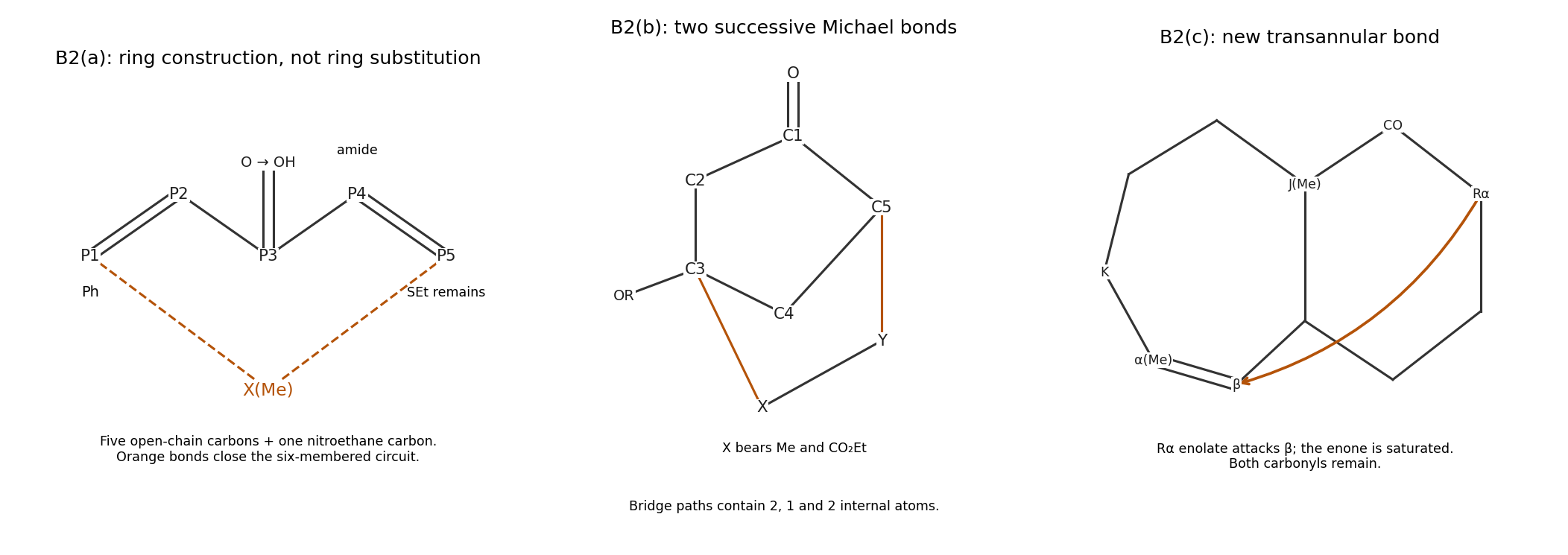
Original atom maps for the open-chain benzannulation, the two bonds of the norbornanone-forming tandem Michael addition, and the intramolecular Michael closure
. Details. 
Number the cyclopentenone carbonyl carbon , its alkene carbons and with OR at , and its saturated carbons and . The ester alkene has alpha carbon , bearing Me and CO2Et, and beta carbon , bearing the protected carbon substituent. lithium diisopropylamide generates the ordinary ketone enolate at the saturated alpha carbon . The acetonide is retained.
The carbon end of this enolate attacks ester beta carbon Y. Its pi system shifts through X onto the ester oxygen, forming the first new bond and an ester enolate at X. That enolate now attacks the original cyclopentenone beta carbon intramolecularly, giving the second new bond . The original enone electrons move onto its ketone oxygen, and protonation of the final ketone enolate completes the product. The OR substituent is retained at the new bridgehead; it need not leave in either Michael addition.
The atom map provides a useful structural check. Between bridgeheads and , the three paths are , , and . Their numbers of internal atoms are 2, 1 and 2, establishing the norbornane skeleton. Both original carbonyls survive and both initial alkenes are consumed. The two successive conjugate additions give this atom map without requiring a concerted cycloaddition.
The new bridge is made by an intramolecular Michael addition. On the cyclohexanone side, the methyl-bearing fused alpha carbon is quaternary and cannot be deprotonated there. triethylamine can instead generate a small equilibrium population of the enolate at the other, methylene alpha carbon. Its carbon attacks the beta carbon of the enone in the seven-membered ring. The enone pi electrons move towards its carbonyl and then onto oxygen, creating the new bridge and a second enolate.
protonation of that enolate at the former methyl-substituted enone alpha carbon restores the left-hand ketone. The initial enone C=C has therefore become a saturated C–C bond while one new transannular C–C bond forms. Both ketones are retained, and the initial two-ring framework becomes a three-ring framework without changing the total index of hydrogen deficiency. The methyl originally at the fused quaternary centre does not migrate; the other methyl ends up on a protonated, formerly unsaturated carbon. A strong-base concentration large enough for quantitative enolate generation is unnecessary for a favourable intramolecular trapping reaction, and neither an aldol dehydration nor a methyl shift is needed.
Let and number the carbon substituent from oxygen: . sodium hydride removes a proton from C3, alpha to the nitrile, forming hydrogen and a nitrile-stabilized carbon anion. That carbon attacks the nitroaryl ipso carbon bearing O. The tether closes a five-membered cyclic Meisenheimer intermediate with sequence C3–C2–C1–O–aryl ipso carbon. The para nitro group stabilizes the negative charge generated by temporary loss of aromaticity.
Rearomatization breaks the aryl–O bond, releasing the tether oxygen as an alkoxide while retaining the new aryl–C3 bond. protonation gives . This is a Truce–Smiles rearrangement: the aryl group migrates from oxygen to carbon. The nitrile remains attached to its original side-chain carbon; the original ether oxygen becomes the terminal alcohol oxygen. The substrate and product have identical atomic composition. Ordinary substitution at a saturated chain carbon would not produce this aryl–carbon bond or restore the terminal OH.
Articles by others on the same topic
There are currently no matching articles.