water achieves substantial binding through a localized O–H···O hydrogen bond; benzene achieves a comparable total through a larger set of weaker contacts. In the water dimer, one water is the hydrogen-bond donor and the other presents an oxygen lone pair region as acceptor. The interaction includes electrostatics, induction interaction, dispersion and short-range exchange repulsion; a hydrogen bond is not a separate fundamental force that can simply be added to all those terms again.
For benzene, draw a T-shaped edge-to-face pair or a slipped parallel pair. Its larger, more polarizable electron clouds provide appreciable London dispersion. Its quadrupolar charge distribution also makes the energy orientation dependent, despite each molecule having no permanent dipole by symmetry. An edge C–H approaching the other ring's pi region is therefore preferable to a model of two structureless, noninteracting dipole-free objects. Dispersion attracts while Pauli repulsion limits close overlap. Several distributed contacts can sum to the scale of one water–water hydrogen bond; counting only the number of conventional hydrogen bonds would miss them.
The comparison concerns the given gas-phase pair interaction energies, not an equality of every solvent-dependent association free energy. Correlated primary calculations explicitly identify both T-shaped and parallel-displaced benzene-dimer minima, rather than a uniquely preferred perfectly eclipsed sandwich.[ref]
Estimates of the Ab Initio Limit for π–π Interactions: The Benzene Dimer by Mutasem Omar Sinnokrot and others. 2002, abstract and pp. 10887–10893, comparison of the three dimer geometries
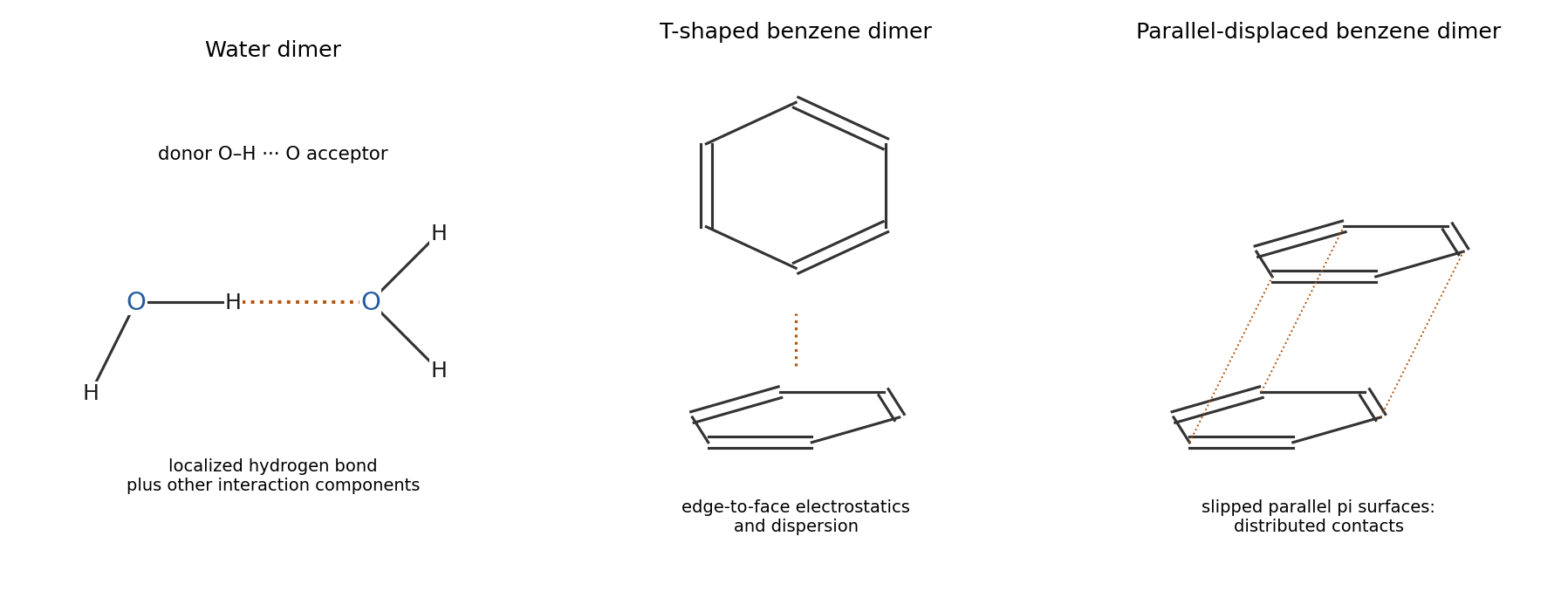
Original schematic geometries of a hydrogen-bonded water dimer and T-shaped and parallel-displaced benzene dimers
. Details. 
Association in solution includes replacement of solute–solvent contacts, not just formation of the isolated dimer. cyclohexane solvates the benzene surface well through dispersion. Much of the London dispersion gained on bringing two benzene molecules together replaces comparable benzene–cyclohexane contacts, leaving only a modest net gain before the translational and orientational entropy penalty. cyclohexane cannot provide the complementary donor/acceptor interactions available when two waters hydrogen-bond, so water association gains a more distinctive interaction relative to its separated solvated monomers.
Using the same concentration standard state, and . For illustration at 298 K and , the ratio of the two supplied association constants corresponds toThus the water-molecule pair can associate more favourably in this solvent even though the stipulated isolated-pair binding energies are similar. Gas-phase potential energy alone omits both differential solvation and the entropy of association.
In water, separated benzene molecules require separate hydration environments around nonpolar surface. Bringing them together buries part of that surface and reorganizes the surrounding water. The resulting solvent contribution favours association relative to cyclohexane, where benzene was already well solvated by dispersion. This solvent-mediated contribution is the hydrophobic effect, not formation of a new covalent bond or a claim that benzene has become a conventional hydrogen-bond acceptor like oxygen.
The supplied constants imply a thirtyfold enhancement. With matched standard states,at an illustrative 298 K. The water value is still slightly below , so enhancement relative to cyclohexane does not mean a negative standard association free energy for a 1 M standard state, nor does it imply that dilute benzene is all dimer. No universal “entropy only” explanation is needed: solvent enthalpy and entropy both contribute and depend on temperature.
TODO: user-deferred biology subquestion. This part is intentionally unsolved under the instruction to skip biology. No biological mechanism, sequence analysis or protein-folding research has been undertaken.
TODO: user-deferred biology subquestion. This part is intentionally unsolved under the instruction to skip biology. No biological mechanism, sequence analysis or protein-folding research has been undertaken.
TODO: user-deferred biology subquestion. This part is intentionally unsolved under the instruction to skip biology. No biological mechanism, sequence analysis or protein-folding research has been undertaken.
TODO: user-deferred biology subquestion. This part is intentionally unsolved under the instruction to skip biology. No biological mechanism, sequence analysis or protein-folding research has been undertaken.
Articles by others on the same topic
There are currently no matching articles.