A and C are chiral; B is achiral. In A, a quaternary ammonium stereocenter occurs because nitrogen has four different substituents: phenyl, methyl, ethyl, and the sulfinylethyl chain. It has no nitrogen lone pair available for ordinary pyramidal inversion of an amine. The sulfoxide sulfur is also stereogenic: its pyramidal arrangement distinguishes oxygen, methyl, the nitrogen-containing chain, and the lone-pair direction. There are two independent stereocenters and no internal symmetry, giving four configurations in two pairs of enantiomers. This is chirality of the cation; a bromide counterion does not remove it.
B can adopt a trans-1,4-dimethylcyclohexane chair with both methyl groups equatorial. An inversion centre at the chair centre exchanges its opposite carbon atoms and methyl groups. Its mirror image is therefore superposable: trans substituents in a flat ring drawing do not by themselves prove chirality. ring inversion gives the less favourable diaxial conformer without changing the trans configuration.
In C, tetrahedral phosphorus has four different substituent directions: oxo, methoxy, ethoxy, and phenoxy. C has a phosphorus stereocenter. Delocalization in the P–O bonds does not make these four ligand environments identical. A tetrahedral drawing and its mirror cannot be superposed without exchanging two ligands.
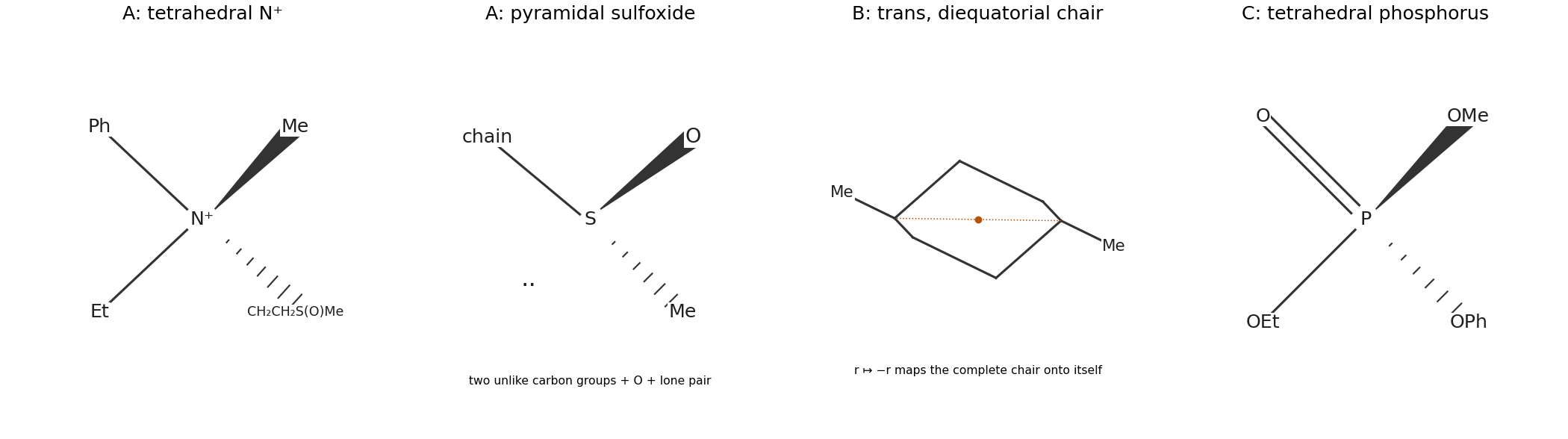
Original three-dimensional models of the two stereocenters in A, the inversion symmetry of trans-1,4-dimethylcyclohexane, and tetrahedral phosphorus in C
. Details. 
The bridged, sterically hindered biphenyl framework is twisted and does not rapidly interconvert the two faces of each methylene group on the NMR timescale. Label one hydrogen on each CH2 and the other . Replacing versus by a test substituent gives diastereomeric environments, so these hydrogens are diastereotopic and need not have equal chemical shifts even in an achiral solvent. Molecular symmetry relates the two sites to each other and the two sites to each other.
Each methylene hydrogen undergoes geminal coupling to its partner, giving the two doublets, each accounting for two hydrogens overall. Their separation is ppm; at operating frequency in MHz it corresponds to Hz. This separation is not the geminal coupling constant, which must be measured from the line spacing within a doublet. If the shift separation is not large compared with that coupling, an AB pattern with second-order distortion is expected rather than ideal first-order doublets. A racemic pair of twisted conformations still has these signals: enantiomers have the same spectrum in an achiral medium, while the two hydrogen environments within each molecule remain different.
Articles by others on the same topic
There are currently no matching articles.