A and C are chiral; B is achiral. In A, a quaternary ammonium stereocenter occurs because nitrogen has four different substituents: phenyl, methyl, ethyl, and the sulfinylethyl chain. It has no nitrogen lone pair available for ordinary pyramidal inversion of an amine. The sulfoxide sulfur is also stereogenic: its pyramidal arrangement distinguishes oxygen, methyl, the nitrogen-containing chain, and the lone-pair direction. There are two independent stereocenters and no internal symmetry, giving four configurations in two pairs of enantiomers. This is chirality of the cation; a bromide counterion does not remove it.
B can adopt a trans-1,4-dimethylcyclohexane chair with both methyl groups equatorial. An inversion centre at the chair centre exchanges its opposite carbon atoms and methyl groups. Its mirror image is therefore superposable: trans substituents in a flat ring drawing do not by themselves prove chirality. ring inversion gives the less favourable diaxial conformer without changing the trans configuration.
In C, tetrahedral phosphorus has four different substituent directions: oxo, methoxy, ethoxy, and phenoxy. C has a phosphorus stereocenter. Delocalization in the P–O bonds does not make these four ligand environments identical. A tetrahedral drawing and its mirror cannot be superposed without exchanging two ligands.
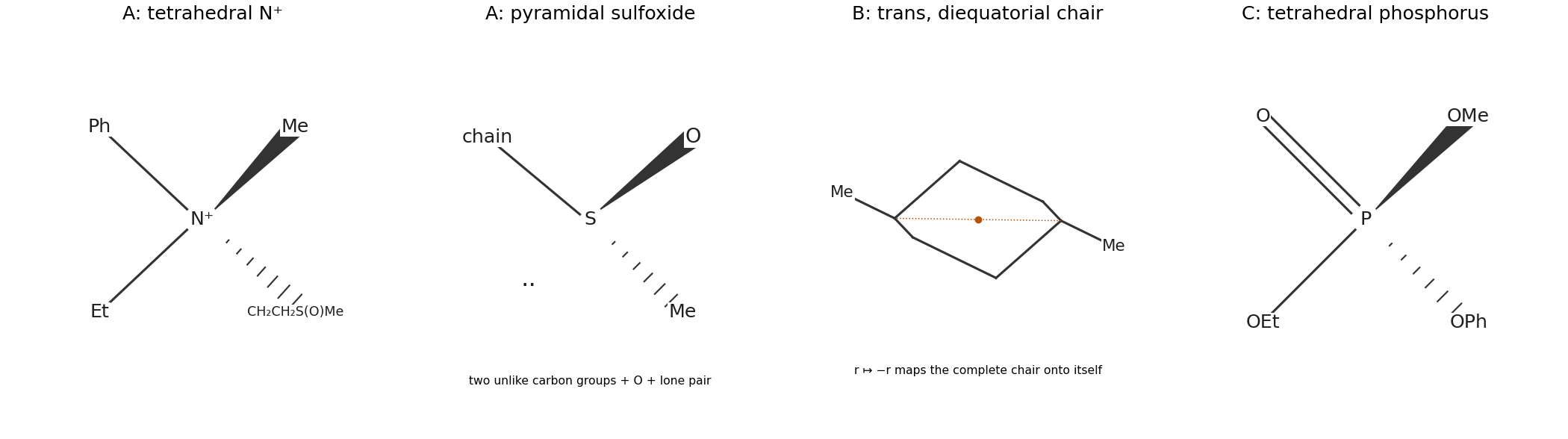
Original three-dimensional models of the two stereocenters in A, the inversion symmetry of trans-1,4-dimethylcyclohexane, and tetrahedral phosphorus in C
. Details. 
The bridged, sterically hindered biphenyl framework is twisted and does not rapidly interconvert the two faces of each methylene group on the NMR timescale. Label one hydrogen on each CH2 and the other . Replacing versus by a test substituent gives diastereomeric environments, so these hydrogens are diastereotopic and need not have equal chemical shifts even in an achiral solvent. Molecular symmetry relates the two sites to each other and the two sites to each other.
Each methylene hydrogen undergoes geminal coupling to its partner, giving the two doublets, each accounting for two hydrogens overall. Their separation is ppm; at operating frequency in MHz it corresponds to Hz. This separation is not the geminal coupling constant, which must be measured from the line spacing within a doublet. If the shift separation is not large compared with that coupling, an AB pattern with second-order distortion is expected rather than ideal first-order doublets. A racemic pair of twisted conformations still has these signals: enantiomers have the same spectrum in an achiral medium, while the two hydrogen environments within each molecule remain different.
In both cases the alkene undergoes concerted oxygen transfer from metachloroperbenzoic acid. The alkene pi bond forms one C–O bond to the terminal peroxide oxygen; electron redistribution forms the second C–O bond, breaks O–O, and transfers the peracid proton to its carbonyl oxygen as the carboxylic acid product forms. This cyclic epoxidation pathway delivers both C–O bonds from one face, without a freely rotating carbon intermediate.
For 1-methylcyclohexene, the two alkene faces are enantiotopic. Attack from opposite faces gives the two mirror-related epoxides, and an achiral peracid in an achiral environment cannot distinguish their Gibbs energies of activation. The product is racemic, 1:1.
For the cis-fused bicyclic alkene, the junction configuration and its puckered ring conformation make approach from the two faces sterically different. The folded saturated ring shields the concave face; oxygen transfer preferentially approaches the more exposed convex face, directed away from that ring. The alternative attack places the incoming peracid closer to the folded skeleton. The 95:5 ratio represents facial diastereoselectivity, while concerted syn oxygen delivery is retained for either product. It should not be explained by free rotation or by one epoxide subsequently changing configuration. For scale only, if this ratio were measured under irreversible kinetic conditions at 298 K, it would correspond to difference between the competing Gibbs energies of activation; the exam does not specify that temperature.
E, with the axial anomeric acetate, hydrolyses faster. The tert-butyl substituent strongly favours the chair in which it is equatorial, so the two substrates cannot freely interchange axial and equatorial acetate simply by an inexpensive ring inversion. protonation activates the anomeric acetoxy leaving group. As its C–O bond cleaves to release acetic acid, a lone pair on the endocyclic oxygen donates into the developing anomeric orbital, producing an oxocarbenium ion. water attacks that carbon, and deprotonation gives the cyclic hemiacetal. Attack from either face accounts for the unspecified anomeric configuration of OH in the product.
The axial C–OAc bond in E can adopt antiperiplanar geometry relative to an endocyclic oxygen lone pair. This favourable interaction assists departure in the ionization transition state. The corresponding bond in F is poorly aligned in its preferred chair; achieving comparable overlap requires an unfavourable chair change, placing tert-butyl axial, or substantial ring distortion. The distinction is stereoelectronic control of acetal hydrolysis, rather than merely counting steric crowding in the products.
An axial acetal can itself receive ground-state stabilization from the anomeric effect, so “axial means unstable” is not an adequate rate argument. What matters is the relative Gibbs energy of activation for the departing bond and the geometry of lone-pair assistance. Conformationally locked model acetals experimentally demonstrate faster acid-catalysed cleavage of the axially oriented isomer, although their numerical rate ratios should not be transferred to these different substrates.[ref]
Stereoelectronic control of the hydrolysis of a conformationally locked acetal by Anthony J. Kirby and Robert J. Martin. 1983, abstract and pp. 1627–1632, acid-catalysed axial/equatorial comparison
With triethylamine present, proton transfer from thiophenol produces a more nucleophilic thiolate population. sulfur attacks the anomeric epoxide carbon C1 from the face opposite its epoxide C–O bond. Displacement by backside attack opens the epoxide, breaks C1–O, and leaves the former epoxide oxygen attached to C2. protonation of that alkoxide by thiophenol or triethylammonium gives G: SPh at C1 on the front face and OH at C2 on the back face, a trans relationship. This is inversion at C1 with retention of the C2 C–O bond; there is no need to invert every stereocentre. Rapid protonation also suppresses competing silyl transfer by the alkoxide.
Without added base, neutral thiophenol is less nucleophilic. acid-assisted cleavage at the anomeric epoxide bond can instead be accompanied by donation from the ring oxygen, giving an oxocarbenium ion with charge shared with the ring oxygen. thiophenol capture from the face that puts SPh back on the original epoxide face, followed by deprotonation, gives H with SPh and C2–OH both on the back face, the net-retention pathway. An ion-pair or highly asynchronous opening can provide this outcome; the drawing does not establish a long-lived free carbocation.
The distinction is configuration, not a mandatory fixed chair. For the closely matching trisilylated substrate, the primary study obtained both anomers with thiophenol alone, and established an unusual inverted chair for the alpha thioglycoside by NMR and crystallography. Thus H should be explained as an accessible product, not asserted to be the sole product or necessarily to have axial SPh in its preferred conformation.[ref]
Reaction of thiophenol with glucal epoxides: X-ray structure of 3,4,6-tri-O-tert-butyldimethylsilyl-1-S-phenyl-1-thio-α-D-glucopyranoside by Caroline Walford and others. 1997, Schemes 1–2 and Figure 1; neutral reaction mixture and configuration/conformation assignment
Articles by others on the same topic
There are currently no matching articles.