An enolate is an ambident nucleophile: the negative charge is concentrated toward oxygen, while its occupied conjugated orbital also has substantial reactive amplitude at the alpha carbon. An alkyl iodide presents an accessible, polarizable carbon electrophile. carbon attack through an SN2 reaction is generally kinetically favorable, while the more strongly charged oxygen is often coordinated to the counterion or solvated. The carbonyl reforms as the new C–C bond is made.carbon alkylation restores the carbonyl and makes the new C–C bond. oxygen alkylation instead gives an enol ether. The two outcomes are not resonance contributors of one product, and their ratio is not determined just by where the largest formal negative charge is drawn. electrophile, counterion, solvent and aggregation can change selectivity; hard silicon electrophiles and suitable acylating reagents often favor oxygen trapping. Product stability alone would not explain an irreversible kinetic choice.
Lithium diisopropylamide removes an alpha proton from the ethyl side of the ketone. The C–H electrons form the C=C part of a lithium enolate, while the C=O pi electrons move to oxygen. The phenyl side has no competing alpha C–H site. Diisopropylamine is the conjugate-acid byproduct.The carbon end of this enolate attacks the primary carbon bearing iodine in . The C–I bond breaks to iodide in an SN2 reaction, and carbonyl reformation givesThus a three-carbon methoxypropyl chain is attached at the ketone alpha carbon. The remote methyl ether survives. The hindered amide base is chosen to generate the enolate rather than to add to the carbonyl. No absolute stereochemical preference is specified for the new stereocenter under these achiral conditions.
The initial nucleophile attacks silicon, not the nitrile or an alkene carbon. Each trimethylsilyl group has an electrophilic Si center. A methyl group from methyllithium attacks Si, passing through a pentacoordinate silicon arrangement; Si–O cleavage releases and the lithium salt of the oxygen-containing fragment. Cleaving the silyl enol ether generates a lithium enolate; cleaving the aryl silyl ether generates a phenoxide. Neither operation needs a new deprotonation at a carbon stereocenter.Here represents either the phenoxide or the oxygen-centered enolate contributor. Excess reagent permits both cleavages. The pre-existing methyl/nitrile stereocenter retains its configuration: it has no hydrogen to remove, and neither bond attached to that center is broken.
After HMPA is added, each anionic oxygen attacks the carbonyl carbon of allyl chloroformate. The C=O pi electrons move to the carbonyl oxygen, giving a tetrahedral intermediate; collapse expels chloride. The enolate becomes an allyl enol carbonate, and the phenoxide becomes an aryl allyl carbonate, each containing . oxygen acylation accounts for preservation of the enol double bond and for the two newly installed carbonate groups. carbon attack would give a different carbon skeleton. The two oxygens are trapped because they were selectively unmasked by desilylation, rather than because every ether oxygen in the molecule is equally reactive.
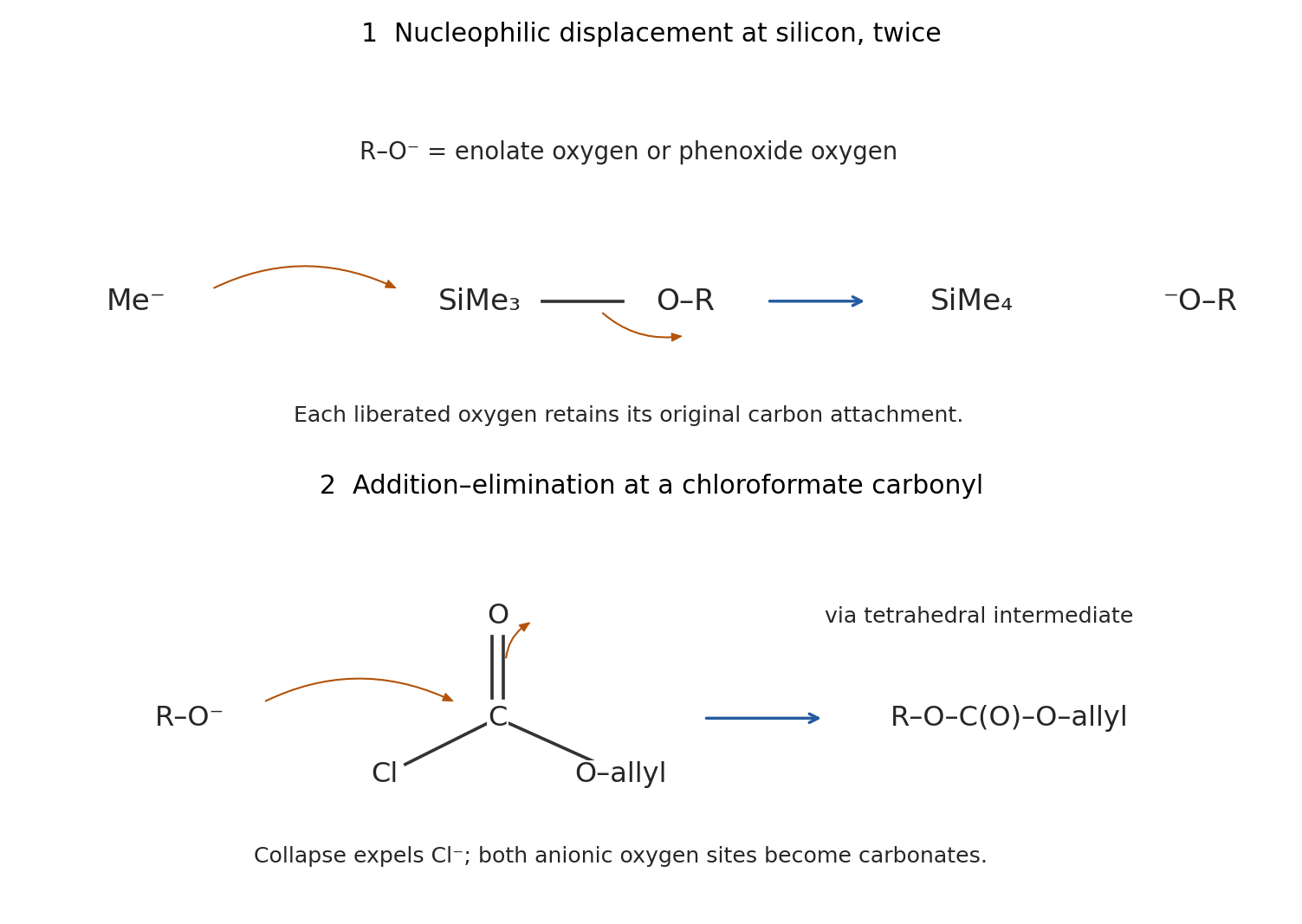
HMPA coordinates Li through its phosphoryl oxygen and makes the anionic oxygen sites more available for acylation. Strong cation solvation changes contact ion pairing, chelation and aggregate structure. It can therefore accelerate trapping of both the enolate and phenoxide by the chloroformate, helping realize the observed O-acylation pathway.
It is too strong to assert that HMPA necessarily produces completely free, monomeric anions. In a primary study of a lithium enolate in THF, low-temperature multinuclear NMR and reaction kinetics identified an HMPA-coordinated dimer as the reactive form, even with excess HMPA.[ref]
Effects of HMPA on the Structure and Reactivity of the Lithium Enolate of Cyclopentanone in THF: The Dimer is Responsible for Alkylation and Proton Exchange Reactions by Masaaki Suzuki and others. 2004, pp. 259–268, HMPA titration, aggregate assignment and alkylation kinetics
The useful conclusion here is altered lithium coordination and enhanced oxygen accessibility; the exact aggregate of this bifunctional substrate is not supplied.The carbamate carbonyl oxygen attacks electrophilic sulfur of triflic anhydride, with cleavage of the anhydride S–O bond to release triflate. Donation of the nitrogen lone pair toward the carbonyl carbon then gives the indicated imidoyl-type cation: the former carbonyl oxygen now bears Tf, and the N–H nitrogen participates in a C=N bond. This converts a relatively unreactive carbamate carbonyl into a strongly electrophilic carbon bearing an excellent leaving group.
The aromatic pi bond para to ethoxy attacks that carbon. The C=N pi electrons move to nitrogen as the new aryl–carbon bond forms. Loss of the aromatic proton restores aromaticity; nitrogen donation and departure of the O-triflylated group restore the imine bond. proton transfers during the sequence and carbonate workup remove the remaining N–H proton. The surviving five-membered ring is an oxazoline: the product is 2-(4-ethoxyphenyl)-2-Oxazoline. An equivalent arrow order can eliminate the triflyloxy leaving group before arene capture; these are limiting descriptions of the activated electrophile, not a need to postulate an unactivated carbamate undergoing ordinary Friedel–Crafts acylation.
Ethoxy donates a lone pair into the ring, stabilizing the ortho and para Wheland intermediates. The para pathway avoids the crowding of an incoming heterocycle beside ethoxy, giving the observed position. Mechanistic experiments on this transformation include in situ carbon NMR of the activated reagent, competition experiments and isotope-effect measurements supporting electrophilic aromatic substitution; they do not directly image every intermediate.[ref]
Simple and Efficient Aromatic C–H Oxazolination by Qiu Shi and others. 2023, Figure 7 and supporting information, product 3a and electrophilic-substitution evidence
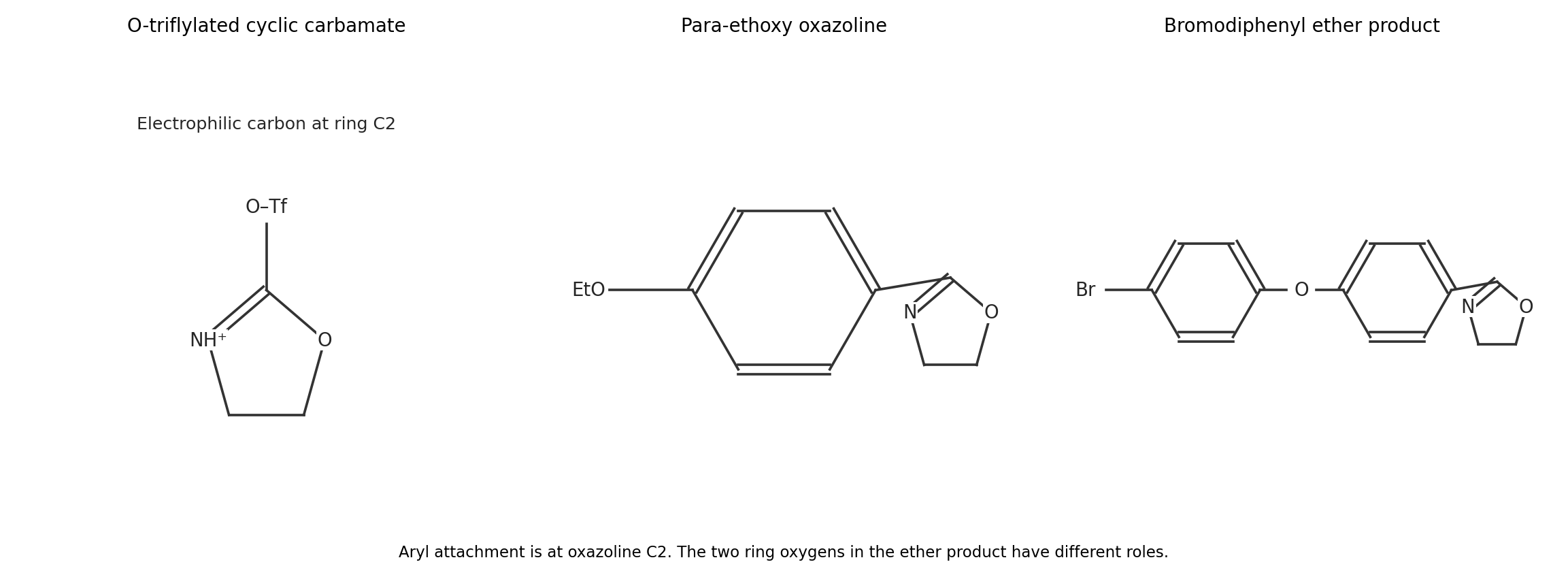


Oxazolination occurs para to oxygen on the ring that does not bear bromine. The product is 2-[4-(4-bromophenoxy)phenyl]-2-Oxazoline, shown in the final panel above. The brominated ring retains its para bromine; the other ring receives the new oxazolinyl group at its open para position.
The diaryl ether oxygen activates both rings toward electrophilic aromatic substitution. On the brominated ring, its least crowded para position is blocked, and bromine also decreases ring reactivity inductively. The unbrominated ring has an accessible para position, favored over its ortho sites by steric effects. This is substitution of an aromatic hydrogen, not displacement of the aryl bromide.
Articles by others on the same topic
There are currently no matching articles.