Place four terminal trifluorophosphine donors on each cobalt and join the cobalt centers by a single metal-metal bond, as in the first panel. The P atoms bind to cobalt; the fluorines remain attached to phosphorus. Each neutral donor supplies two electrons. Neutral electron counting givesThe ionic description is Co(0), , with eight electrons from the four donors and one from the Co–Co bond. A Co–Co single bond supplies the missing electron at each center. No bridging PF is required by this count.
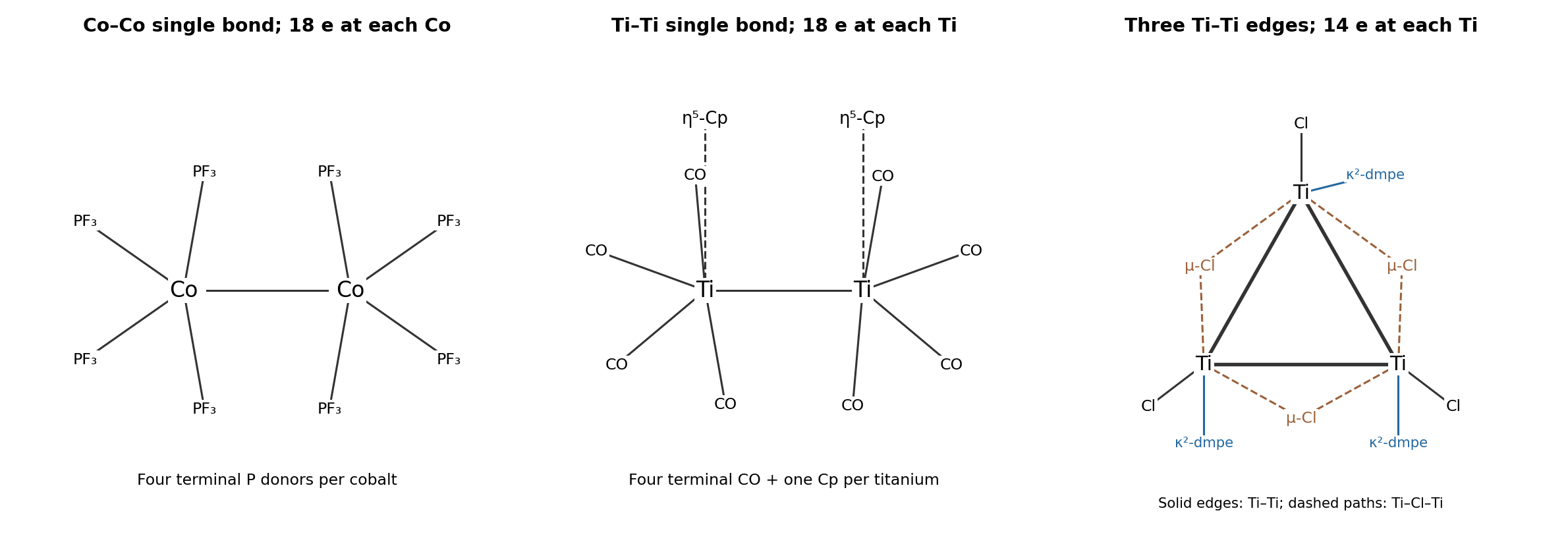

Use an cyclopentadienyl ligand and four terminal carbonyl ligands at each titanium, with a Ti–Ti single metal-metal bond. The middle panel shows this connectivity. Neutral electron counting assigns five electrons to each Cp and givesEquivalently, the two Cp anions require an average oxidation state Ti(I), hence ; ionic counting gives . The formal Ti–Ti bond order is one. The large coordination envelope can make this bond weak and long; reaching 18 electrons is bookkeeping, rather than proof of a short, strong bond. There is no need to invent extra CO bridges or a higher Ti–Ti bond order.
A suitable structure is a triangular Ti metal cluster with one 1,2-Bis(dimethylphosphino)ethane chelate and one terminal chloride at each titanium, and one bridging ligand -Cl spanning each edge. Include a direct Ti–Ti single metal-metal bond along each edge. The last panel distinguishes these direct bonds from the chloride bridges.
The six chlorides have total formal charge , so equivalent centers are Ti(II), . At each titanium the two phosphorus donors supply four electrons, the terminal chloride supplies two, and the two incident chloride bridges each donate a pair in ionic electron counting. Two incident Ti–Ti single bonds supply another two electrons:Each center can contribute one electron to each of its two edge bonds, making three bonds from six metal electrons overall. This is a 14-electron early-metal cluster, not an 18-electron complex. Forcing the 18-electron rule here would invent excessive bond orders. chloride bridges donate to more than one center, so summing local counts is not the same as counting distinct electrons of the whole cluster.
Articles by others on the same topic
There are currently no matching articles.