Treat the two donors of 2-Picolylamine as distinct: denotes pyridyl N and denotes amino N. Each ligand must join two adjacent octahedral positions because its five-membered chelate ring cannot span a trans pair. The three sites can either occupy a triangular face, giving a facial isomer, or a meridian containing a trans pair, giving a meridional isomer. Each geometry has a pair of nonsuperposable mirror images. Therefore there are four configurational stereoisomers: fac-, fac-, mer- and mer-. Rapid ring puckering or amine inversion does not introduce additional persistent configurations in this count.
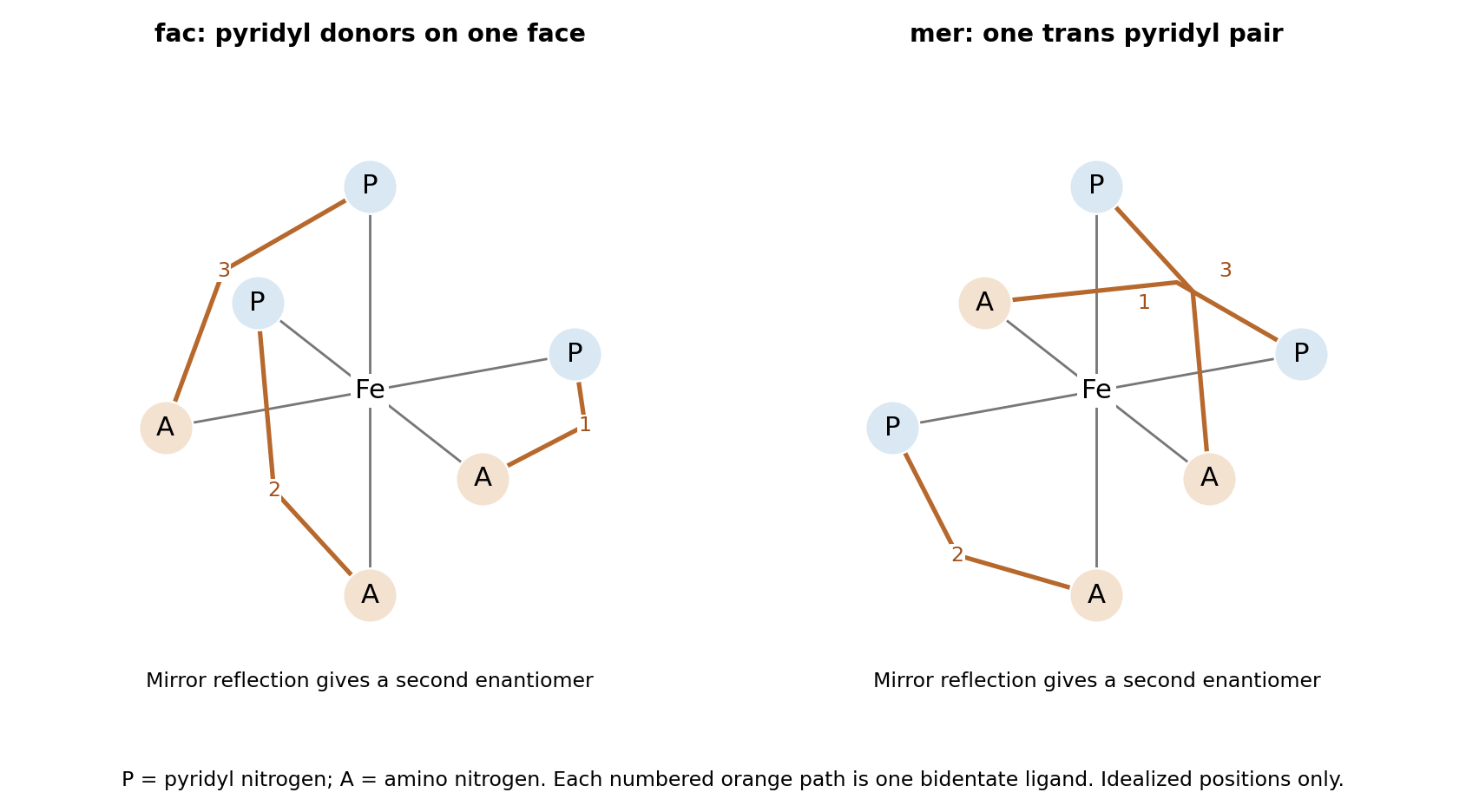

The mer geometry is the reasonable steric prediction for the more stable form. It spreads the bulky pyridyl rings farther apart, allowing one pyridyl–pyridyl trans relationship, whereas the fac geometry groups all three pyridyl donors on one face. This is a qualitative preference, not a proof independent of counterions and solvent: hydrogen bonding and packing can favor the alternative. Primary structures of different salts contain both geometries, so neither should be claimed impossible.[ref]
Spin Crossover in [Fe(2-Picolylamine)3]2+ Adjusted by Organosulfonate Anions by Xin-Hua Zhao and others. 2015, pp. 7857–7867, mer structures in compounds 1 and 2 and fac structure in compound 3
iron remains Fe(II), , in both states; the change is a spin crossover, rather than a change in oxidation state. At the higher temperature the high-spin complex has : four unpaired electrons, , andThis matches the observed moment. At low temperature a low-spin complex with has and shows diamagnetism. Cooling switches high-spin to low-spin . Emptying the metal–ligand antibonding orbitals strengthens and shortens the Fe–N bonds, accounting for the contraction by roughly .
The octahedral splitting and electron pairing energy must be sufficiently close for both states to be accessible. The low-spin state gains electronic energy, while the high-spin state has greater spin degeneracy and usually greater vibrational entropy because of its softer bonds. The resulting Gibbs free energy balance favors high spin at higher temperature. The two endpoint observations do not by themselves specify hysteresis or transition cooperativity; those require a temperature series. Coupled structural and magnetic measurements distinguish this explanation from a mere bond-length anomaly.
Articles by others on the same topic
There are currently no matching articles.