Treat the two donors of 2-Picolylamine as distinct: denotes pyridyl N and denotes amino N. Each ligand must join two adjacent octahedral positions because its five-membered chelate ring cannot span a trans pair. The three sites can either occupy a triangular face, giving a facial isomer, or a meridian containing a trans pair, giving a meridional isomer. Each geometry has a pair of nonsuperposable mirror images. Therefore there are four configurational stereoisomers: fac-, fac-, mer- and mer-. Rapid ring puckering or amine inversion does not introduce additional persistent configurations in this count.
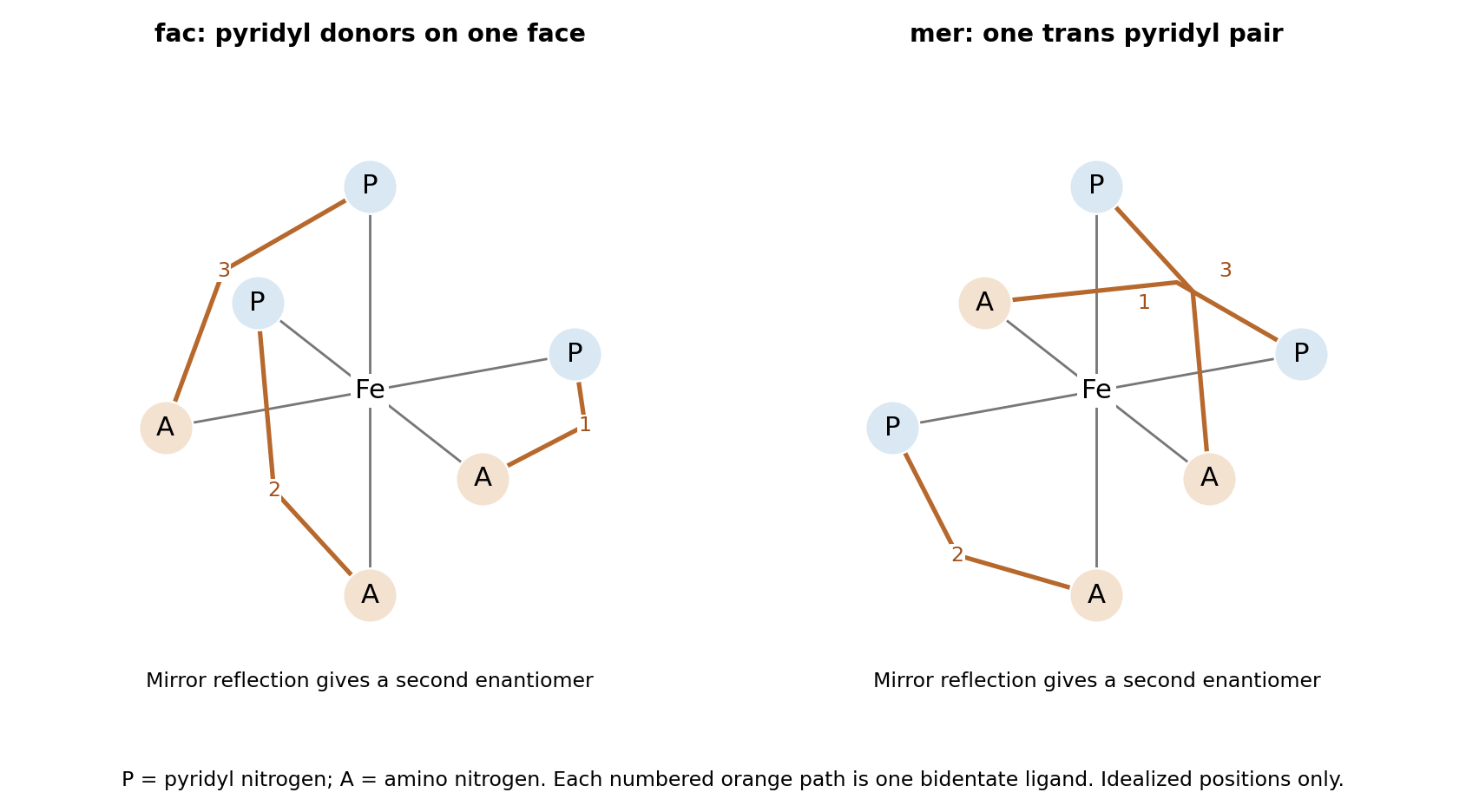

The mer geometry is the reasonable steric prediction for the more stable form. It spreads the bulky pyridyl rings farther apart, allowing one pyridyl–pyridyl trans relationship, whereas the fac geometry groups all three pyridyl donors on one face. This is a qualitative preference, not a proof independent of counterions and solvent: hydrogen bonding and packing can favor the alternative. Primary structures of different salts contain both geometries, so neither should be claimed impossible.[ref]
Spin Crossover in [Fe(2-Picolylamine)3]2+ Adjusted by Organosulfonate Anions by Xin-Hua Zhao and others. 2015, pp. 7857–7867, mer structures in compounds 1 and 2 and fac structure in compound 3
iron remains Fe(II), , in both states; the change is a spin crossover, rather than a change in oxidation state. At the higher temperature the high-spin complex has : four unpaired electrons, , andThis matches the observed moment. At low temperature a low-spin complex with has and shows diamagnetism. Cooling switches high-spin to low-spin . Emptying the metal–ligand antibonding orbitals strengthens and shortens the Fe–N bonds, accounting for the contraction by roughly .
The octahedral splitting and electron pairing energy must be sufficiently close for both states to be accessible. The low-spin state gains electronic energy, while the high-spin state has greater spin degeneracy and usually greater vibrational entropy because of its softer bonds. The resulting Gibbs free energy balance favors high spin at higher temperature. The two endpoint observations do not by themselves specify hysteresis or transition cooperativity; those require a temperature series. Coupled structural and magnetic measurements distinguish this explanation from a mere bond-length anomaly.
The filled alkene molecular orbital donates into a vacant metal acceptor orbital directed toward the center of the C=C bond. In the reverse direction, a filled metal orbital can overlap with the alkene antibonding molecular orbital. These are the donation and pi backbonding components of the Dewar-Chatt-Duncanson model, illustrated in the lower part of the bonding schematic. The alkene is an alkene ligand, attached through both carbons. Increasing backbonding weakens and lengthens C=C and can push the bonding toward a metallacyclopropane description.
Zr(IV) is , so alkene-to-metal donation predominates. It has suitable empty orbitals but no occupied metal set to provide substantial conventional backbonding. An electron-deficient cationic zirconocene can consequently bind and activate an alkene largely through its Lewis acidity; it should not be drawn as a strongly backbonded late-metal alkene merely because its formal coordination mode is .
The trityl cation acts as an electrophile and removes one metal-bound methyl by methyl abstraction. The balanced conversion isThus and , 1,1,1-triphenylethane. Transfer is formally of to carbon, not transfer of a hydride or a methyl radical. zirconium remains Zr(IV), . Ionic electron counting changes from in the dimethyl to at the cation, creating an accessible coordination site. The borate is a weakly coordinating anion, although ion pairing can still occur in solution.
Write for the current growing chain. Propene first binds at the available site of , giving a coordinated alkene adjacent to the metal-bound chain. In the Cossee-Arlman mechanism, the chain migrates to the substituted alkene carbon while the terminal carbon forms the new Zr–C bond:The electron-pair arrows for insertion take the old Zr–R bond toward the substituted alkene carbon and the alkene pi bond toward the new Zr–terminal-carbon bond. A four-center arrangement permits both bonds to change in one migratory insertion; Zr remains Zr(IV). The product again has an accessible site, so coordination and insertion can repeat.
Predominant 1,2 insertion leaves a primary Zr–CH chain end and generates head-to-tail polypropylene. It avoids the more crowded alternative secondary Zr–CH(Me) end and unfavorable methyl contacts with the cyclopentadienyl ligands in the insertion geometry. This explains regioselectivity. An unbridged, unsubstituted zirconocene does not by itself establish a fixed tacticity; the schematic alignment of methyl groups in a polymer drawing is not evidence for an isotactic product.
A plausible explanation is a stronger, less labile Hf–C interaction, reflecting the different bonding of the heavier metal. Breaking and reorganizing that interaction in migratory insertion can raise the propagation barrier and reduce the insertion rate. At the same time, stronger retention of the metal-bound alkyl can suppress beta-hydride elimination or other chain transfer in chain polymerization processes even more strongly.
The chain length depends on competing rates, not on propagation speed alone. In a simple stationary competition,where the denominator includes the operative chain-transfer or chain-stopping rates per active chain. The Hf catalyst can propagate more slowly yet make longer chains if transfer is suppressed by a still larger factor. Slower insertion alone would not explain longer polymers. Distinguishing particular transfer pathways would require polymer end-group analysis and the concentration dependence of molecular mass and polymerization rate.
Articles by others on the same topic
There are currently no matching articles.