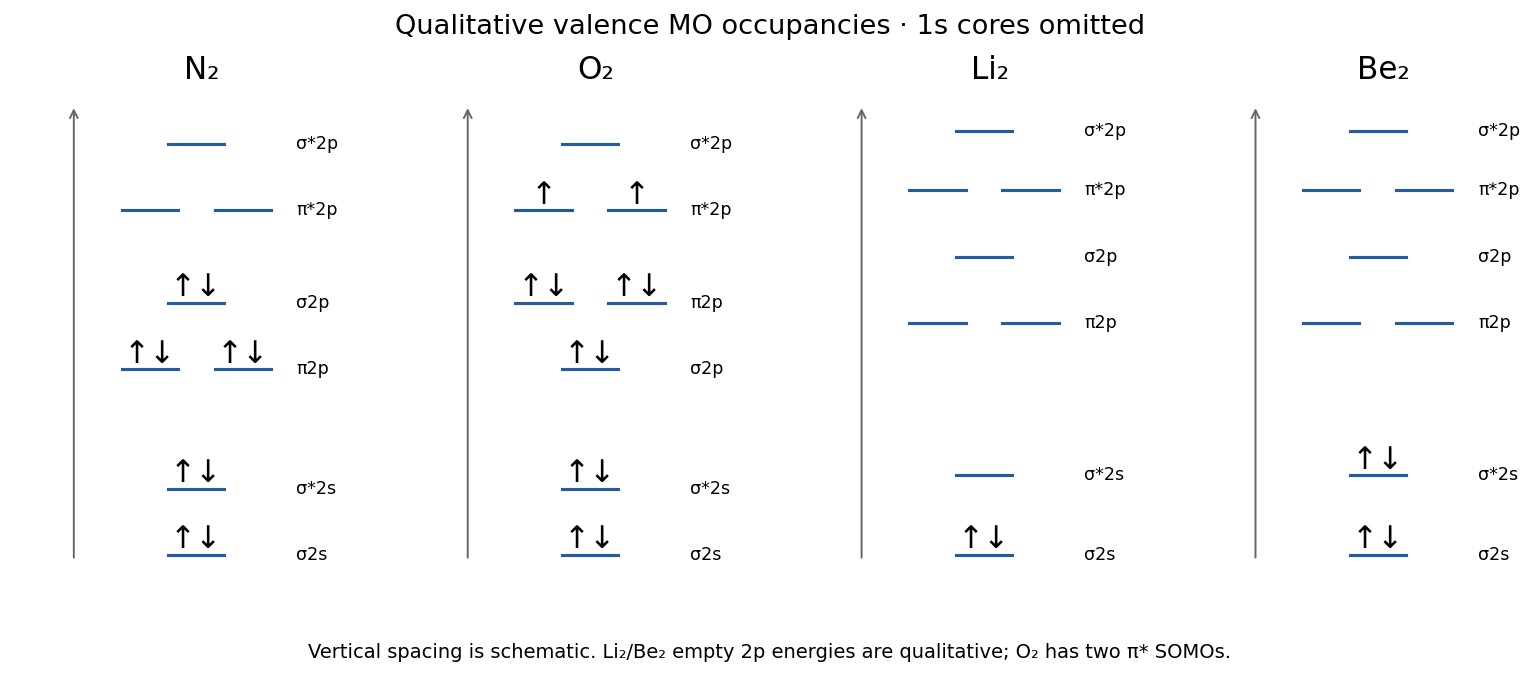
Qualitative valence molecular-orbital occupancies for nitrogen, oxygen, lithium and beryllium dimers
. Details. Suppress the filled 1s core pair, which contributes zero net bond order. For N, use the valence orderingand occupy it as .
For O, the ordering of the bonding 2p levels is reversed: . Occupancy is , with parallel spins in the two degenerate antibonding pi orbitals.
Li has ; Be has in the elementary valence description. Empty 2p-derived levels must also be included to discuss mixing and Be's weak bonding; their precise energies are not set by this qualitative diagram.
O: the two orbitals are the highest occupied, singly occupied spatial orbitals. The next completely empty spatial orbital is . An added electron can instead occupy the opposite-spin vacancy in a singly occupied pi-star orbital; this distinction matters if “LUMO” is being used for an electron-addition spin orbital.
Li: Homo ; next empty sigma orbital conventionally denoted in this elementary diagram. Be: Homo ; the low empty 2p manifold supplies the LUMO candidates, drawn as in the stated light-diatomic ordering. Mixing makes these labels descriptions of dominant atomic-orbital character, not strictly unmixed atomic functions.
This distinction is the open-shell frontier orbital convention.
Use :in the elementary configurations. The zero for Be is a limitation of this occupancy count, not proof that its measured interaction potential is everywhere repulsive.
Both Be's occupied bonding and antibonding 2s levels cancel in the simplest diagram. Beryllium's relatively accessible empty 2p orbitals allow mixing and correlated configurations to change that cancellation and produce a weak bond. An s-only single-configuration picture is therefore insufficient; spectroscopy and accurate correlated calculations establish its binding.[ref]
For He, similarly gives zero elementary covalent bond order, but the empty-shell excitation gap is much larger and there is no comparable low-energy 2s/2p near-degeneracy. Thus it has no ordinary stable covalent bond.
The literal claim that He does not exist needs qualification: an extraordinarily weak, cold van der Waals helium dimer has been observed. That does not contradict the zero covalent-bond-order diagram.[ref]
The beryllium dimer and helium dimer illustrate two physically different ways that the elementary bond-order picture can miss weak binding.
No ordinary covalent bond is expected. He's filled 1s orbital is very low in energy, whereas Be supplies another filled shell and much higher empty valence orbitals. Mixing the two occupied s combinations gives no net elementary bond-order gain, and their large energy mismatch limits useful shared covalent character. A very weak dispersion-bound encounter is a different possibility; the answer concerns a conventional covalent bond.
BeLi has three valence electrons: two occupy a bonding sigma orbital and the third its higher partner. The elementary bond order is therefore , with one unpaired electron: expect a relatively weak, paramagnetic, doublet diatomic molecule. Because Be attracts valence charge more strongly than Li, the bond is polar toward Be. This is a qualitative prediction, not a numerical dissociation energy.
This is the elementary picture of the lithium beryllium diatomic molecule.
The reacting Homo is the tertiary-amine nitrogen lone pair. The relevant LUMO is the C-I antibonding orbital, , of MeI. Backside lone-pair donation into that orbital forms N-C while weakening C-I. The neutral OH group is not first converted to an alkoxide in the stated reaction.
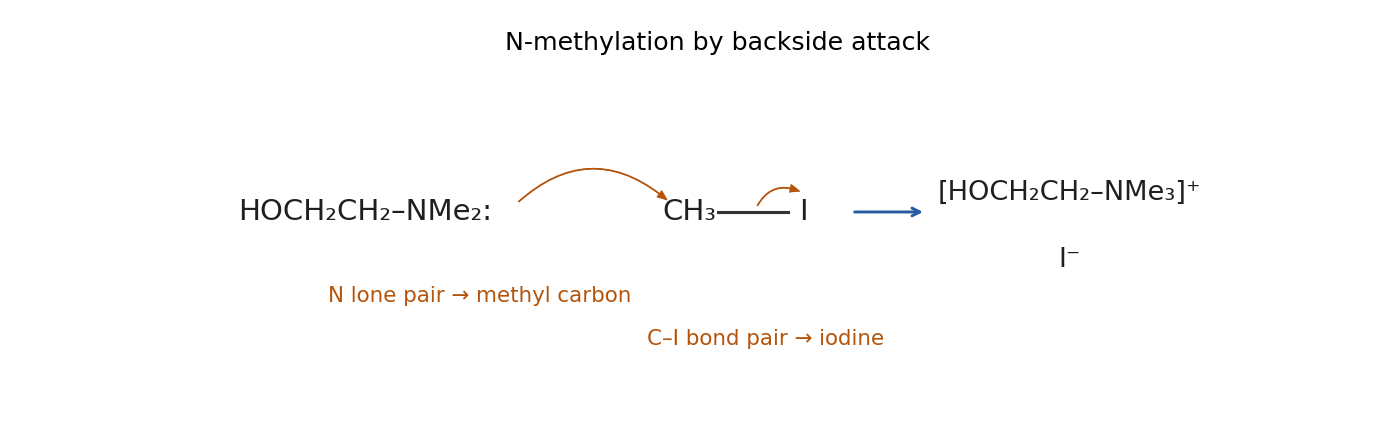


Draw a curly arrow from the nitrogen lone pair to methyl carbon, and a second from the C-I bond to I:This is concerted SN2 quaternization. The product is choline iodide; nitrogen has four carbon substituents and positive charge, while the alcohol remains OH.
Acetonitrile is suitable: it dissolves the organic reagents, is polar enough to stabilize the developing ionic products and is an aprotic, relatively unreactive medium. It does not strongly hydrogen-bond-solvate the amine lone pair or compete efficiently as the methylating nucleophile. Sufficient solubility and chemical compatibility matter as well as polarity.
Articles by others on the same topic
There are currently no matching articles.