The products lie below the reactants, while the transition state lies above both. On an energy-versus-reaction-coordinate plot, the forward activation energy is the vertical separation , not the difference between product and reactant energies. For an exothermic elementary path, , and the reverse barrier is .
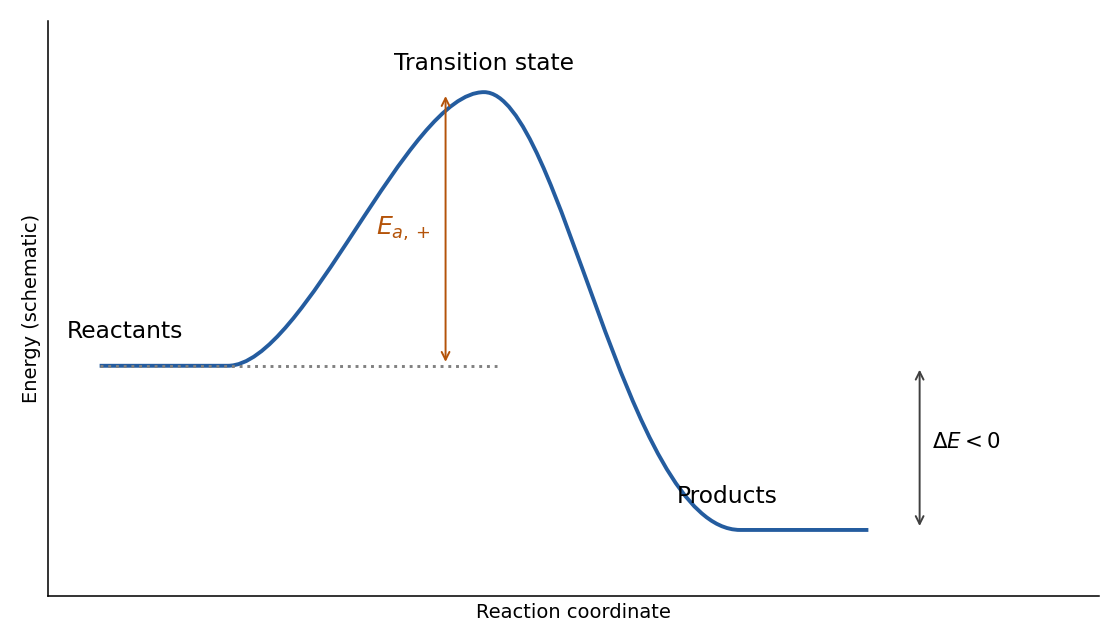
Original schematic exothermic energy profile with reactant, product, transition-state and forward-barrier labels
. Details. 
The Arrhenius equation isThe exponential gives the strongly temperature-dependent energetic factor. For a simple bimolecular collision picture, collects the encounter frequency per reactant concentration and the fraction of encounters with a suitable orientation and other dynamical requirements. Thus a collision is not automatically a successful reaction even when its energy is sufficient.
has the same units as , which depend on the rate law; it is not always a frequency in . More generally it is an effective prefactor containing statistical and dynamical contributions rather than a literal universal collision count. Treating it as temperature independent is the approximation requested here.
Rearrange the Arrhenius relation using the molar activation energy and the molar gas constant:The exponent is dimensionless. There is no Avogadro factor in it because both and are expressed per mole; the molecular concentration convention only determines the units of the prefactor.
For forward and reverse elementary reactions at equilibrium, the two rates are equal. Both directions have two reactant particles and use the same concentration convention, so the conversion factors cancel and . ThereforeFor molar rather than molecular number concentration, the bimolecular rate constant is multiplied by the Avogadro constant:Only one factor is needed: converting the two concentration factors contributes , while converting the production rate from molecules to moles removes one factor.
Step 1 is initiation; steps 2 and 3 are propagation; step 4 is termination. Initiation dissociates a chlorine molecule into two chlorine free radicals. Each propagation step consumes one free radical and creates another, carrying the chain forward without destroying its free radical carrier overall. Termination removes two chlorine free radicals by recombination.
The inert collision partner accepts or supplies energy as needed and is regenerated. It is not a free radical chain carrier or a net reagent. Adding the two propagation steps cancels the hydrogen and chlorine free radicals and gives one complete conversion of hydrogen plus chlorine to two molecules of hydrogen chloride.
The reverse elementary rate constant is extraordinarily small at 298 K. Its reaction would require hydrogen chloride and a chlorine free radical to produce a hydrogen free radical and chlorine, reversing a highly exothermic propagation step. The value found above makes this channel negligible for the intended reacting mixture compared with forward propagation.
A large equilibrium constant alone does not permit a reverse reaction to be ignored under every conceivable composition: if forward reactants were exhausted, concentration ratios would matter. The simplification applies during the forward chain-reaction regime specified, rather than constituting a universal statement about all late-time or imposed reverse conditions.
Apply the steady-state approximation in chemical kinetics to the hydrogen and chlorine free radicals. After a short initiation transient their formation and consumption can balance while the stable reactants continue to be depleted and hydrogen chloride accumulates. Accordingly set and .
This does not mean the free radicals are absent or that the whole mixture is at equilibrium. hydrogen and chlorine molecules and the hydrogen chloride product generally cannot all be assigned steady concentrations over appreciable conversion. The inert-body concentration can be treated as an imposed or slowly varying bath quantity; it is not an intermediate to which a free radical balance must be applied.
Let be the event rate for step , soThe free radical balances, including the factors of two for initiation and termination, areThus and , givingBoth propagation events form hydrogen chloride, soThe orders are one in hydrogen, one half in chlorine and three halves overall, with when the observed rate is HCl formation. If the rate is instead defined as the stoichiometrically normalized reaction rate, half that formation rate, the prefactor lacks the factor two. The bath concentration cancels because the same M-assisted initiation and recombination control the free radical pool. The result does not require ; different free radical concentrations make their steady fluxes equal. For molar concentration, has units .
Using bonds broken minus bonds formed, the enthalpies per mole of elementary events areUnder the steady-state approximation in chemical kinetics, initiation and termination have equal event rates, so their enthalpy contributions cancel. The two propagation steps also have equal flux, and their combined enthalpy is per overall reaction producing two moles of HCl. Step 3 dominates the heat release; the small endothermic contribution of step 2 only slightly offsets it.
An insulated vessel cannot remove this released energy as heat, so its temperature rises as reaction proceeds. In a rigid vessel the precise energy balance uses reaction internal energy and constant-volume heat capacities, whereas a constant-pressure adiabatic balance uses enthalpy; the strong exothermic conclusion is the same. Warming changes the rate constants, and activated initiation and propagation can accelerate, producing positive thermal feedback and potentially a rapid temperature rise. A numerical final temperature or a claim of an inevitable explosion is not justified without composition, heat capacities and heat-loss information. The initially assumed 298-K rate constants cannot remain fixed throughout an appreciable adiabatic temperature rise.
Articles by others on the same topic
There are currently no matching articles.