Quantum tunnelling is penetration of, or transmission through, a finite potential barrier into a classically forbidden region, where the total energy is less than the potential energy. The wavefunction generally remains nonzero there, so the Born rule assigns a nonzero probability of detection. This does not require an increase in total energy; it is the classical relation between a definite position and a definite kinetic energy that cannot be imposed on the quantum state. For a bound quantum harmonic oscillator, the relevant quantity is the probability of finding the particle beyond its classical turning points; it is not an escaping transmitted beam.
For the reduced quantum harmonic oscillator, and the ground-state energy is . Thus the classical turning points satisfy , giving . Normalizing the wavefunction gives , because . The Born rule therefore gives the harmonic-oscillator forbidden-region probabilityThe factor two includes both tails. Using the exact complementary error function gives . A stationary real wavefunction has zero probability current, so this result describes forbidden-region occupancy, not continuous loss of the bound particle.
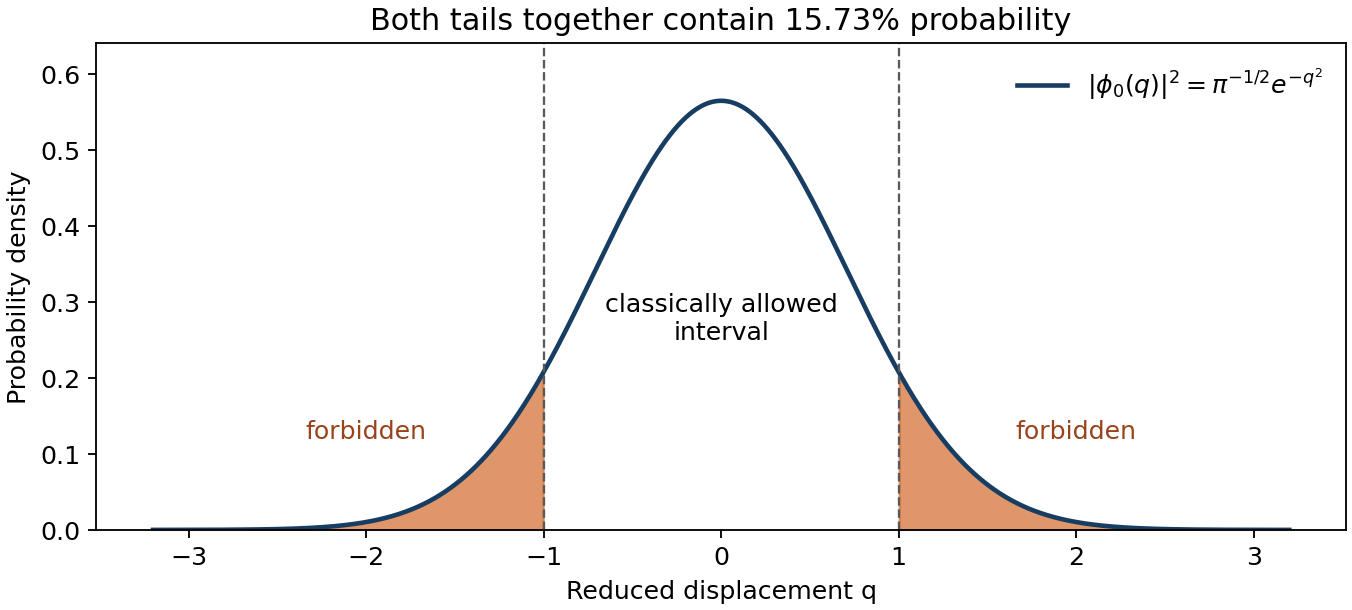
Normalized ground-state probability with both classically forbidden tails shaded
. Details. 
Articles by others on the same topic
There are currently no matching articles.