Quantum tunnelling is penetration of, or transmission through, a finite potential barrier into a classically forbidden region, where the total energy is less than the potential energy. The wavefunction generally remains nonzero there, so the Born rule assigns a nonzero probability of detection. This does not require an increase in total energy; it is the classical relation between a definite position and a definite kinetic energy that cannot be imposed on the quantum state. For a bound quantum harmonic oscillator, the relevant quantity is the probability of finding the particle beyond its classical turning points; it is not an escaping transmitted beam.
For the reduced quantum harmonic oscillator, and the ground-state energy is . Thus the classical turning points satisfy , giving . Normalizing the wavefunction gives , because . The Born rule therefore gives the harmonic-oscillator forbidden-region probabilityThe factor two includes both tails. Using the exact complementary error function gives . A stationary real wavefunction has zero probability current, so this result describes forbidden-region occupancy, not continuous loss of the bound particle.
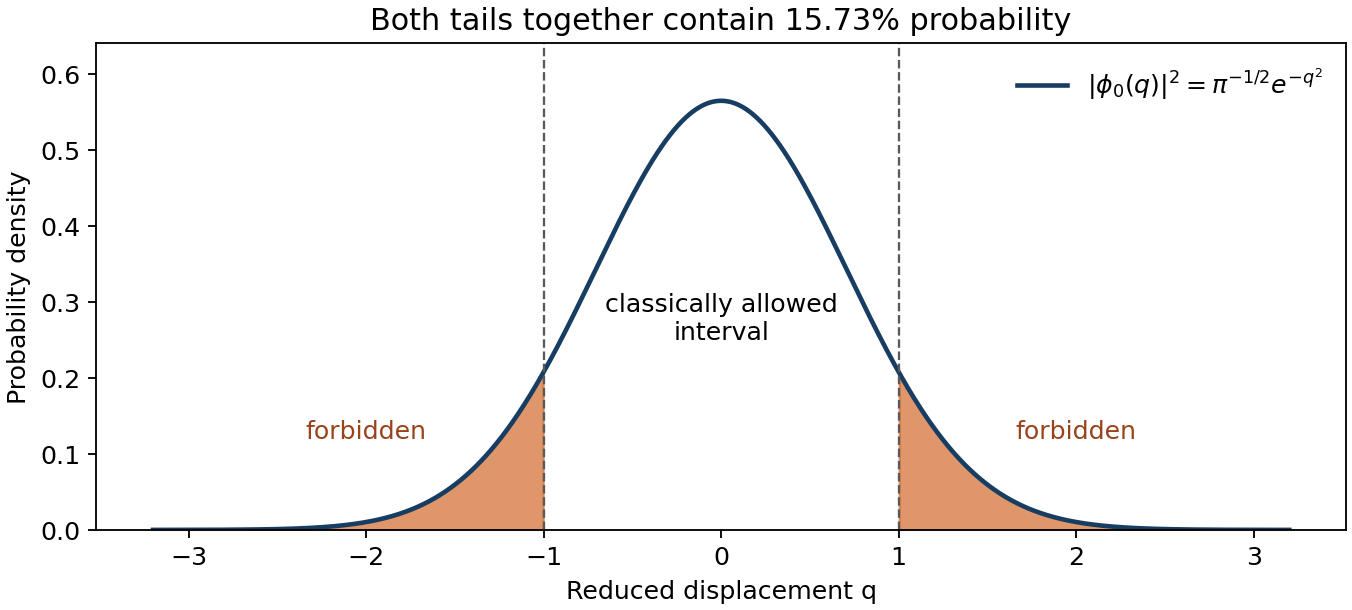
Normalized ground-state probability with both classically forbidden tails shaded
. Details. 
Inside the infinite square well, the Hamiltonian is purely the kinetic energy operator,Its admissible wavefunctions obey the boundary conditions and vanish outside the interval. Equivalently write with inside and an infinite confining wall outside. The boundary conditions are part of the specification of this Hamiltonian; the differential expression alone does not determine the spectrum.
Twice differentiating gives , so inside the infinite square wellThe boundary condition at zero is automatic. The other requires , hence . A nonzero eigenfunction can therefore be labelled byIf desired, its normalized form is . The positive lowest energy follows from confinement and the required spatial variation of a nonzero wavefunction.
For the proposed wavefunction vanishes identically and cannot be normalized. A negative integer gives , which differs from the corresponding positive-integer wavefunction only by a physically irrelevant global phase. Both have the same positive energy, proportional to . Thus zero is inadmissible and negative labels are redundant. A negative integer is not forbidden by a separate negative-energy argument.
Within a specified electron configuration in the LS coupling regime, Hund's rules select the lowest atomic term as follows. First maximize the total electron spin subject to the Pauli exclusion principle. Among the terms having that , choose the largest total orbital angular momentum . Finally, spin-orbit coupling places the smallest allowed lowest for a subshell less than half full, and the largest lowest for a subshell more than half full. At half filling the maximum-spin term has , hence . These rules rank terms within configurations; the exceptional neutral-atom configurations of chromium and copper must also be used.
For chromium the configuration is . The half-filled subshell has and ; aligning the spin gives , while . Therefore the ground-state term symbol is . For cobalt, has a closed pair. The subshell has the same possible values as three holes; maximizing spin and then orbital angular momentum gives , . Because it is more than half full, , giving . For copper, has a closed subshell, leaving , and . These are neutral-atom terms, rather than the terms of the common metal ions. The tabulated zero-energy levels independently confirm all three assignments.[ref][ref]
Energy Levels of Neutral Cobalt (Co I) by National Institute of Standards and Technology. Co I table, ground row 3d7 4s2 4F9/2
[ref]Energy Levels of Neutral Copper (Cu I) by National Institute of Standards and Technology. Cu I table, ground row 3d10(1S)4s 2S1/2
For the character of a localized orbital basis, take the trace of the transformation matrix: both permutation of centres and signs of atomic orbitals matter. The two metal centres lie on the principal axis and remain fixed under rotation about . At either metal the basis has the matrixThe full four-dimensional group representation is block diagonal with two such blocks. Consequently , and for the rotation of the D6h molecular point group, .
A rotation leaves both metal centres fixed but reverses each transverse p orbital: and . Its matrix is , so its character of a representation is , also obtained from .
Choose transverse directions parallel and perpendicular to the vertical mirror plane. At each metal the parallel p orbital is unchanged, whereas the perpendicular p orbital changes sign. Thus each two-dimensional block has trace . The total character of a representation is . A mirror plane passing through an orbital centre does not imply that every orbital on that centre contributes .
Use the axes actually printed: the two hydrogens lie in the plane, is the principal twofold axis, and is perpendicular to that plane. For a Cartesian-displacement group representation, only atoms left at their own sites contribute to the trace; their vector components must also be transformed. In the order , identity fixes six components, the twofold rotation exchanges the hydrogens, the reflection fixes both hydrogens with vector matrix , and the reflection exchanges them. ThereforeThe nonzero mirror character of a representation is , not six.
The C2v molecular point group has four one-dimensional irreducible representations. In the operation order used above, the character table rows are , , and . Their character inner products with giveHence , whose dimensions sum to six. The labels refer to the source axes; swapping and swaps these names.
Fix the positive lobes of the real atomic orbitals along the printed positive axes, and write , , and . A coordinate model consistent with the figure is , , and , with . For the D2d molecular point group, take the two transverse twofold axes along and , with vertical mirrors and . The character table row on is . The character projection operator isThe eight signed images needed for this projection areso . Under the standard orthonormal atomic orbital approximation its squared norm is . Therefore the normalized symmetry-adapted linear combination isAn overall minus sign describes the same quantum state; changing one local atomic orbital phase requires changing its coefficient too. If intersite orbital overlap were retained, normalization would instead use the overlap matrix.
Two contributions must be separated: the underlying contraction of the metal ion across the series and the configuration-dependent crystal field stabilization energy. Increasing effective nuclear charge across the relevant divalent ions generally contracts the metal orbitals and favours shorter metal–chlorine bonds. Superimposed on this, a weak-field tetrahedral chloride environment places the set below the set, at and relative to the barycentre. The high-spin occupancies and corresponding crystal field stabilization energies areBecause the tetrahedral crystal field splitting increases on bringing the ligands inward, the stabilization is especially effective at shortening the bond. Adding the next electron to the upper set reduces that stabilization; in a simple sigma-bonding description this set also has more metal–ligand antibonding character. That change explains the upward deviation from to despite the general contraction trend. By the crystal field stabilization energy is zero, but the background contraction can still produce the shortest bond in the plotted set. Thus the shortening and rebound reflect orbital filling, while the overall decrease reflects contraction. A zero crystal field stabilization energy does not mean no chemical bonding. Absolute distances also involve covalent bonds, repulsion and ligand interactions; this qualitative model does not determine them numerically. No inference about the missing distance is required.
The planar benzene structure has a sixfold principal axis normal to its plane, six transverse twofold axes, the molecular mirror plane and an inversion centre. Its molecular point group is , the D6h molecular point group.
The fulvene structure has an in-plane twofold axis through the exocyclic double bond and the opposite part of the five-membered ring. The molecular plane and a plane perpendicular to it containing that axis are both mirrors. There is no perpendicular sixfold axis or inversion centre. Its molecular point group is , the C2v molecular point group.
For hexa-1,5-diyne in the extended anti conformation drawn, inversion at the midpoint of the central carbon–carbon bond exchanges the two identical ends. A twofold axis through that midpoint perpendicular to the carbon skeleton plane, together with the mirror plane of that skeleton, completes the C2h molecular point group. The methylene hydrogens occur in the corresponding mirror-related pairs. Thus the answer is . The whole molecule is not linear simply because its terminal triple-bond fragments are linear; the conformation is essential to this assignment.
The planar three-radialene structure has a threefold axis normal to the plane, three in-plane twofold axes and the molecular plane as a horizontal mirror. Therefore its molecular point group is , the D3h molecular point group. Its threefold connectivity does not supply a sixfold axis.
The folded benzvalene cage has one twofold axis and two mirror planes containing it. The double-bonded edge distinguishes it from cages having higher rotational symmetry; it has neither an inversion centre nor a horizontal mirror perpendicular to the twofold axis. Its molecular point group is , the C2v molecular point group.
Articles by others on the same topic
There are currently no matching articles.