Write and . Product differentiation for the reduced quantum harmonic oscillator givesFor an eigenfunction, this must equal at every . Matching the coefficients gives , and matching constants then gives . Hence and . This is the even oscillator state. Its normalized wavefunction is .
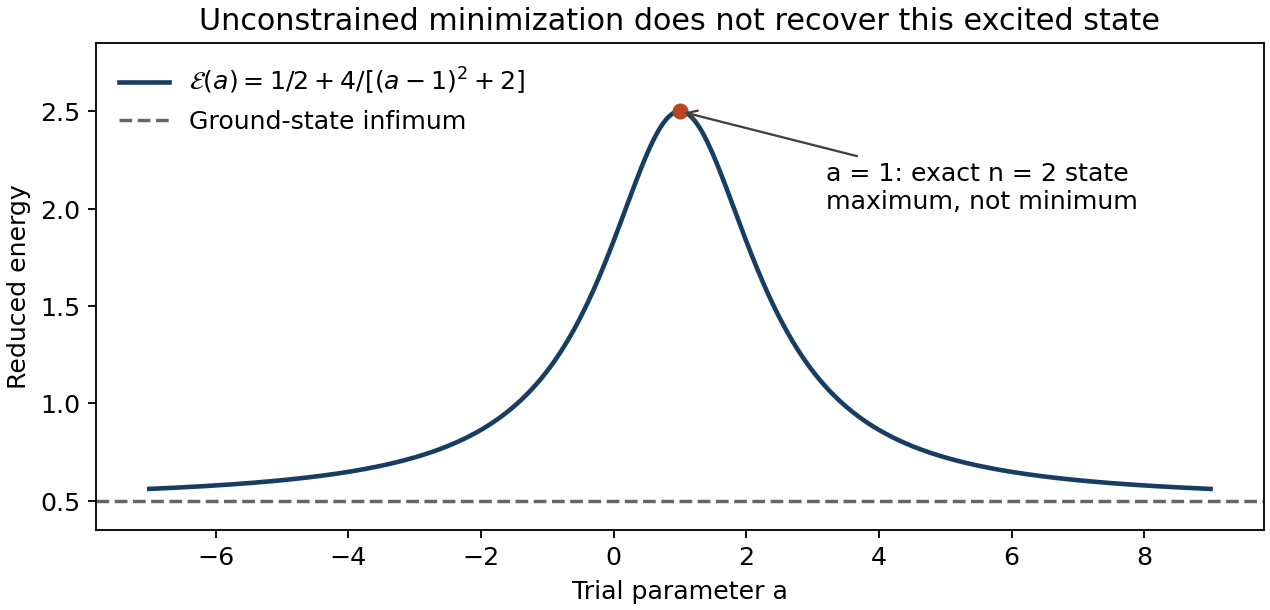
Direct evaluation of the Rayleigh quotient exposes a problem with the requested minimization. Using the supplied Gaussian integrals,ThusThe eigenfunction value is a maximum, not a minimum. Indeed , whereas is already lower. There is no finite minimizing in this family: its infimum is , approached as , when the normalized trial wavefunction approaches the ground state. This is consistent with the quantum variational principle. The original printed instruction in this subpart is therefore inconsistent as an unconstrained minimization; a stationary Rayleigh quotient need not be a minimum.
The intended excited state can instead be obtained by imposing an excited-state variational constraint. Orthogonality to the ground state requireswhich fixes . Every member of the family is even, so it is already orthogonal to the odd state. With the ground state excluded, the lowest allowed oscillator energy is therefore . In the exact oscillator basis, is proportional to , making both the maximum and the orthogonality correction transparent.

Exact solutions of the Schrödinger equation are unavailable for most interacting or realistic molecular systems. The quantum variational principle turns the search for a ground-state wavefunction into optimization of a computable energy quotient in a tractable trial family. The result is an upper bound: enlarging a nested trial space can only lower or preserve the optimized energy, providing a systematic convergence check. Trial functions can incorporate boundary conditions and known symmetry before calculation. Near an exact normalized ground state, a small orthogonal wavefunction error changes the energy only to second order, which explains why useful energies can result from imperfect trial functions. This does not ensure that every other observable is equally accurate, nor that a restricted trial family captures correlation adequately. Excited states require orthogonality or appropriate symmetry restrictions; unrestricted minimization seeks the ground state, as the preceding calculation demonstrates.
Articles by others on the same topic
There are currently no matching articles.