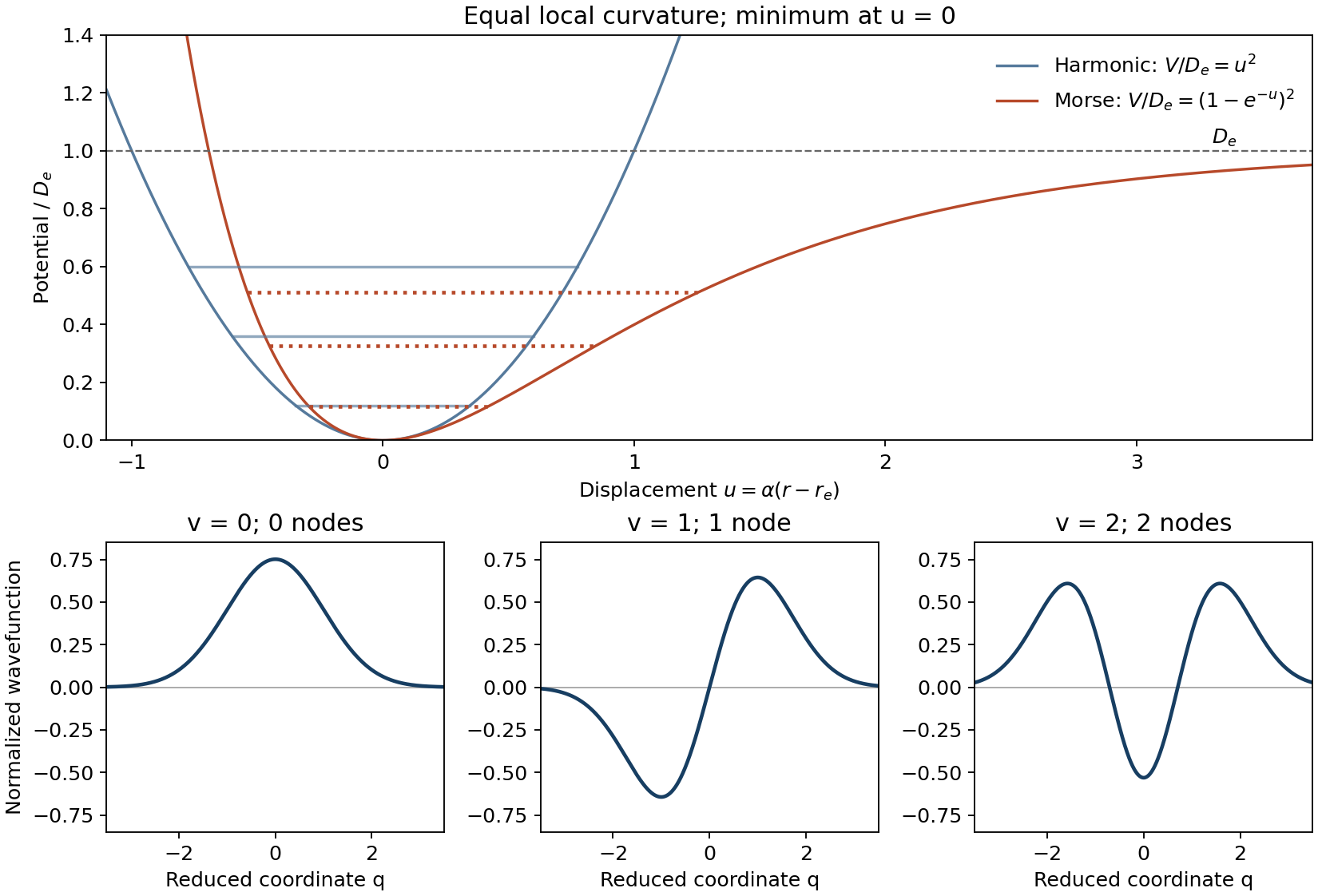
Let measure displacement from the equilibrium bond length and put the minimum of potential energy at zero. The harmonic model and the Morse potential areThe harmonic approximation is a symmetric parabola and has no dissociation limit. The Morse potential has a steep compressed side and a shallower extended side, approaching as . Matching the curvatures at the minimum gives . With denoting a spectroscopic wavenumber rather than an angular frequency, the energy levels areHere is the dimensionless spectroscopic anharmonicity constant. The harmonic spacing is constant, while the Morse oscillator spacing is and decreases as the levels approach dissociation. Only finitely many Morse oscillator levels are bound. The exactly solvable potential was introduced to model this anharmonic behaviour.[ref]
Diatomic Molecules According to the Wave Mechanics. II. Vibrational Levels by Philip M. Morse. Physical Review 34 (1929), pp. 57–64, potential and bound-level solution
For the harmonic model put , with , and . The first three normalized reduced-coordinate wavefunctions areTheir numbers of nodes are zero, one and two, and their parities are even, odd and even. The nodes are at . The diagrams below use analytic curves and arbitrary illustrative scales, with both potentials given the same local curvature.

Write and complete the square in the Morse oscillator energy:The finite bound-level sequence approaches the dissociation limit at the vertex of this extrapolated parabola. Thus the bond potential-well depth isThe continuous vertex is a convenient way to identify the limit; it is not an additional normalizable bound level at the threshold.
The ground-state dissociation energy starts at the lowest vibrational level, rather than the minimum of the potential. The zero-point energy of the Morse oscillator isSubtracting it from the bond potential-well depth givesThis distinction matters whenever a dissociation energy is inferred from a vibrational spectrum.
The strong band is the vibrational fundamental, and the weaker band near twice its wavenumber is the first vibrational overtone. At room temperature these high-frequency oscillators have overwhelmingly ground-state vibrational populations. In the harmonic-potential, linear-dipole limit the infrared selection rule is ; anharmonicity and nonlinear dipole dependence make the overtone weakly allowed. A hot band would lie near, and slightly below, the fundamental wavenumber, rather than near twice it.
Let and denote the measured fundamental and first-overtone wavenumbers, and put . Differences of the Morse oscillator levels giveConsequently , and . Substituting the two pairs of measured bands gives the following derived quantities:The conversion is , after multiplication by and consistent length units. Therefore the requested ground-state dissociation energies are and . The corresponding potential-well depths are and . These are extrapolations under the stipulated Morse oscillator model; two low-lying bands do not establish the accuracy of the real potential near dissociation.
The molecule with the larger inferred dissociation energy is assigned the stronger hydrogen–halogen bond: and . Moving from bromine to the larger iodine atom generally lengthens the bond and reduces effective overlap with the compact hydrogen orbital, so hydrogen iodide is more weakly bound. Independently, the tabulated ground-state harmonic constants near for hydrogen bromide and for hydrogen iodide agree with the inferred assignment.[ref]
Hydrogen bromide: Constants of diatomic molecules by Klaus P. Huber and others. Ground X 1Sigma+ row, harmonic wavenumber 2648.975 cm−1
[ref]Hydrogen iodide: Constants of diatomic molecules by Klaus P. Huber and others. Ground X 1Sigma+ row, harmonic wavenumber 2309.014 cm−1
The ordering is the identification criterion; the low-level Morse oscillator extrapolations above should not be presented as measured dissociation energies. Articles by others on the same topic
There are currently no matching articles.