In a frame rotating with angular velocity , a particle of relative velocity experiences the Coriolis forceFor nearly horizontal atmospheric motion, the relevant vertical rotation component is , with latitude . In the northern hemisphere the horizontal deflection is to the right of the motion. A low-pressure center produces an inward pressure-gradient force; an anticlockwise circulation has an outward Coriolis force to oppose it. A high-pressure center instead supports clockwise circulation, with inward Coriolis force opposing the outward pressure-gradient force.
The sense reverses in the southern hemisphere. There, anticlockwise circulation is anticyclonic and corresponds to high atmospheric pressure. HenceThis is the large-scale rotating-fluid interpretation; friction, centrifugal acceleration and departures from ideal balance modify actual wind profiles. NASA's description independently identifies the southern, counterclockwise Great Red Spot as a high-pressure system.[ref]
The Great Red Spot: An Ancient Storm in Jupiter's Atmosphere by National Aeronautics and Space Administration. Description comparing the southern-hemisphere counterclockwise Great Red Spot with low-pressure terrestrial hurricanes
Let denote the planar rotation matrix, and choose the initial cup center on the positive axis, as in the requested equations. Its trajectory is . The handle rotates relative to the radial line at signed rate , so its absolute angular velocity is . A positive recurrence time is ; the sign records rotation direction.
Writing , the relation isor explicitlyOne obtains the same result by rotating cup coordinates through into the radially aligned axes, then rotating through into the inertial axes.
At , , andThe axes maintain a fixed orientation in inertial space while their origin accelerates around a circle. This is translation without rotation of the cup frame; it is not an inertial frame because the origin accelerates. In particular its inertial correction is a spatially uniform fictitious force, rather than a Coriolis force from rotation of these axes.
Treat the marble as a frictionless point particle; no size, rolling constraint or friction law is supplied. Neglect its vertical kinetic energy as requested, but retain the gravitational potential energy .
For completeness keep the general constant cup rotation rate . In cup components the center's velocity is . With , the horizontal velocity norm is . ThusIn the nonrotating translating case , this reduces toThe time-only constant may be dropped. Integrating the cross-velocity term by parts gives an equivalent LagrangianIt differs by a total derivative and a time-only term, so gives the same trajectories but different expressions for the canonical momenta. The small-vertical-velocity approximation is typically consistent at small surface slope ; it need not remain valid during unlimited resonant growth.
For the original Lagrangian of solution, differentiation with respect to the generalized velocities givesIn contrast, using in the nonrotating case gives , ; this is the expected momentum shift under adding a total derivative.
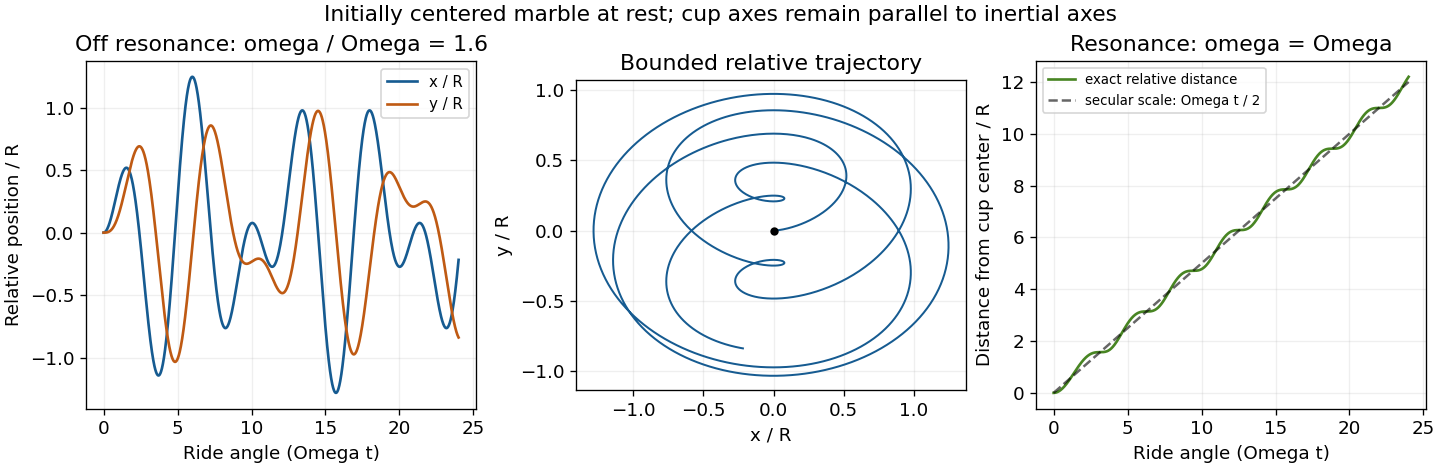
The Euler-Lagrange equations in the general cup frame areThese include the Coriolis and centrifugal terms when the cup axes really rotate. Set to obtainFor , its complete solution iswhere the two complex constants provide the four real initial data. The driving denominator is independent of cup-axis rotation: rotation changes the coordinate description, not the physical trap frequency.
In the requested special case , an equivalent real form isFor example , , and determine the constants.
At resonance with nonzero , replace the particular term byIn the nonrotating cup frame this has components , plus the homogeneous solution. Secular growth eventually invalidates a finite cup or the neglected vertical kinetic energy. If the ride does not rotate, its forcing vanishes and ordinary free oscillations remain.

Articles by others on the same topic
There are currently no matching articles.