All four questions are solved. Letters on unlettered marked paragraphs are inferred. The opening theorem question in Question 2 has its own solution directly under that question, leaving the original subsequent labels (a)–(c) unchanged.
In a frame rotating with angular velocity , a particle of relative velocity experiences the Coriolis forceFor nearly horizontal atmospheric motion, the relevant vertical rotation component is , with latitude . In the northern hemisphere the horizontal deflection is to the right of the motion. A low-pressure center produces an inward pressure-gradient force; an anticlockwise circulation has an outward Coriolis force to oppose it. A high-pressure center instead supports clockwise circulation, with inward Coriolis force opposing the outward pressure-gradient force.
The sense reverses in the southern hemisphere. There, anticlockwise circulation is anticyclonic and corresponds to high atmospheric pressure. HenceThis is the large-scale rotating-fluid interpretation; friction, centrifugal acceleration and departures from ideal balance modify actual wind profiles. NASA's description independently identifies the southern, counterclockwise Great Red Spot as a high-pressure system.[ref]
The Great Red Spot: An Ancient Storm in Jupiter's Atmosphere by National Aeronautics and Space Administration. Description comparing the southern-hemisphere counterclockwise Great Red Spot with low-pressure terrestrial hurricanes
Let denote the planar rotation matrix, and choose the initial cup center on the positive axis, as in the requested equations. Its trajectory is . The handle rotates relative to the radial line at signed rate , so its absolute angular velocity is . A positive recurrence time is ; the sign records rotation direction.
Writing , the relation isor explicitlyOne obtains the same result by rotating cup coordinates through into the radially aligned axes, then rotating through into the inertial axes.
At , , andThe axes maintain a fixed orientation in inertial space while their origin accelerates around a circle. This is translation without rotation of the cup frame; it is not an inertial frame because the origin accelerates. In particular its inertial correction is a spatially uniform fictitious force, rather than a Coriolis force from rotation of these axes.
Treat the marble as a frictionless point particle; no size, rolling constraint or friction law is supplied. Neglect its vertical kinetic energy as requested, but retain the gravitational potential energy .
For completeness keep the general constant cup rotation rate . In cup components the center's velocity is . With , the horizontal velocity norm is . ThusIn the nonrotating translating case , this reduces toThe time-only constant may be dropped. Integrating the cross-velocity term by parts gives an equivalent LagrangianIt differs by a total derivative and a time-only term, so gives the same trajectories but different expressions for the canonical momenta. The small-vertical-velocity approximation is typically consistent at small surface slope ; it need not remain valid during unlimited resonant growth.
For the original Lagrangian of solution, differentiation with respect to the generalized velocities givesIn contrast, using in the nonrotating case gives , ; this is the expected momentum shift under adding a total derivative.
The Euler-Lagrange equations in the general cup frame areThese include the Coriolis and centrifugal terms when the cup axes really rotate. Set to obtainFor , its complete solution iswhere the two complex constants provide the four real initial data. The driving denominator is independent of cup-axis rotation: rotation changes the coordinate description, not the physical trap frequency.
In the requested special case , an equivalent real form isFor example , , and determine the constants.
At resonance with nonzero , replace the particular term byIn the nonrotating cup frame this has components , plus the homogeneous solution. Secular growth eventually invalidates a finite cup or the neglected vertical kinetic energy. If the ride does not rotate, its forcing vanishes and ordinary free oscillations remain.
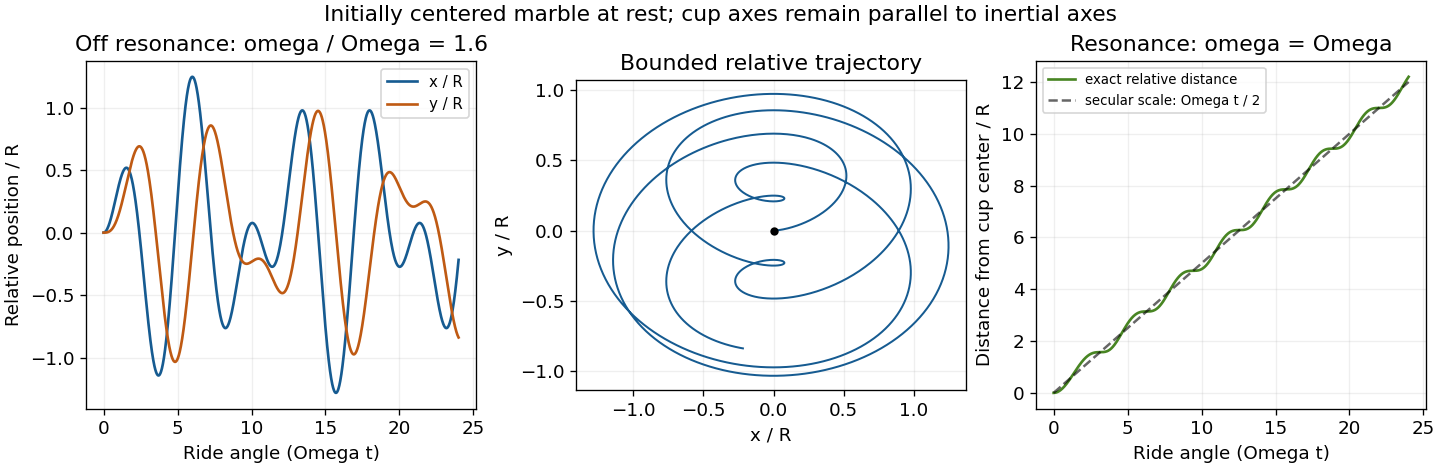
Marble response in a nonrotating cup frame with a circularly accelerating origin: bounded off-resonant motion and secular resonant growth, starting at the cup center at rest
. Details. 
A constant of motion is a function whose total derivative vanishes along every physical trajectory. It may depend explicitly on time; arbitrary functions of conserved quantities are also conserved, so a count normally concerns a specified independent set or symmetry generators.
For a fixed-time infinitesimal variation , suppose . On a solution of the Euler-Lagrange equations,Therefore Noether theorem givesFor a transformation also changing time by , the action variation includes , and the transformed velocity varies by . The same integration by parts gives the general point-symmetry chargeThus a time-translation symmetry gives the energy, a spatial translation gives the corresponding total momentum, and a rotation gives its angular-momentum generator. The required symmetry is a symmetry of the action, allowing a boundary term; demanding that the numerical value of the Lagrangian remain strictly unchanged is unnecessarily restrictive. Conversely, explicit time dependence of a Lagrangian generally prevents conservation of its energy even while other charges survive.[ref]
Classical Dynamics by David Tong. Chapter 2, section 2.6 and 2.6.1, continuous symmetries, conserved charges and Noether's theorem
Assume positive, pairwise distinct masses and generic nonzero . Let , and similarly for . The three uncoupled oscillators each conserveUniform translation of all conserves . The interaction permits their common translation, while is entirely free, giving two independent momenta and . The interacting subsystem is autonomous and has its own conserved energy. A useful basic collection is thereforeThe total energy is generally not conserved. With , its derivative is , which is generically nonzero.
Unequal masses do not remove every rotation charge in the oscillator sector. Put , . This is a canonical transformation and makes that sector an isotropic harmonic oscillator. Its rotations conserveThese mass-weighted oscillator symmetries exist already at distinct masses. The energies and three rotation charges are not all functionally independent; the three-oscillator sector has at most five independent time-independent integrals on regular trajectories.
There are further simple explicitly time-dependent constants, such as and , and center-of-mass boost constants. For example is constant for and . These illustrate why an unrestricted raw number of conserved functions is not meaningful.
At , the explicitly time-dependent coefficient becomes one. This restores time-translation symmetry, and the total energy becomes conserved. No further analogous restoration occurs merely from setting equal to them: the three arbitrary interaction functions still distinguish their arguments and particle labels.
If the question counts the extra ordinary unweighted rotations of the coordinate labels, the conventional generator count is as follows. For , rotations of preserve both the kinetic and oscillator terms, so one ordinarily displayed rotation charge joins the restored energy: two displayed generators beyond the elementary list. For three equal masses, the full ordinary rotation group of has three generators; together with energy this gives four, or two more than in the preceding equal-pair case.
There is a necessary qualification to interpreting those numbers as genuinely new independent conservation laws. The weighted charges in solution deform continuously to those same ordinary rotation charges at equality. For example is conserved for every positive and becomes when the masses agree. ThusThe restriction must be stated if using the first count. Equal mass does not create three previously absent independent oscillator integrals. If , energy conservation was already present; special choices of the interaction functions can add further symmetries and are excluded by the generic assumption.
With , the explicit energy and ordinary rotation generators just discussed areThe energy is constant because the drive factor no longer depends on time. For each rotation charge, differentiating and using gives .
These are angular momenta in the auxiliary three-dimensional space whose coordinates are the particle labels . They are not the physical spatial angular momentum ; generic do not have physical rotational invariance. They are precisely the equal-mass representatives of the weighted charges already present in solution. The new energy integral supplies the autonomous relative- dynamics not present in the driven case.
For an action functional , vary a path while fixing its endpoint coordinates. Integration by parts givesThe endpoint term vanishes. Since the interior variations are arbitrary, stationarity givesDefine canonical momentum . For a regular velocity Hessian, these relations can be inverted for , and the Legendre transform definesIts differential is . Inserting the Euler-Lagrange equations already suggests the canonical equations.
To derive them directly from an principle of stationary action, vary the first-order action with independent and fixed endpoint . Integrating by parts givesThereforeThe endpoint momenta need not be fixed. A singular velocity Hessian instead requires a constrained Hamiltonian formulation; the ordinary Legendre inversion is an assumption, not an identity valid for every Lagrangian.
For degrees of freedom, phase space is the -dimensional space of canonical coordinates . Initial data at one point determine a trajectory under the Hamilton equations.
Liouville's theorem in Hamiltonian mechanics states that this flow preserves the canonical volume element . Its divergence isIf is the Jacobian determinant of the flow from initial data, the determinant evolution formula gives . Since , it remains one, proving preservation of every advected phase volume. The proof also applies to smooth explicitly time-dependent Hamiltonians.
For an ensemble density , probability conservation and the same vanishing divergence giveThus the fine-grained density is constant along the Hamiltonian trajectories, although the ensemble may shear, stretch and develop fine structure. This is not a claim that coordinate-space volume or every lower-dimensional projection is conserved.
Solving , gives the linear phase flowIts Jacobian determinant isHence every patch keeps its area , directly verifying Liouville's theorem. The energy ellipses are also invariant, but area preservation applies to arbitrary patches, not just whole energy shells.
In scaled canonical coordinates , the flow is a rigid clockwise rotation, . The following original plot follows an off-center patch and shows equal areas at successive times.
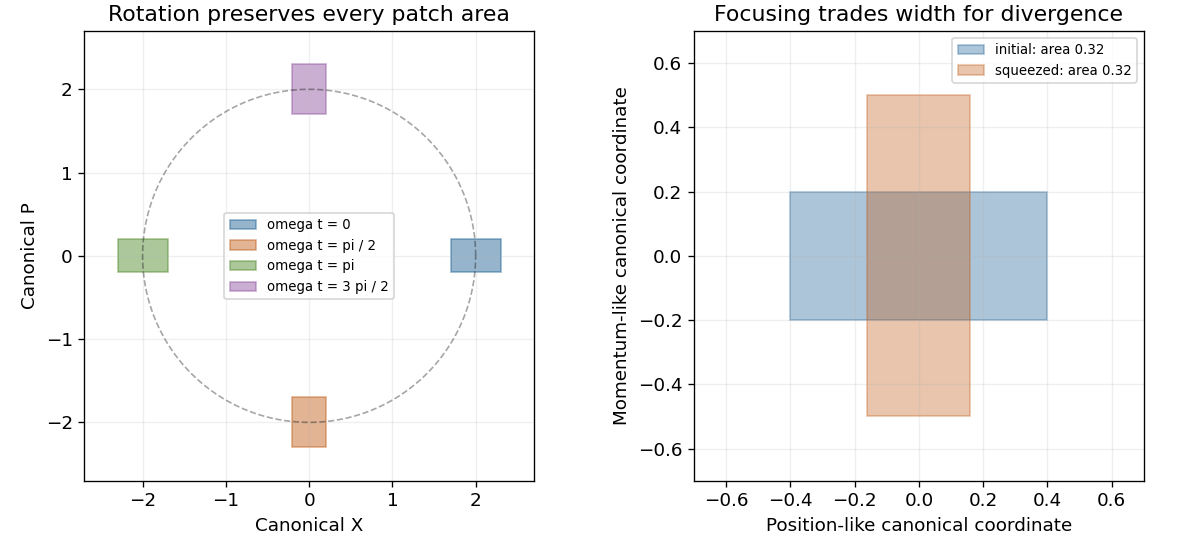
Area-preserving harmonic-oscillator flow: the same phase-space patch at four times, with a focusing squeeze that trades position width against momentum width
. Details. 
For a truly isolated Hamiltonian bunch, Liouville's theorem preserves the fine-grained volume in its full -dimensional phase space. Hamiltonian manipulation cannot increase its full phase-space density by compressing all canonical position and momentum directions simultaneously. Merely focusing the beam to a smaller transverse spot generally increases angular or momentum divergence; it does not by itself reduce beam emittance.
The distinction between full volume and projected spreads matters. Coupling transverse and longitudinal degrees of freedom can exchange emittance or move spread into other coordinates and correlations, so a projected transverse quantity may decrease without reducing the complete phase volume. That is redistribution, not cooling of every degree of freedom. In linear uncoupled optics, preservation of each transverse canonical area makes the spot-size/divergence tradeoff particularly direct.
Actual cooling allows the beam to exchange energy and entropy with other systems. In electron cooling, a colder comoving electron population receives the protons' random kinetic energy and is subsequently renewed or cooled. In stochastic cooling, a pickup measures deviations and a downstream kicker applies feedback corrections; the electronics, measurement noise and environment belong to the enlarged system. CERN's description identifies exactly this pickup-and-kicker arrangement.[ref]
Stochastic cooling by CERN. Feedback and corrections: pickup measurement of sample motion and downstream electric-field correction
Thus these methods relax the idealization that the proton bunch alone is isolated. Including the cooling apparatus does not require the complete closed dynamics to violate Liouville's theorem. For protons, direct radiative damping is much weaker than for electrons, so stochastic or electron cooling is a more relevant practical suggestion than relying on strong synchrotron damping.
Fix an initial event . For each reachable final event , evaluate the action on a classical path satisfying those endpoints. On a chosen local branch this produces Hamilton's principal function , rather than a functional of every possible path. Multiple classical paths may make this function multivalued, so the derivation is local to a branch.
Allow the final event to vary. The integrated interior variation vanishes by the Euler-Lagrange equations. The endpoint variation must distinguish the total coordinate change from the change at fixed time: . ConsequentlyHence and . Eliminating the momenta yields the Hamilton-Jacobi equationA complete integral of the Hamilton-Jacobi equation depends on suitable independent constants for coordinates; differentiating it with respect to those constants supplies the conjugate integration constants needed to reconstruct trajectories.
The required Hamilton-Jacobi equation isBecause and time are cyclic in the Hamiltonian, use separation . The remaining equation isFor , each sign branch has the separated complete integralIt is real in the classically allowed region , and . At a turning point one matches the ascending and descending branches. If , the integral is simply with constant .
A convenient equivalent complete integral, expressed using initial-momentum constants , is globally polynomial in time:Substitution verifies that its time derivative cancels the kinetic term and . It avoids a square-root branch change when extracting the complete trajectory.
Apply Jacobi's reconstruction to the polynomial complete integral in solution. Its parameter derivatives are constant:ThereforeAt the constants are the initial positions and are the initial momenta. Direct differentiation of gives , , , confirming the same motion. The six constants provide arbitrary initial data; the solution covers both ascent and descent, not merely one local square-root branch of the separated action.
An autonomous Hamiltonian system with degrees of freedom is Liouville integrable if it has conserved functions , including the Hamiltonian, whose differentials are independent on a regular open set and which are in involution:The equations can then be reduced locally to quadratures. The statement about action-angle coordinates on invariant tori additionally requires compact connected regular common level sets; integrable unbounded motion need not be periodic or lie on a torus.
For the uniform-gravity Hamiltonian, take the three integrals . Since the potential does not depend on ,For , the term in makes these three differentials independent. Thus the system is Liouville integrable, as the explicit separated solution already demonstrates.
Replacing by a sufficiently smooth arbitrary function preserves the same commuting integrals. They are independent wherever and do not vanish simultaneously. The vertical motion reduces toThe horizontal motion remains uniform. Thus an elementary antiderivative is unnecessary: the system is still integrable by a one-dimensional quadrature on regular branches, joined at turning points. Critical equilibria may be singular common level sets without destroying generic integrability. If is constant, the three momenta themselves give an everywhere independent commuting set, avoiding the rank loss of at .
Articles by others on the same topic
There are currently no matching articles.