The SI volume magnetic susceptibility is the weak-field response , or for a linear isotropic sample with no spontaneous moment. It is dimensionless; a molar susceptibility would be a different quantity. For weak magnetization, . Neglect local-field and demagnetizing corrections in this independent-spin model.
A spin- ion has moment projections . The requested coefficient assumes a spin-only , giving projections and Zeeman energies . With , the one-ion partition function and magnetization areFor , , soHere is a number density, as specified, rather than total ion number. The small-field condition ismeaning the Zeeman splitting is small compared with the thermal scale up to an irrelevant order-one convention. It is not a temperature-independent absolute upper bound on . For a different value the coefficient contains instead of .
A point magnetic dipole producesFor and neighbour separation , its characteristic magnitude isThe axial field is twice this scale; the exact orientation and crystal geometry are unspecified. The corresponding pair magnetic dipole interaction has energy scale , givingAn axial orientation changes this to about . A real ordering temperature depends on a lattice sum, symmetry and fluctuations, so this is a nearest-neighbour energy estimate, not a complete ordering calculation. It establishes that ordinary dipolar coupling is far too weak to explain a thousand-kelvin ferromagnetic transition.
The inverse-susceptibility curve has a Curie–Weiss form above and vanishes on approach to it. The material can have spontaneous magnetization for , including the zero-temperature limit, whereas for its zero-field equilibrium state is paramagnetic. At a continuous transition the spontaneous moment tends to zero at ; divergence of differential susceptibility there is not a finite saturated permanent moment.
A simple Weiss molecular field model takes the effective internal field intensity to be , with positive coupling . Let be the independent-moment Curie constant. Linearizing the single-ion response on the high-temperature side givesThis explains the straight upper branch and its positive temperature intercept. At the zero-field linearized response diverges; finite field, finite size and critical fluctuations limit its use. For a spin-only two-state mean-field model the full equation is , with ; below it has nonzero zero-field solutions.
An ordering scale near corresponds to , about four orders of magnitude larger than the preceding dipolar pair scale. Exchange interaction can supply such energies: the Pauli antisymmetry of overlapping electron states changes their spatial correlations and hence Coulomb and kinetic energies according to their spin configuration. An effective ferromagnetic coupling can favor parallel moments. It is not simply the classical magnetic field of a neighbouring dipole. For example, with the convention and , the localized-spin mean-field scale is ; this illustrates why an atomic electronic interaction, rather than a bare dipolar field, can produce a high transition temperature.
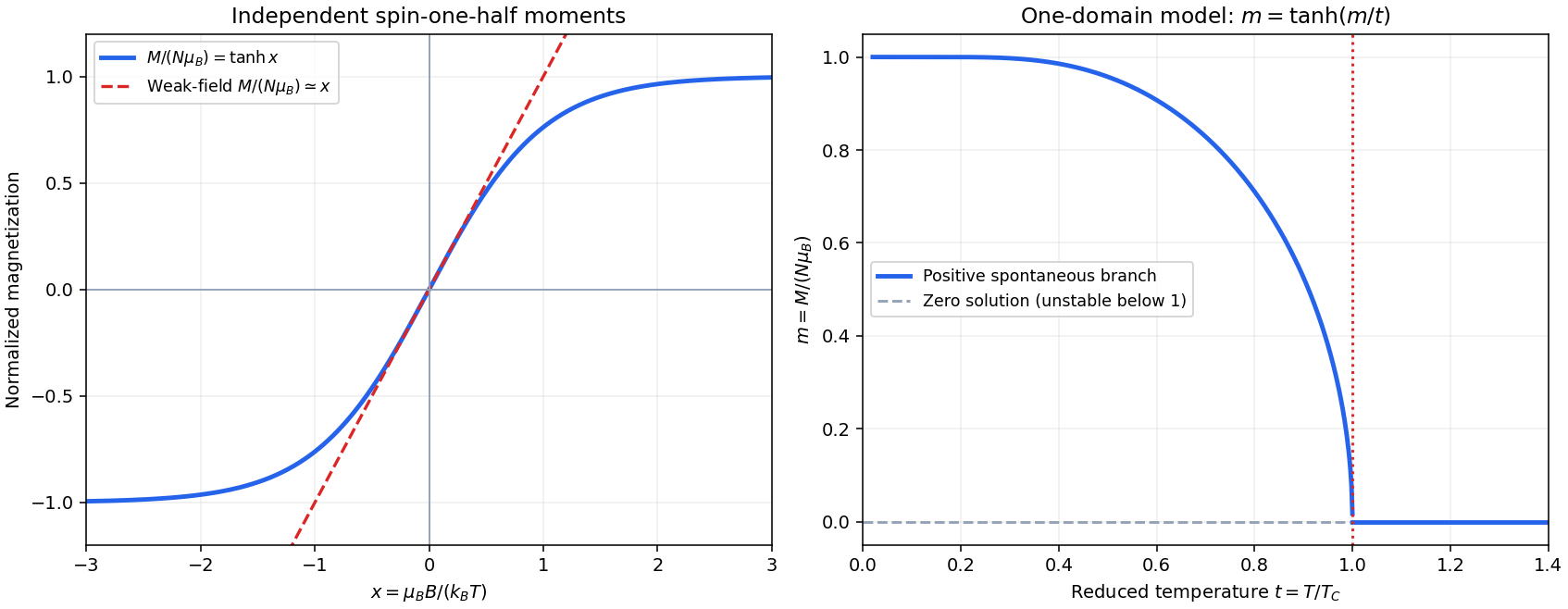

A bulk ferromagnet generally separates into magnetic domains. Within each domain many moments align and the local magnetization can be large, but different domain orientations partially or almost completely cancel the vector sum measured for the entire specimen. This reduces its external stray field and magnetostatic energy. Formation of magnetic domain walls costs exchange and anisotropy energy, so the actual pattern balances these costs with the reduction in stray-field energy.
A strong applied field can move domain walls and rotate moments toward a nearly saturation magnetization. When the field is removed, pinning and the sample's magnetic history determine the remanent moment. Thus a small net moment does not show that local ferromagnetic order has disappeared, or that moments within each domain are all randomly oriented. At finite temperature, thermal spin fluctuations also reduce the local ordered moment below its zero-temperature maximum even in a single-domain specimen. These two reductions—between-domain cancellation and within-domain thermal reduction—should be distinguished.
Articles by others on the same topic
There are currently no matching articles.