With the convention , the reciprocal lattice of a face-centered cubic lattice is a body-centered cubic lattice. The reciprocal conventional cube is parallel to the direct conventional cube and has side . In direct-cubic coordinates its points areThe even triples supply the corners of that reciprocal cube and the odd triples its body centres. The atomic basis can change diffraction intensities through its structure factor; it does not change the reciprocal lattice determined by the translation lattice.
The cubic Miller indices give an interplanar spacing . Equivalently, the reciprocal lattice vector normal to these lattice planes has length . HenceThe eight reciprocal lattice vectors are the nearest nonzero reciprocal points. Their perpendicular bisectors form the eight hexagonal faces of the first Brillouin zone, a truncated octahedron. For the positive direction, that Bragg plane is , or . It is parallel to the direct lattice planes. The six remaining square zone faces correspond to the reciprocal points. The zone boundary is halfway to a reciprocal point, not the point itself.
Use the angle between two planes defined as the acute angle between their normal vectors. The normals and have dot product one and lengths . ThusChoosing an oriented rather than an acute interplanar angle could give the supplementary ; it describes the same unoriented pair of lattice planes.
The normal vector is . Its normalized dot product with is , soThis is the acute angle between the lattice planes, rather than the complementary angle between a plane and the other plane's normal.
The X-ray wavelength is . Write the amplitude of one conventional unit cell as the face-centred cubic selection rule times the two-atom atomic basis amplitude:The first bracket is four when the indices have equal parity and zero otherwise. Among the allowed Bragg reflections, the zinc blende structure factor therefore givesHere the atomic scattering factors are taken as real. For the requested rough estimate set and . The weak difference reflections remain allowed: unequal species do not have the extra exact extinction of the equal-species diamond limit.
The first six allowed values of are . Bragg's law gives the measured scattering angle . For powder diffraction, multiply the squared amplitude by the powder diffraction multiplicity . The last two columns use :The first intensity column is the geometry-independent multiplicity-and-structure estimate. The second additionally assumes an unpolarized beam and a common symmetric powder-diffractometer geometry, with Lorentz-polarization factorAn overall constant cancels in either normalization. A particular measured intensity set is not fixed by the atomic numbers alone: actual atomic scattering factors decrease with momentum transfer, anomalous scattering and absorption can matter, and the instrument geometry and polarization determine angular corrections. The two columns state the approximation rather than asserting identical peak heights for all instruments.[ref]
The sixth allowed family is . For the two lattice constants, use :ConsequentlyThe larger lattice constant shifts the AlAs reflection to lower scattering angle. As a differential check, in radians.
If the angular displacement is unresolved, use the intensity contrast. With the same model, a difference reflection has basis amplitude for AlAs, versus for GaAs. Its squared amplitude is therefore one hundred times greater before overall sample normalization. More robustly, compare a weak and a strong reflection within each specimen. Neglecting their almost identical angular corrections,The contrast in this internal ratio is about a factor . Element-specific X-ray fluorescence, for example testing for a Ga characteristic line with a suitably energetic incident beam, or an X-ray absorption spectroscopy scan through an element-specific absorption edge, also distinguishes composition. Such scans can change incident energy; one must not assume every core shell can be excited by the original beam.
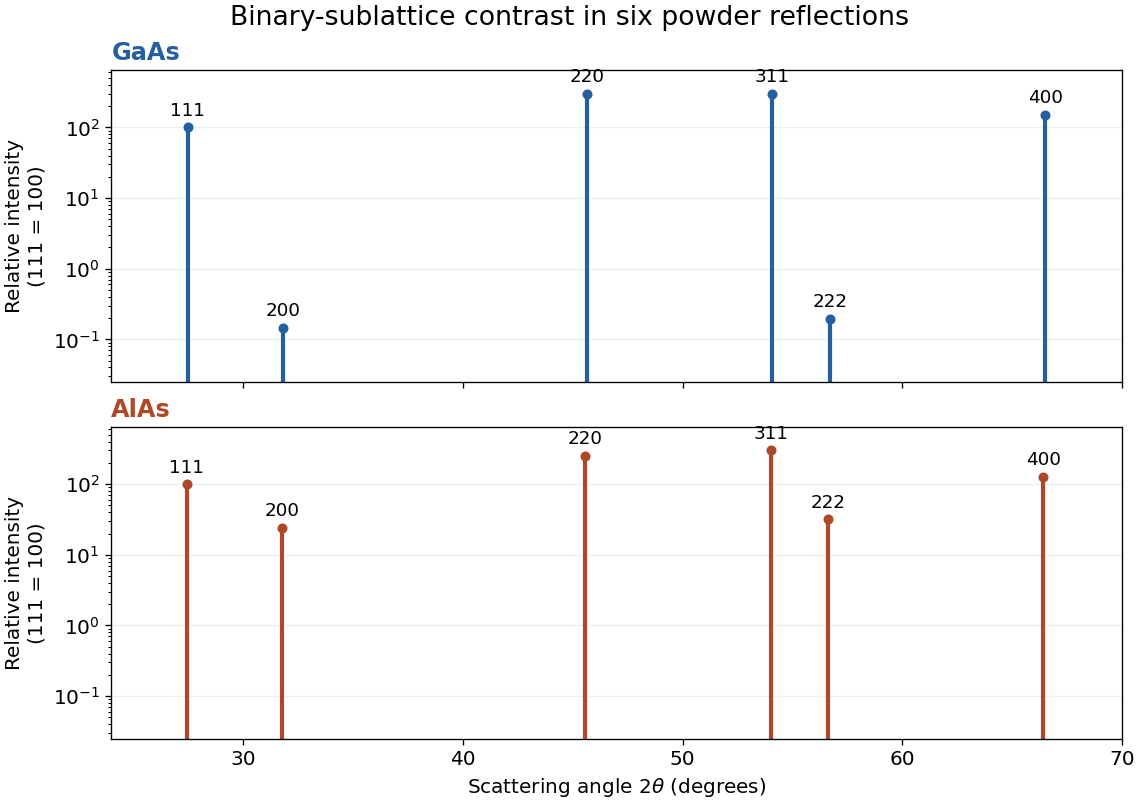
Approximate powder-reflection contrast for GaAs and AlAs
. Original stick patterns use the six derived angles, , and multiplicity times squared structure amplitude. Each compound is normalized to its own reflection. A logarithmic intensity scale reveals the nearly cancelled and GaAs reflections. Geometry and form-factor corrections are omitted deliberately. Details.
Articles by others on the same topic
There are currently no matching articles.