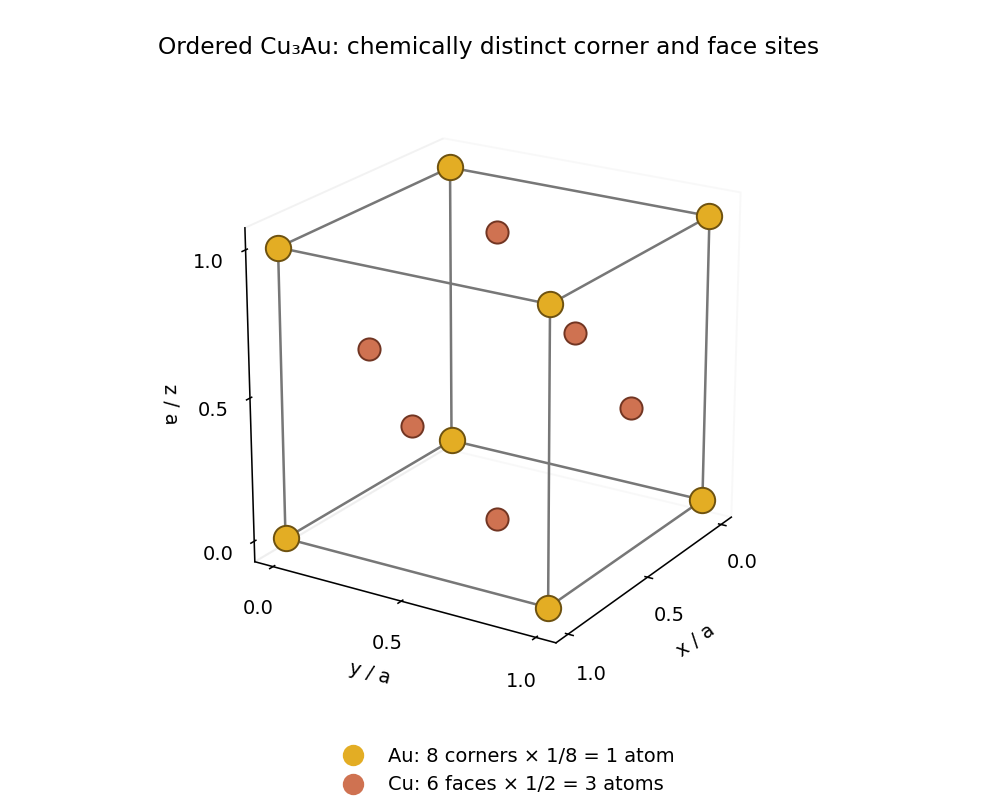
The ordered crystal structure consists of a primitive cubic lattice with the four-site atomic basisin fractional crystal coordinates. The drawing shows all boundary representatives of these sites. Eight corner gold chemical atoms, shared among eight unit cells each, contribute one gold chemical atom. Six face-centred copper chemical atoms, shared between two unit cells each, contribute three copper chemical atoms. Thuswhich gives the required stoichiometry. Although the unlabelled positions form a face-centered cubic lattice, a face-centering lattice translation exchanges gold and copper and therefore fails to preserve the ordered crystal structure. Its Bravais lattice is primitive cubic lattice.

For the reciprocal lattice vector , sum the atomic scattering factors with the atomic basis phase factors. Taking the positive phase convention gives the structure factorChanging the phase convention complex-conjugates the structure factor and leaves the diffraction wave intensity unchanged. Since the Miller indices are integers,If all three Miller indices have the same integer parity, all pairwise sums are even. Otherwise exactly one pairwise sum is even and two are odd. ConsequentlyThe corresponding structure factors are and . Reflections with mixed integer parity are superlattice reflections that reveal chemical ordering in alloys.
In elastic scattering, the incoming and outgoing wave vectors have equal magnitude . Their mutual angle is . The scattering vector therefore has magnitudeThe elastic Bragg scattering condition is , givingEquivalently, turns this relation into Bragg's law, , with the reflection order incorporated into the Miller indices.
Articles by others on the same topic
There are currently no matching articles.