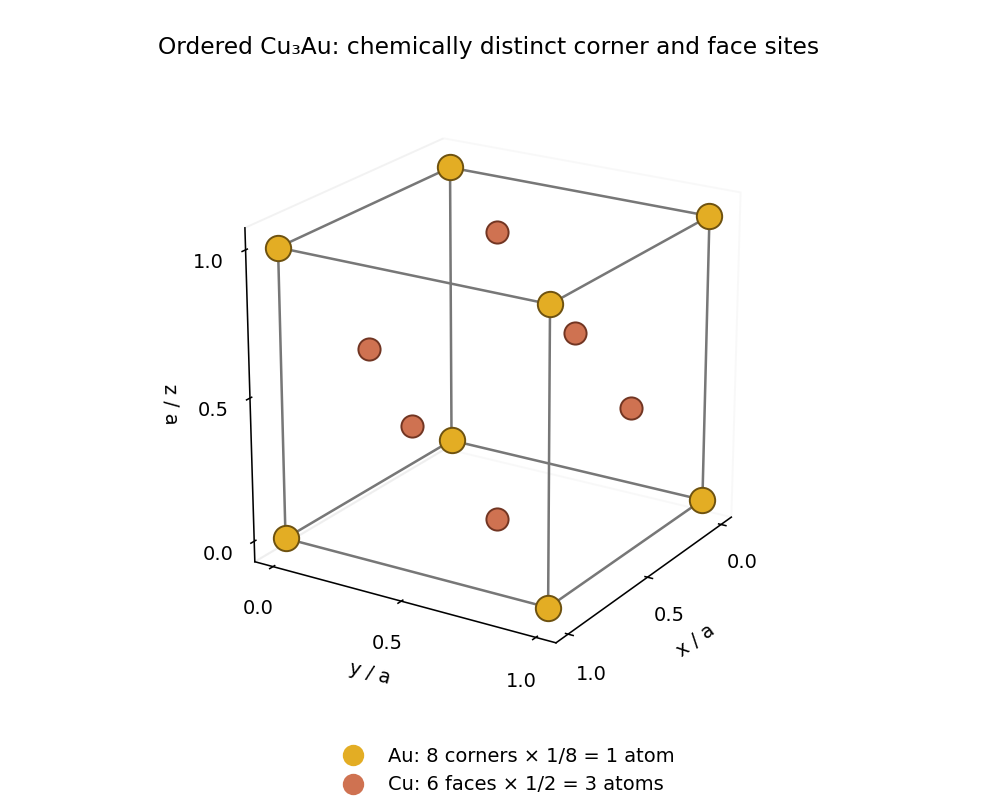
The ordered crystal structure consists of a primitive cubic lattice with the four-site atomic basisin fractional crystal coordinates. The drawing shows all boundary representatives of these sites. Eight corner gold chemical atoms, shared among eight unit cells each, contribute one gold chemical atom. Six face-centred copper chemical atoms, shared between two unit cells each, contribute three copper chemical atoms. Thuswhich gives the required stoichiometry. Although the unlabelled positions form a face-centered cubic lattice, a face-centering lattice translation exchanges gold and copper and therefore fails to preserve the ordered crystal structure. Its Bravais lattice is primitive cubic lattice.

For the reciprocal lattice vector , sum the atomic scattering factors with the atomic basis phase factors. Taking the positive phase convention gives the structure factorChanging the phase convention complex-conjugates the structure factor and leaves the diffraction wave intensity unchanged. Since the Miller indices are integers,If all three Miller indices have the same integer parity, all pairwise sums are even. Otherwise exactly one pairwise sum is even and two are odd. ConsequentlyThe corresponding structure factors are and . Reflections with mixed integer parity are superlattice reflections that reveal chemical ordering in alloys.
In elastic scattering, the incoming and outgoing wave vectors have equal magnitude . Their mutual angle is . The scattering vector therefore has magnitudeThe elastic Bragg scattering condition is , givingEquivalently, turns this relation into Bragg's law, , with the reflection order incorporated into the Miller indices.
The primitive cubic lattice has . Combining this with Bragg's law gives the Bragg angleUsing and yieldsThese are the full scattering angles; the Bragg angles themselves are half as large.
At each reflection, the argument of the atomic scattering factor isSubstitution into the given atomic scattering factor approximation givesThus the structure factors are and . The powder diffraction multiplicity is : choose which Miller index is zero in three ways and the signs of the other two in four ways. For , the eight sign choices give . With the specified instrumental and angular factors omitted, the integrated powder diffraction wave intensity is proportional to , soIt would be incorrect to use the same atomic scattering factors at the two different scattering vectors, or to omit the powder diffraction multiplicity.
The stoichiometry fixes the site probabilities to gold and copper. Every site in the average crystal structure therefore has the same atomic scattering factorThe average structure factor isAt the bracket vanishes, while at it is four. HenceThe powder diffraction multiplicity is unchanged, so its coherent Bragg diffraction wave intensity equals the ordered value under the stated equal-lattice constant approximation.
The zero refers to the coherent Bragg diffraction peak of the average crystal structure. A random alloy can still give occupational diffuse scattering at the same scattering vector: the average of the squared amplitude includes fluctuations as well as the square of the average amplitude. Such background is not a surviving Bragg diffraction peak.
Replace every coloured site in the drawing by an identical site carrying . The face-centering lattice translations now preserve the average crystal structure, whose Bravais lattice is a face-centered cubic lattice. One choice of primitive lattice translation vectors isA coherent Bragg diffraction peak requires for all three primitive lattice translation vectors. Thus , , and must all be even, equivalent to all three Miller indices having the same integer parity. This is the face-centred cubic selection rule: is forbidden and is allowed. The restoration of these lattice translations explains the disappearance of the ordered superlattice reflections.
Specify the normalization of the alloy sublattice order parameter rather than assuming that its endpoint values uniquely define it. Let be the probability of gold occupation at a corner site and defineThe complementary copper probability is , so the corner-site atomic scattering factor isThe stoichiometry provides one gold chemical atom per four-site unit cell. If all three face sublattices are equivalent, their gold occupation probability obeys . ThereforeAt the corner and face sites carry pure gold and pure copper; at they have identical statistical compositions. These formulas describe the branch with and equivalent face-site averages.
Use the same atomic basis phases as in the ordered structure factor, replacing each atomic scattering factor by its site average. For the reflection with equal integer parity,Conservation of the total composition removes the alloy sublattice order parameter from this amplitude. For the reflection with mixed integer parity,The coherent powder diffraction wave intensities consequently satisfyHere the lattice constant, atomic scattering factors, powder diffraction multiplicities, and omitted experimental factors are held fixed. The ratio of a superlattice reflection to a fundamental reflection can therefore measure the magnitude of the alloy sublattice order parameter.
Articles by others on the same topic
There are currently no matching articles.