A phonon is one quantum of a normal vibrational mode of a crystal. In the harmonic approximation, each mode with wavevector , branch index and angular frequency is an oscillator with energies . A phonon changes the occupation by one; it is not a particular atom moving through the solid.
For a three-dimensional primitive cell containing atoms there are branches. Three acoustic branches approach zero frequency as : at zero wavevector they represent rigid translations, with all basis atoms displaced together. Their small-wavevector frequencies usually grow linearly with wavevector. The remaining optical branches have internal relative motion of basis atoms and generally nonzero zone-centre frequencies. The names reflect their coupling to radiation in suitable polar crystals, not a rule that every optical mode must be infrared active. Acoustic and optical branches can each have longitudinal or transverse polarizations.
Each atom supplies three displacement coordinates. Translational invariance gives three acoustic branches for either structure, leavingThese count branches at a general wavevector; a doubly degenerate pair still counts as two modes. The stated atom counts refer to primitive cells, so no additional centring factor is needed.
To obtain a crystal's point group, discard the translation parts of its space-group operations. A screw becomes a rotation and a glide becomes a mirror. Thus the tetragonal group's , and operations giveFor the orthorhombic structure the three perpendicular twofold/glide or screw/mirror directions giveThe primitive Bravais lattice symbol does not itself add a point operation; the fractional translations matter for the space group but disappear from this point-group reduction.
At the zone centre, the dynamical matrix commutes with the point-group representation on displacements. An irreducible representation of dimension two enforces a doublet; distinct one-dimensional representations need not have equal frequencies. The tetragonal point group has two-dimensional and representations, so optical modes transforming that way are doubly degenerate at the centre. Atomic positions and the displacement representation would be needed to assign every optical branch to a particular representation; the point-group label alone is not a complete mode decomposition.
For propagation along the tetragonal fourfold axis, the two transverse acoustic polarizations transform together and have equal sound speeds and frequencies. For example , whereas the longitudinal speed is independent. An optical doublet may split away from the centre along a direction whose little group has only one-dimensional representations. It need not remain degenerate at every nearby wavevector.
All irreducible representations of are one-dimensional, so the orthorhombic point group enforces no analogous optical doublet or equality of transverse sound speeds. The three acoustic frequencies are nevertheless all zero at the exact centre in both crystals, because of translations; that common zero is not evidence that their slopes are equal. Accidental equalities remain possible. For a polar crystal, a direction-dependent macroscopic electric field also distinguishes longitudinal from transverse infrared-active limits; an analytic zone-centre symmetry classification alone does not remove LO–TO splitting.
For neutron energy loss, . Write . The neutron dispersion , or , givesA triangle of these wavevectors exists ifWith , the requested momentum transfers have . ConsequentlyFor example is too small even for forward scattering at these unequal neutron energies, and exceeds the backscattering maximum. This identifies accessible reciprocal lattice points, not guaranteed nonzero intensity: a one-phonon structure factor contains the atomic scattering lengths, eigenvectors and factors . A transverse eigenvector perpendicular to may be invisible, and basis interference can cause extinctions. The supplied geometry and cell constants do not specify that full intensity selection rule.
For , . The scattering triangle givesTo state signed sample angles without an implicit axis convention, take the incident beam along , positive angular rotation counterclockwise, and at choose along and along . ThenThe positive- condition is the vector equation . PutThe two detector sides then give, modulo full rotations,These pairs obey the stated same-sense sign convention and transfer momentum along . The lower-right panel below illustrates the first choice. If the initial direction is chosen on the opposite side of , a commonly used positive-angle pair is . Merely taking absolute values without fixing that crystal-axis convention can exchange and . The measurable scattering angle and the vector-triangle construction are invariant.
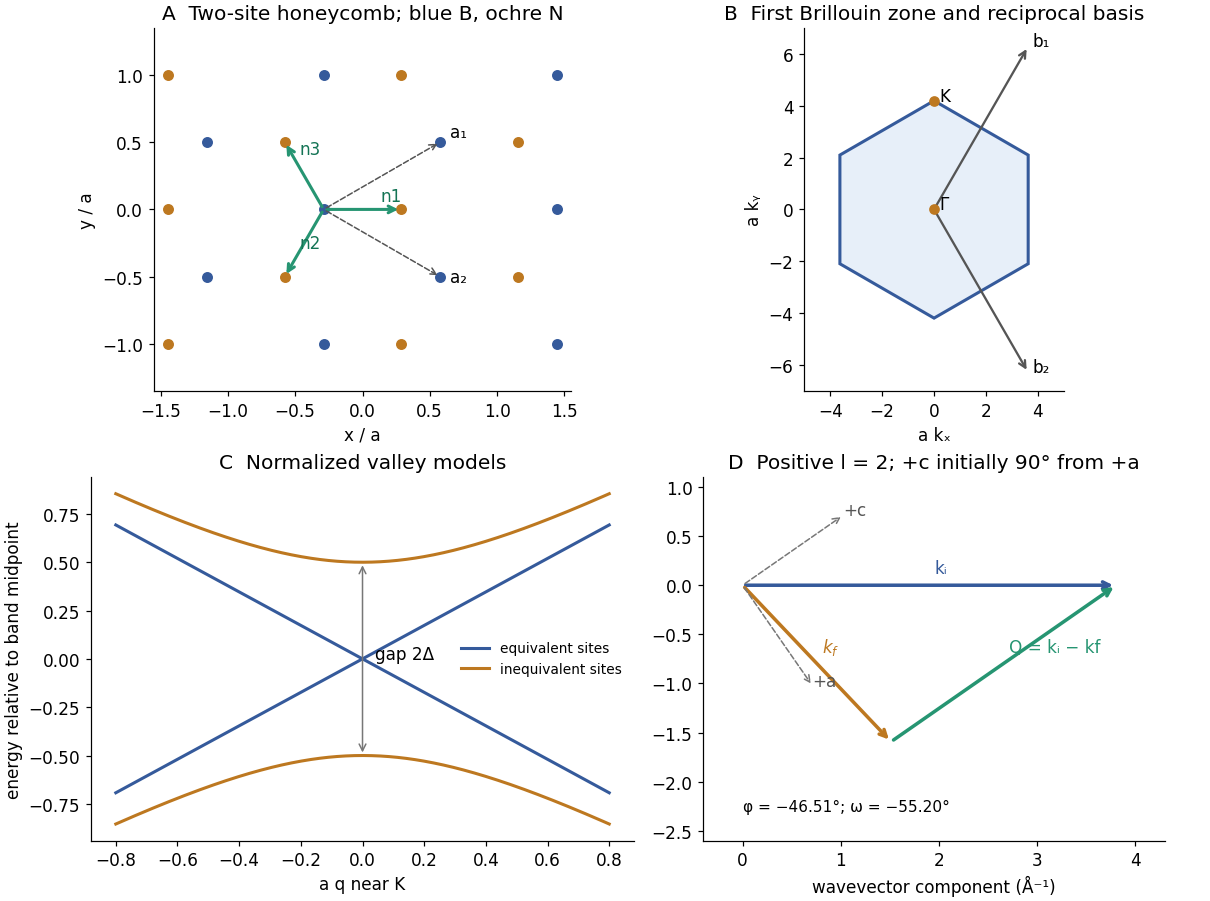
Honeycomb geometry, reciprocal-space hexagon, sublattice band gap and a signed neutron-scattering triangle
. Original calculations and schematic geometry. Lattice panels use ; the band panel compares normalized two-sublattice models. The neutron panel uses the explicit signed-axis convention of Question 1(c)(ii). Details.
Articles by others on the same topic
There are currently no matching articles.