Use the explicit convention , counting every bond once and taking dimensionless spins of length . On the simple cubic lattice there are six nearest and twelve face-diagonal next-nearest neighbours.
For type I all six nearest bonds are antiparallel and all twelve next-nearest bonds parallel, so . Choose the parallel direction of type II as . It has two parallel and four antiparallel nearest bonds, and four parallel face diagonals but eight antiparallel diagonals. Thus andConsequently, for the stated antiferromagnetic exchanges,This comparison is also consistent with the full classical spiral energy. With ,It is affine in each , so some minimum occurs at a cube vertex, giving the competing collinear states above. At the boundary, the coefficient of vanishes for , producing the larger degeneracy and permutations. It is not an isolated two-state crossing. The first panel of the model figure below shows the competing energies.
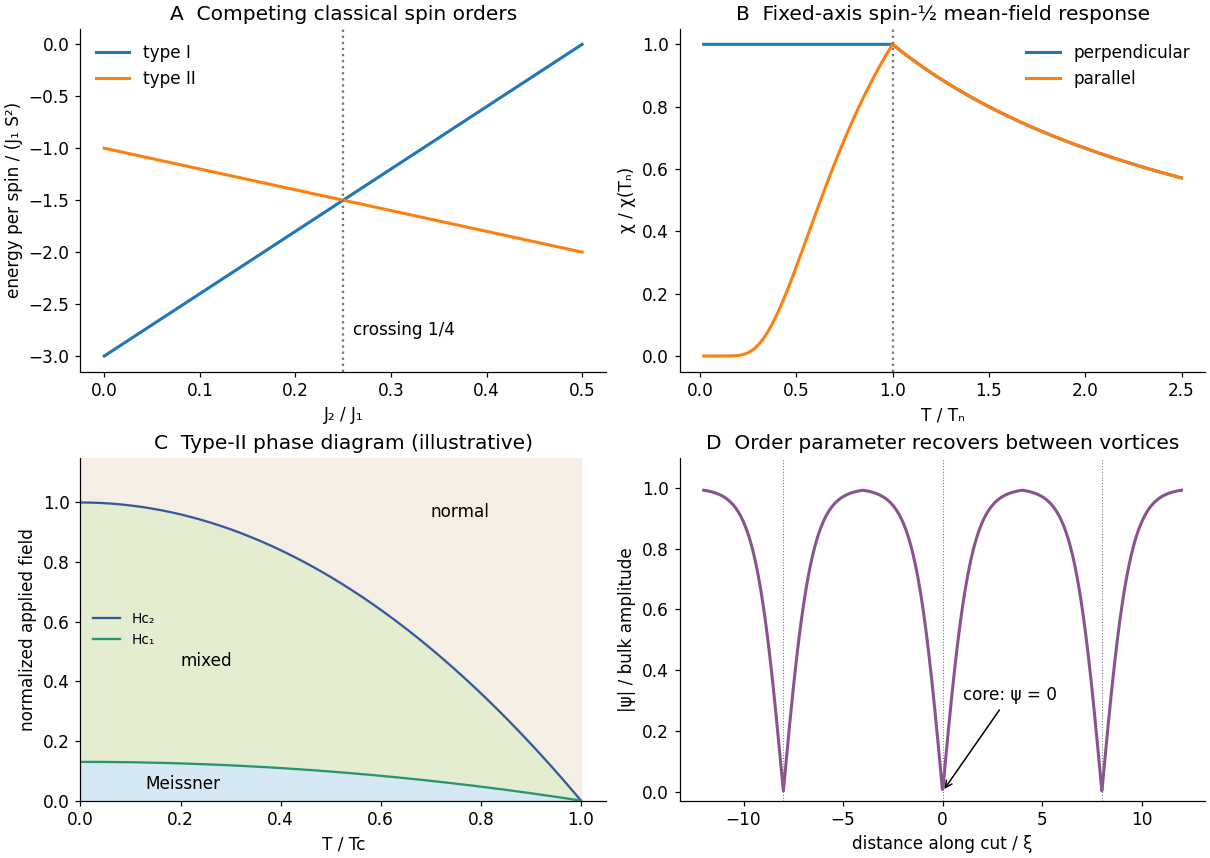
Competing antiferromagnetic energies, mean-field susceptibilities, a type-II phase diagram and vortex cores
. Original illustrative models. Susceptibilities use spin-one-half mean-field theory, fields in the phase diagram are normalized, and the order-parameter profile is a schematic cut through separated vortex cores. Details.
For type I, a magnetic unit cell uses the magnetic Bravais translations , and . They form an FCC lattice with conventional cubic parameter . A two-spin basis is an up spin at and a down spin at , or fractional conventional coordinates and . Every translation preserves the parity of .
At , the FCC translation sum allows all integers or all half-odd-integers. The spin basis contributes , which removes the integer set and leavesEquivalently the spin field is , so magnetic Bragg peaks are nuclear reciprocal vectors shifted by .
For type II with parallel spins along , use , and as magnetic translations: a primitive tetragonal cell with side lengths , containing an up spin at zero and a down spin at . The reciprocal translations have both integers or both half-odd-integers, with integer. The same basis factor removes the integer- set:This also follows from . Other domains permute the three coordinate directions. A magnetic neutron cross section further multiplies these lattice conditions by the magnetic form factor and by the component of ordered moment perpendicular to ; that polarization factor can suppress an otherwise allowed peak.
Keep the once-per-bond Hamiltonian convention of part (a). Let each sublattice magnetization be its magnetic moment per total physical volume, so the density of B-sublattice spins is . Writing their moments as fixesThe exchange energy of one A spin is , givingA convention using per bond would double this coefficient; defining magnetization per sublattice volume instead changes its normalization. The definitions above make the total magnetization .
For equal fixed sublattice magnitudes , put and , with the external field along . The effective A-site field is . Its alignment with requires , soThe last equality uses the externally imposed vacuum field and neglects demagnetizing corrections. Canting costs exchange energy but need not change the magnitude of either sublattice moment. The result holds before saturation and assumes the ordered axis is maintained when defining a transverse response.
Below , a small perpendicular field produces canting of the two ordered sublattices. In the isotropic two-sublattice mean-field model, the induced component is : the reduced ordered moment at higher temperature tilts more easily and the two effects cancel. Thus remains constant until the transition.
A field parallel to the maintained ordering axis instead increases the magnitude of one sublattice magnetization and decreases the other. At zero temperature saturated localized spins have essentially no such amplitude response in this model, so . Thermal population changes make it easier to redistribute the longitudinal moments as temperature rises, giving the growing longitudinal susceptibility that meets at . These directions presume the domain or a weak anisotropy fixes the ordered axis; in a perfectly isotropic freely rotating sample the Néel vector can reorient.
Above there is no chosen magnetic axis, so the response is isotropic. Antiferromagnetic correlations oppose uniform magnetization, giving the mean-field Curie–Weiss formAt it equals , consistent with the transverse branch; at large temperature it decreases as . A negative Weiss temperature characterizes this uniform antiferromagnetic response, rather than a ferromagnetic divergence at positive . The illustrative mean-field curves in solution make these limits visible.
Articles by others on the same topic
There are currently no matching articles.