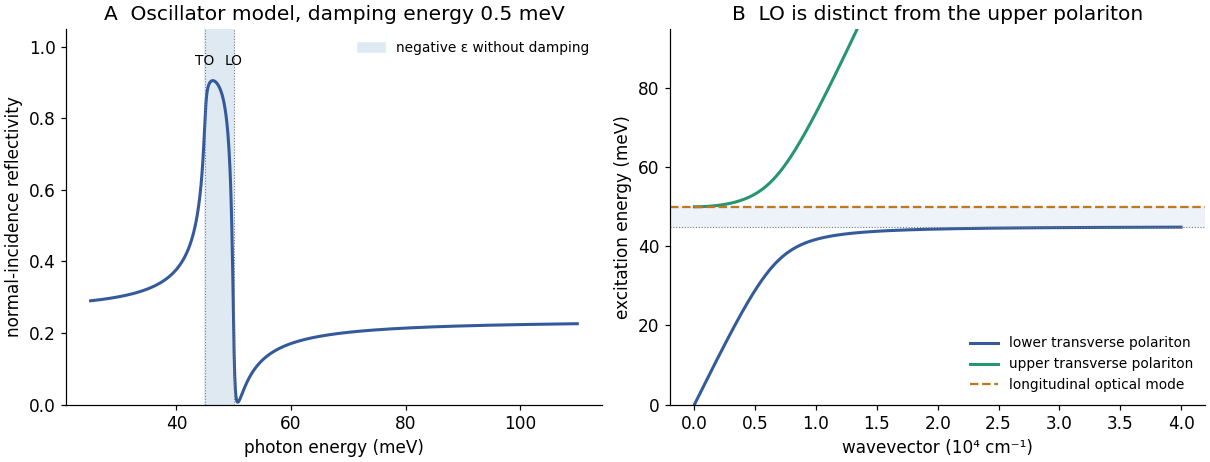
At normal incidence from vacuum the reflectivity iswith the passive branch of the complex refractive index. Below the optical resonance the real permittivity rises towards its pole and reflectance increases. Between the TO and LO frequencies, the lossless permittivity is negative; the wave is evanescent and the reflectivity is unity in that idealization. Finite damping rounds and reduces this reststrahlen band. Above the LO edge, positive permittivity returns and reflectivity can become very small when the refractive index is near one, before rising towards its electronic-background value.
Reading the surviving source graph to its available precision givesThese are band-edge estimates, not a high-precision damping fit. The minimum immediately above the band is not exactly the LO zero: for zero damping occurs at .
The high-energy plotted tail near has . Ignoring residual phonon dispersion gives and . Correcting with the finite-energy oscillator ratio givesThus a background of order – is supported; equating the still-dispersive tail exactly to the asymptotic background would slightly underestimate it. The original model curves below use these approximate energies, without copying or fitting individual source data points.

Articles by others on the same topic
There are currently no matching articles.