Seek the steady forced displacement as . The oscillator equation givesFor ion pairs per volume, the ionic polarization is . Add the electronic polarization , assumed frequency-independent over this infrared range. The complex relative permittivity is thereforeFor a longitudinal free oscillation without external free charge, and the longitudinal electric field requires in the lossless limit. HenceEliminating the microscopic oscillator strength givesHere denotes the undamped longitudinal frequency; with finite damping the zero is at a complex frequency. The sign of the imaginary term follows the stated convention and gives positive absorptive for , . At zero frequency the same model yields the Lyddane-Sachs-Teller relation . The high-frequency limit here is above the phonon resonance but below electronic resonances, not arbitrarily high photon energy.
At normal incidence from vacuum the reflectivity iswith the passive branch of the complex refractive index. Below the optical resonance the real permittivity rises towards its pole and reflectance increases. Between the TO and LO frequencies, the lossless permittivity is negative; the wave is evanescent and the reflectivity is unity in that idealization. Finite damping rounds and reduces this reststrahlen band. Above the LO edge, positive permittivity returns and reflectivity can become very small when the refractive index is near one, before rising towards its electronic-background value.
Reading the surviving source graph to its available precision givesThese are band-edge estimates, not a high-precision damping fit. The minimum immediately above the band is not exactly the LO zero: for zero damping occurs at .
The high-energy plotted tail near has . Ignoring residual phonon dispersion gives and . Correcting with the finite-energy oscillator ratio givesThus a background of order – is supported; equating the still-dispersive tail exactly to the asymptotic background would slightly underestimate it. The original model curves below use these approximate energies, without copying or fitting individual source data points.
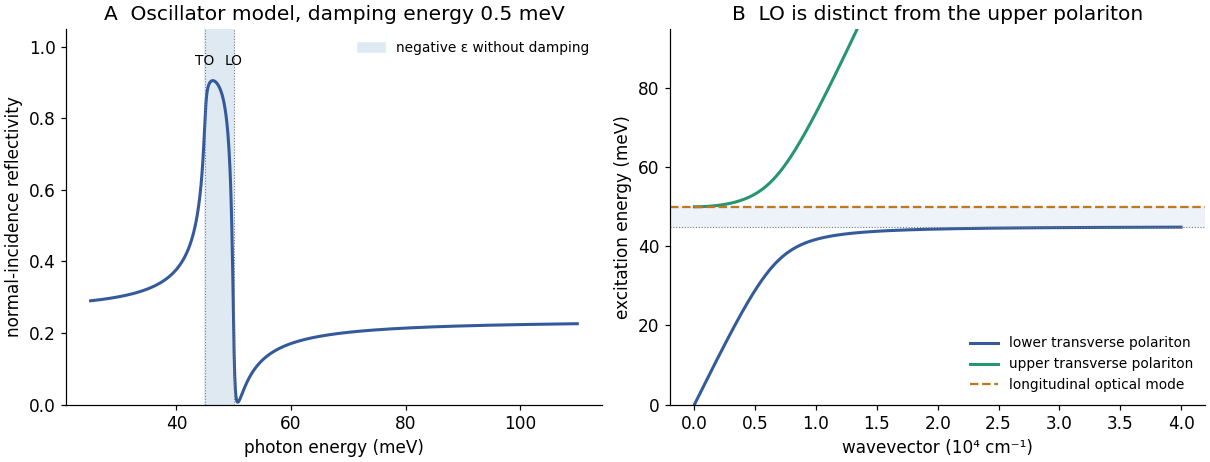

For a transverse electromagnetic plane wave in a nonmagnetic medium, Maxwell's equations give . Set damping to zero and define . Substitution yieldsso . Therefore the two phonon polariton branches areTake the nonnegative square root for the positive physical frequencies. At , and . At small wavevector the lower branch is photon-like with velocity ; at large wavevector it approaches from below. The upper branch ultimately becomes photon-like with velocity . There is no real propagating transverse branch with frequency strictly between and in this lossless bulk model. Coupling changes the eigenmodes from a bare photon crossing a flat oscillator into mixed normal modes.
In Raman scattering, the photon transfers and to a collective excitation. Changing scattering geometry selects different and probes its dispersion.
The open circles rise and then flatten near : they trace the lower transverse phonon polariton branch. It is strongly dispersive on its photon-like side, then becomes predominantly TO-phonon-like and approaches the TO energy at larger wavevector. The open triangles stay near and are the nearly nondispersive longitudinal optical phonon. Longitudinal motion creates its own polarization field and is shifted above the transverse resonance. It does not hybridize with a propagating transverse photon in the same way, and it should not be misidentified as the upper transverse polariton branch, which rises with wavevector. Raman tensor and polarization selection rules determine which excitation is visible.
Scale qualification: the source horizontal label appears to print . Taken literally, one plotted unit would have vacuum photon energy only , inconsistent with the observed tens of meV and the dispersive polariton. The physically compatible scale is of order ; the qualitative branch identification does not require silently treating the printed negative exponent as correct. The original model figure in solution explicitly labels its calculated wavevector scale.
Articles by others on the same topic
There are currently no matching articles.