Where , . By the mean value theorem, the solution is strictly decreasing on every interval where it avoids . At , the derivative is zero, so a constant segment there is possible. Thus all solutions are nonincreasing, while strict decrease need not persist through an interval spent at that equilibrium.
For example, choose and around . On the rectangle, , so is continuous, and . The mean value theorem therefore supplies a Lipschitz constant . These choices even satisfy and .
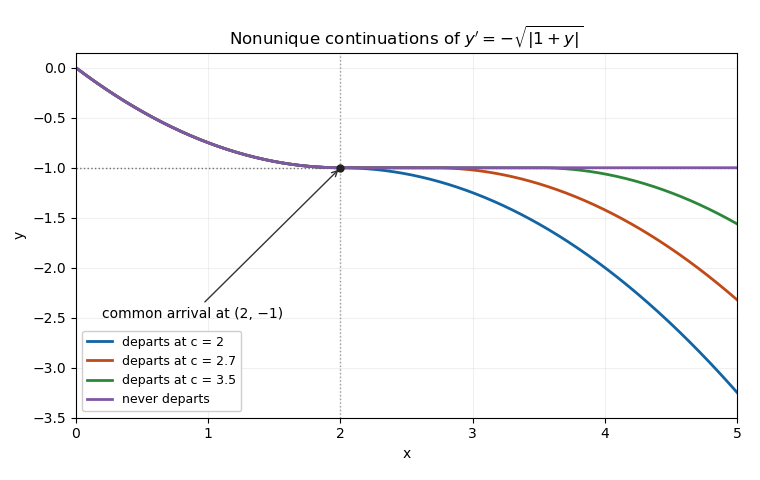
While , separation of variables gives . Therefore the uniquely determined branch up to its first arrival at isIt reaches at , with derivative zero. The restriction is essential: extending the same quadratic beyond two would make its derivative positive and violate the original differential equation. Beyond that time the waiting-time continuation at a non-Lipschitz equilibrium is nonunique.
Two solutions for areFor the second, because ; both have value and derivative zero at two. They are distinct for every . Local Lipschitz continuity fails at the equilibrium, so the existence of these two continuations is compatible with the Picard-Lindelöf theorem.
For each departure time , defineEach branch satisfies the ordinary differential equation, and both joins have matching value and matching derivative zero. Thus is continuously differentiable and satisfies the same initial value problem. If , the solutions differ on , proving infinitely many solutions on every with .
The uniqueness hypotheses fail when the solution reaches . IndeedNo finite Lipschitz constant works on a rectangle containing that level in its interior. The local theorem still controls the earlier branch near zero; it cannot be extended through a point where its hypotheses fail. These are waiting-time continuations at a non-Lipschitz equilibrium.

Articles by others on the same topic
There are currently no matching articles.