Eliminating the phase velocity from the first two relations yieldsWith , putThen . The dispersion relation becomesHere follows from . The parameter has dimensions of length; and are dimensionless.
For the strict mode count for a rigid-backed elastic layer, considerThe right side is negative, so intersections occur only on the negative branches of the tangent,On each such branch is strictly increasing. If , its limit at is negative infinity. At the other end of the available interval, it is positive: either with , or with . The intermediate value theorem and strict monotonicity give exactly one intersection. No such interval exists when .
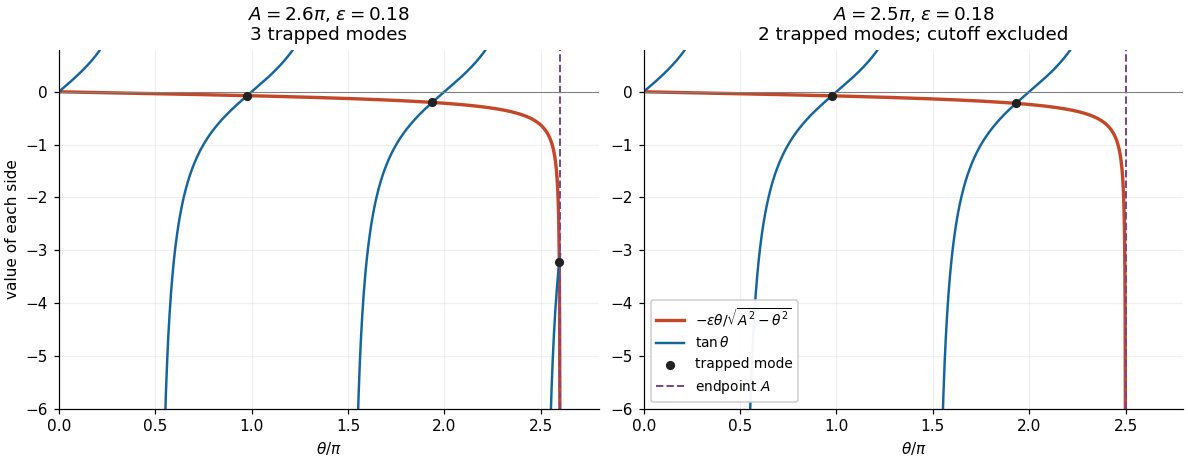
Intersections of the negative tangent branches with the interface loading curve. A branch beginning exactly at the cutoff contributes no trapped mode.
Details. 
Thus the exact answer, including all cutoff values, isAway from , this equals the printed floor function expression . At , the printed expression is one too large: the th interval is empty and the limiting state has , contradicting exponential decay. This exception is present in the native paper, rather than introduced by transcription.
Now hold fixed and let . Neglecting the right side gives and hence the candidate phase velocitiesThe zero is excluded: it would require , already ruled out. For every , the candidate is a valid leading asymptotic expansion. A first correction, obtained by expanding the tangent about , isThe big O notation here assumes a fixed positive gap between and . In particular, when , all leading approximations are valid. The phase velocity increases strictly with , so only the last branch can cause an endpoint difficulty.
If , the formal last equation root lies outside the allowed interval. The actual last equation root approaches , where the small factor is balanced by the vanishing denominator. This is a singular perturbation. For fixed strictly inside that interval, write . Since ,The valid endpoint approximation for a rigid-backed shear mode consequently givesHere we used and . Thus this normal mode approaches the upper wave speed from below; it does not approach the inadmissible value obtained from .
There is a further exceptional fixed value . Put again. Now , so the balance changes toIn the last formula the bracket specifies the first nonzero correction. The zeroth-order candidate is correct as a limit but misses this correction and the positive exterior exponential decay rate. More generally, close to , let and . For , a transition approximation valid on both sides isIt recovers the balance at and the ordinary expansion above the transition. The fixed-endpoint formula involving should be used when is below, and bounded away from, .
Articles by others on the same topic
There are currently no matching articles.